Rpi scoop and afe intake..

tertius said:
Yes I understand that. That quote was not meant to be exhaustive, my point was that a supercharged engine is not really a similar type of engine as a normally aspirated one.
In the case of the S54 engine as I've used, it's not similar, it's the same. The difference between that same engine when it is either supercharged or normally aspirated is not the engine, but instead, it's the method of induction.

Surely the BMEP is a measure of engine performance irrespective of the method of induction? Obviously, if you can devise a method of increasing the mass of air that can be ingested by the cylinders, you increase the Volumetric Efficiency, which increases torque/power, and consequently BMEP increases.

Since a well-designed ram-air intake can take the volumetric efficiency above 100%, by definition, this is forced induction. Therefore, at what point do you suggest that the S54 engine ceases to be Normally Aspirating and crosses over into the class of forced induction, where you suggest the engine becomes a different "animal"?


tertius said:
Taking the examples from the quote above: the forced induction CI engines are producing BMEPs more than 30% better than the NA CI engines but I don't think we could conclude from that that the NA versions are poorly designed would we?
All this says to me is that the same engine will produce a BMEP proportional to the amount of air that it ingests. The concept of BMEP is that it is a kind of "yardstick" which can be used to compare the performance of different engines in much the same way that "hands" is a measure of the height of horses and ponies. Just because ponies are never above 14.2hh, doesn't mean that they can't be compared to horses which may be as tall as 18.2hh.
 
can I ask a simple question..well relatively.

how come, with all this extra air and no remap, does the engine not run a bit on the lean side?

and this ram air thing, is it like a big scoop that sits behind the front bumper mesh and swallows a lot of air and flies? I used to race mountain bikes downhill in me youth and kept my mouth wide open to catch air and flies...
 
JaEdBa said:
how come, with all this extra air and no remap, does the engine not run a bit on the lean side?

The MAF simply reports the "Mass Airflow" that flows out of the air-filter box to the ECU and the ECU then uses its "look up" tables and adds the required amount of fuel through the injectors on each cylinder stroke, this result is checked by the O2 sensors so that the fueling is always correct. The ECU also calculates the "Load" and adjusts the air/fuel ratio (AFR) according to the load requirement, in this way the fuelling varies from around stoichiometric AFR (14.7:1) to richer levels when at maximum load at WOT. From my datalogging, the ECU is able to "see" the greater flow of air and fuel accordingly, therefore the engine doesn't run lean and no remap required.

As I wrote in an earlier post, in the days of carburetors, running lean was a problem, but with EFI this isn't a problem.


JaEdBa said:
and this ram air thing, is it like a big scoop that sits behind the front bumper mesh and swallows a lot of air and flies? I used to race mountain bikes downhill in me youth and kept my mouth wide open to catch air and flies...

Yes. The Z4M already has a genuine ram-air intake which is just like your open mouth catching flies.
 
exdos said:
JaEdBa said:
how come, with all this extra air and no remap, does the engine not run a bit on the lean side?

The MAF simply reports the "Mass Airflow" that flows out of the air-filter box to the ECU and the ECU then uses its "look up" tables and adds the required amount of fuel through the injectors on each cylinder stroke, this result is checked by the O2 sensors so that the fueling is always correct. The ECU also calculates the "Load" and adjusts the air/fuel ratio (AFR) according to the load requirement, in this way the fuelling varies from around stoichiometric AFR (14.7:1) to richer levels when at maximum load at WOT. From my datalogging, the ECU is able to "see" the greater flow of air and fuel accordingly, therefore the engine doesn't run lean and no remap required.

As I wrote in an earlier post, in the days of carburetors, running lean was a problem, but with EFI this isn't a problem.

hmmm, but there have been reports on the internet (not to say I believe all I read.... :) ) that even a lowly cone filter can confuse the MAF, so this excess of air doesn't send it into a barney?

exdos said:
JaEdBa said:
and this ram air thing, is it like a big scoop that sits behind the front bumper mesh and swallows a lot of air and flies? I used to race mountain bikes downhill in me youth and kept my mouth wide open to catch air and flies...

Yes. The Z4M already has a genuine ram-air intake which is just like your open mouth catching flies.

your ram air intake is a major progression on this?
 
Now you're asking questions that cannot be answered without exdos then killing you :D
 
JaEdBa said:
hmmm, but there have been reports on the internet (not to say I believe all I read.... :) ) that even a lowly cone filter can confuse the MAF, so this excess of air doesn't send it into a barney?

If you followed the thread on this forum about the Simota intake for the Z4M, you'll see that I suggested that the Simota had a design fault because the tube supplied as part of the Simota kit in which the MAF is sited, was too small, thus decalibrating the MAF, which would cock-up the ECU. MMM-five found that his Simota caused such problems.

JaEdBa said:
your ram air intake is a major progression on this?
Tempting as it is to tell you more, I'm afraid I won't give any clues as to what I've been up to. A Dyson is a hoover (vaccum cleaner) isn't it? But the Dyson works better than all the other hoovers that have gone before, right? So why didn't anyone before Dyson come up with what he did, especially when it doesn't actually look much different to everything before? The devil is in the detail.
 
exdos said:
Since a well-designed ram-air intake can take the volumetric efficiency above 100%, by definition, this is forced induction. Therefore, at what point do you suggest that the S54 engine ceases to be Normally Aspirating and crosses over into the class of forced induction, where you suggest the engine becomes a different "animal"?

I agree it gets a bit grey when we we are talking about adding a supercharger to a specific engine, however, I take a very simple view: the point at which it becomes an FI engine is the point where we add a mechanical pump (whether supercharger or turbocharger) to the overall engine configuration.
 
JaEdBa said:
how come, with all this extra air and no remap, does the engine not run a bit on the lean side?

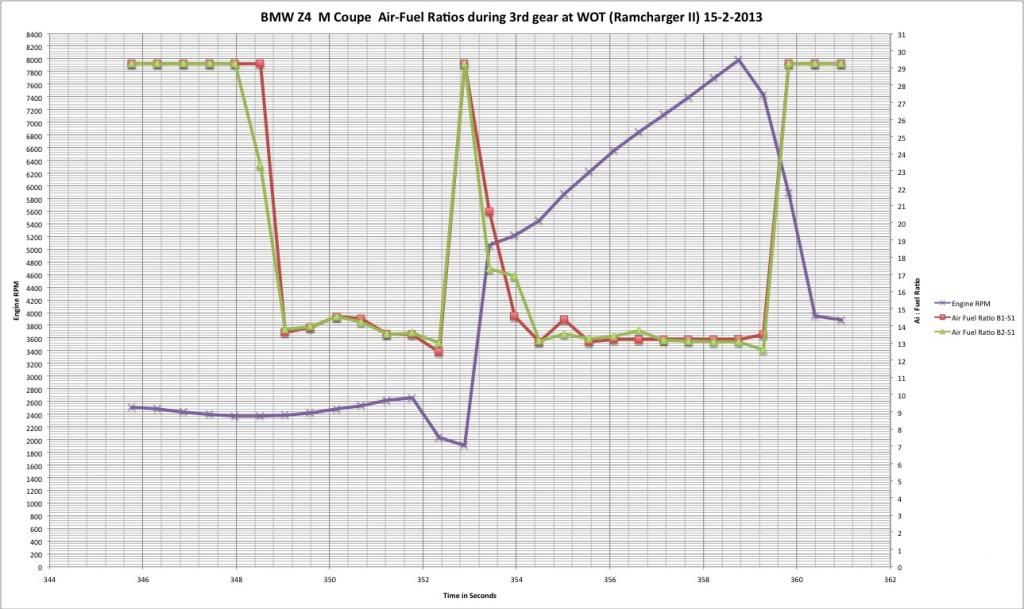
Over the last few days I've been assembling some professionally made parts for my intake mod, and I was able to do a quick test drive with the parts fitted, and I wanted to datalog the air:fuel ratio (AFR). I haven't had a remap or even done an ECU reset, and as you can see, during the 3rd gear acceleration (at 354 secs to 359secs) the AFR was at 13:1 during that period. Clearly the ECU simply monitors the appropriate parameters and adjusts the fuel accordingly. 8)


RamchargerIIAFR_zps116789fb.jpg
 
Do you know if there is a point where the ECU will stop adapting - i.e. so much air that the fuel cannot be pumped fast enough to deliver a good AFR?

I know from experience that it will cut-out if it becomes too rich, so thought there might be a cut-out at the other end of the scale?
 
mmm-five said:
Do you know if there is a point where the ECU will stop adapting - i.e. so much air that the fuel cannot be pumped fast enough to deliver a good AFR?

The prime measure of the amount of air flowing into the cylinders is done by the MAF, which measures the voltage change from the rate of cooling of a hot wire. Obviously there will be limits at which the MAF can reliably measure, but since it should be possible to drive the car in Siberia at very low temperatures, which we're most unlikely to see in the UK, then I would assume that the relatively slight increase in cooling created by flowing more air with my intake mods, I will be unlikely to be near those limits at the sort of ambient temperatures I'll experience.

My datalogger can also record a PID for a MAP from the Z4M's ECU, in addition to the MAF. I've not been able to determine what the data recorded from this MAP actually is; I've looked at the list of sensors for the Z4M and I can't find a MAP sensor listed and the data from the MAP doesn't closely mirror the data from the MAF. I'm puzzled with this one. :scratchhead:

mmm-five said:
I know from experience that it will cut-out if it becomes too rich, so thought there might be a cut-out at the other end of the scale?

How did you measure the AFR to know the fuelling was too rich? Are you referring to your experience with the Simota? If so, the reason that your ECU cut out was because the under-sized smaller diameter pipe in which the MAF sat "decalibrated" the MAF, and so the air-flow through the MAF would be at considerable variance to other parameters (i.e O2 sensors, calculated load etc.) and would probably throw up some unexpected figures which were at complete odds to the OEM "look up" tables in the software, which would make the ECU shut down for safety's sake.
 
exdos said:
The prime measure of the amount of air flowing into the cylinders is done by the MAF, which measures the voltage change from the rate of cooling of a hot wire. Obviously there will be limits at which the MAF can reliably measure, but since it should be possible to drive the car in Siberia at very low temperatures, which we're most unlikely to see in the UK, then I would assume that the relatively slight increase in cooling created by flowing more air with my intake mods, I will be unlikely to be near those limits at the sort of ambient temperatures I'll experience.

My datalogger can also record a PID for a MAP from the Z4M's ECU, in addition to the MAF. I've not been able to determine what the data recorded from this MAP actually is; I've looked at the list of sensors for the Z4M and I can't find a MAP sensor listed and the data from the MAP doesn't closely mirror the data from the MAF. I'm puzzled with this one. :scratchhead:
Means my Trans-Siberian jaunt is not out of the question then :P

exdos said:
How did you measure the AFR to know the fuelling was too rich? Are you referring to your experience with the Simota? If so, the reason that your ECU cut out was because the under-sized smaller diameter pipe in which the MAF sat "decalibrated" the MAF, and so the air-flow through the MAF would be at considerable variance to other parameters (i.e O2 sensors, calculated load etc.) and would probably throw up some unexpected figures which were at complete odds to the OEM "look up" tables in the software, which would make the ECU shut down for safety's sake.
Correct!

I was just stating what the error codes were saying, but 'too rich' could simply mean 'out of range'.
 
Very interesting project you've got here exdos, as a big fan of NA engines I'm looking forward to seeing this progress.

I know from another forum I use that a few people have had good results from optimising factory airboxes/intakes with a bit of cunning ducting and smoothing of the airbox internals but were talking about 25 year old, K-jetronic equipped cars and not modern M engines with a high specific output as standard so quite how you're getting such results is both puzzling and intriguing!

If you'd like some testing doing in a slightly warmer climate then I'd be glad to offer my services this summer, you know, in the name of science and all that!
 
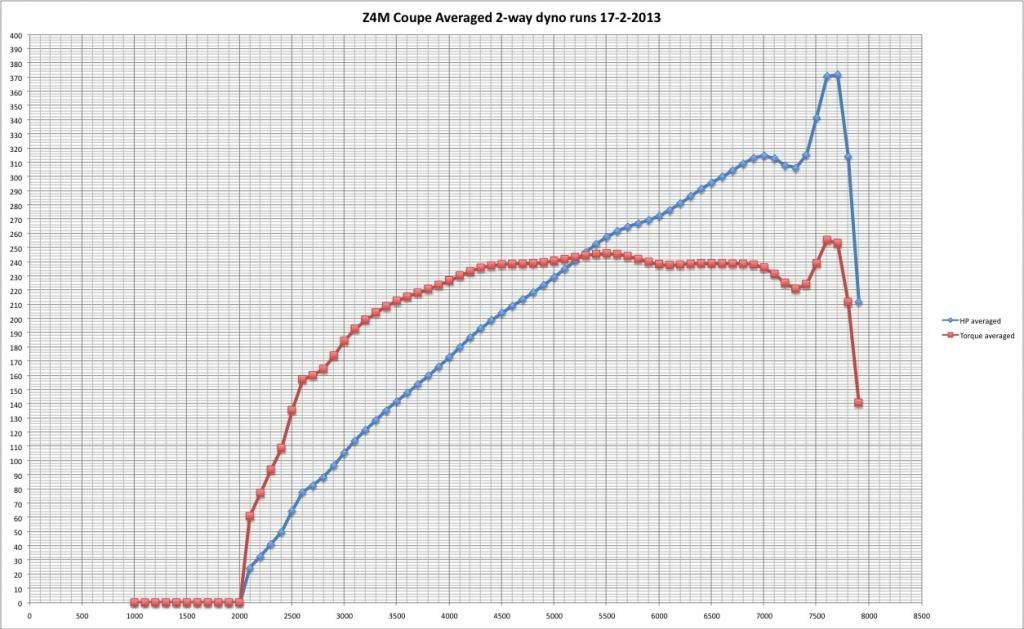
As I posted a few days ago, I've now fitted some professionally made parts that I've designed for my intake. It's been a dry day today, so this afternoon, I've been out and done some more dyno runs with my DashDyno to test my ramcharger, and lo and behold, I'm getting almost identical results to those I previously posted. In order to correct any direction bias afforded by the topography of the road and to eliminate any influence of the light wind (local weather station says 11.3mph) I've averaged the two runs (North <--> South) and here's the graph I've got. Max Torque at 5500rpms of 245.87 ft/lbs and Max Hp of 371.88hp at 7700rpm. Both the north and south runs show the same dip and spike at 7000-7600rpms, as did the previous graph, therefore my earlier explanation doesn't seem to apply because I definitely planted my right foot until after the engine limiter cut in during both runs. At present, the only think that I can think of that can be causing this dip to show in the graphs of all my runs would be the Vanos maps are written that way?

In any event I think these further runs show that the DashDyno produces repeatable results and that my ramcharger mod definitely produces some impressive gains which I stand by.

Z4MCdyno17-2-2013_zps306569ce.jpg
 
Yeah ok. Put this to REAL WORLD effect (and not just your theories based on a pocket calculator) and watch your AFR's lean right out. Good luck w/ that.
 
Not sure why this is attracting such negative reactions :?

Loads of great inventions came from "men in sheds" and Exdos is sharing data from a known baseline. Regardless of actual bhp at the wheels, he's seeing an uplift in power from his baseline start figures. I for one couldn't afford to rolling road my car each time I made a change, and he's using as good a tool as he can afford for his development work.

I take my hat off to him for the ingenuity
 
SweetRide said:
Yeah ok. Put this to REAL WORLD effect (and not just your theories based on a pocket calculator) and watch your AFR's lean right out. Good luck w/ that.

Sweetride Stop being a negative dick. If you have comments put them in an intelligent manner. We're all here to help each other get the best out of our motors.

We should be applauding those that are trying to do set-ups with methodical thinking.

I'm reading with interest Exdos!
 
SweetRide said:
Yeah ok. Put this to REAL WORLD effect (and not just your theories based on a pocket calculator) and watch your AFR's lean right out. Good luck w/ that.

My development of modifications is based on known theoretical science and has been influenced considerably by my own observations of various phenomena in certain other practical applications, and from my interest in improving car performance, I have seen a parallel application for my purposes and therefore I've researched the science and developed my ideas. Then there comes a time when it becomes necessary to put these ideas to the test and all of my R&D has been done in the REAL WORLD by proper performance testing, which has been closely monitored by proper datalogging using a scientific protocol throughout. In your earlier postings, you've mocked my use of the DashDyno, because it works in Real World conditions, advising me to use a variety of static dynos, but now you're telling me to "Put this to REAL WORLD effect". You are somewhat contrary with your advice! :roll:

I've already posted the AFR readings (a few postings above) as the first thing that I datalogged after fitting my Ramcharger II. Clearly, you've missed that, so I'll post it again for you below. As you can see, the AFR at WOT in 3rd gear remains at 13:1, which is exactly the same AFRs I recorded with OEM and through the development of my mods, when less airflow than I can presently achieve was the case. I have not watched my "AFR's lean right out" as you've suggested: by stoichiometric standards 13:1 is not a "lean" AFR. The Z4MC does not use carburettors, which would do as you suggest, instead it's EFI controlled by an ECU, which does not appear to do as you suggest. My datalogging shows that the ECU adapts with the short-term fuel trims to everything that I've thrown at it.


RamchargerIIAFR_zps116789fb.jpg


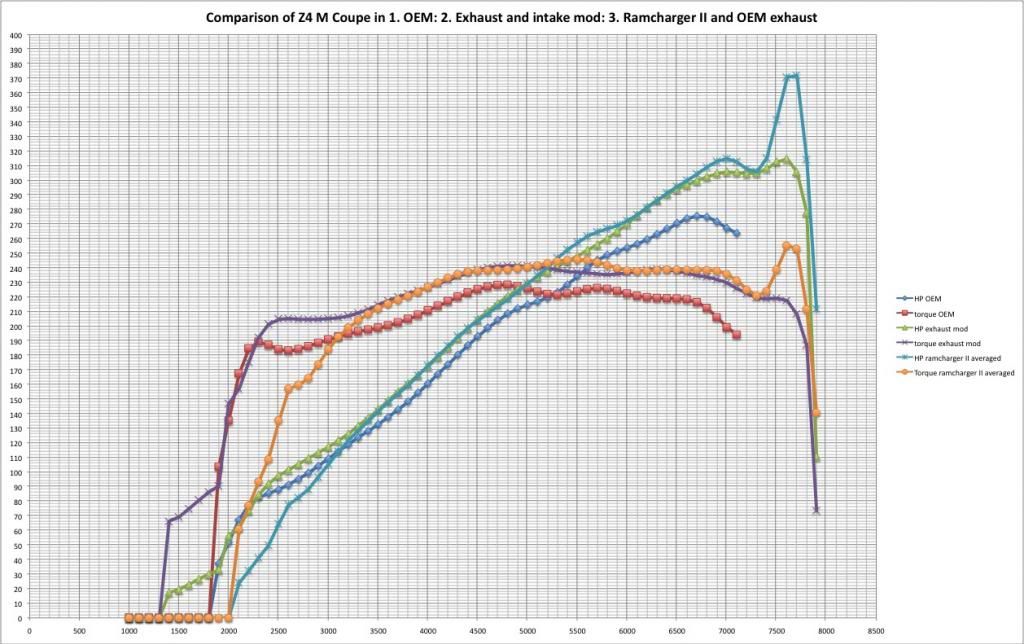
I've just produced a comparison dyno graph of the various stages of my development of mods for the Z4MC as below. for each of the plots, I've used an "averaged" figure from 2 dyno runs in opposite directions on the same road and performed within minutes of each other using the same car and the same protocol. All these results are "standardised" so that the variability of environmental factors has been eliminated. I think my protocol is about as scientific as you can get! As can be seen, modding the exhaust and a couple of other small intake mods has had a similar effect as my Ramcharger II mod, which has been run with OEM silencers, except for the sudden upward spike which is occurring with the Ramcharger mod. Something is clearly causing this phenomenon. Having thought about it for the past few hours, I have a hunch it's because the increase in airflow, when running with OEM exhausts is unbalancing the "double Vanos", where the exhaust valve timing is not keeping up with things. Now that I've been able to monitor the effect of the Ramcharger mod on its own, it's my intention to put the modded exhaust back on the car and test the Ramcharger in combination with the modded silencers, and I expect to see another increase in performance over that which occurs with the Ramcharger alone. I expect further flak/ridicule if/when my DashDyno shows a further gain in performance. :fuelfire:

ModcomparisonsZ4MC_zps405198e0.jpg
 
Stuart Truman said:
Not sure why this is attracting such negative reactions :?

Loads of great inventions came from "men in sheds" and Exdos is sharing data from a known baseline. Regardless of actual bhp at the wheels, he's seeing an uplift in power from his baseline start figures. I for one couldn't afford to rolling road my car each time I made a change, and he's using as good a tool as he can afford for his development work.

I take my hat off to him for the ingenuity
Stuart,

The mention of "ram-effect" seems to have this effect on some participants on every car forum I've ever read. Likewise, the mention of dynos seems to do the same. :roll:

Inventors throughout the ages have always attracted negativity from those who cannot see the possibilities that the inventive types can see. As the Dean of my faculty often used to say to us students when we didn't understand some of his words of wisdom: "There's none so blind as those who cannot see". I very much hold with that opinion.
 
Back
Top Bottom