S54 rod bearing

DPG said:
At £1500 - £2000 I think I'll let the warranty take care of any issues.

If I had a warranty I'd do the same :cry:

Maybe uneven wearing is related to oil starvation under high g-loads ? So a car driven only enthusiastically or tracked a lot may be more susceptible. Or maybe not warming the engine enough before pushing it... Oil doesn't flow as well when it's cold, right ? Not saying current owners on here would do that, but previous owners might have ?
 
well this thread got interesting!

question is why is the rod bearing on the S deritive motorsport engine seen as a consumable and why is their such a variance in their wear.
The s65 in particular rod bearing wear rate / engine failure rate from bearing fail is beyond what anyone can call acceptable / normal and this is a later engine, are BMW creating this consumable for a reason?? Either way their is a huge number of 'S' engines that are experiencing this bearing wear at very different intervals, some go mega miles, some don't. Just log on to the s65 / s85 forums and review the amount of threads on these subjects, whatever way you look at it or feel about the issue / non issue, its alarming for sure.

Vanne I'm sorry you've decided to remove the pictures as it seems you've been offended in some part of the thread however i don't think that was intended at all.... we all drive our cars hard at times, i do.... and mines got the added stress of boost!! lol!
 
Bing said:
DPG said:
At £1500 - £2000 I think I'll let the warranty take care of any issues.

If I had a warranty I'd do the same :cry:

Maybe uneven wearing is related to oil starvation under high g-loads ? So a car driven only enthusiastically or tracked a lot may be more susceptible. Or maybe not warming the engine enough before pushing it... Oil doesn't flow as well when it's cold, right ? Not saying current owners on here would do that, but previous owners might have ?

Warranty won't want to know though until there is a problem. Also will warranty cover wear and tear?
 
I think you will find that any NA engine that is over 100 bhp per 1000cc has some inherent problems..

You are pushing the envelope of design parameters by achieving this.. Yes it's not too hard to get more bhp from a lower Capacity unit, but it cannot be reliable over a long term lifespan..

High rpm is how "S" derived engines achieve power... More power,more RPM's, more thrust, more wear..
 
Is that why NA engines appear to be dying off ? Does adding a turbo or two help reduce stress on the engine components as well as improve efficiency ? I only ask because I'm not a mechanic - I know as much as the last topic I got interested enough in to learn about - which in relation to my comment in this thread was finding out what a dry sump is, how it works, and the benefits :oops:

(Oh, and I also know from that reading that dry sumps are not really great for 'ordinary' road going cars because the oil cools too much... It was the benefit of reducing oil starvation that clicked in my head with regard to this topic)
 
No,(powerful) NA engines die off because of the CO2 emissions.
If you want more power (400hp+) with NA you need big engines. 5L, 6L etc
It's not difficult to make a reliable 500hp engine, but it'll be 6+ litres (merc m156, GM LS etc(
They consume more fuel in the test cycle than a turbo engine with equal HP.
Car manufactureres must meet c02 targets if they want to sell in countries that signed the kyoto treaty.
So that's why.
 
Yep, just did some googling and discovered that. Learned a few new things along the way too :D
 
doesn't the s54 have a semi dry sump setup, the marketing info certainly says it has... the same tyre setup that the gt4 cayman runs.

heres the quote.

"High-performance lubrication and cooling

To help ensure adequate lubrication under the high cornering, acceleration and braking loads the Z4 M Roadster and Coupe attain, the S54 engine employs a “semi-dry-sump” oiling system. Particularly in hard cornering to the left, it is critical to ensure return of oil to the pan; therefore, integrated into the gear-type pressure pump is a scavenging pump that collects oil from the right side of the small forward oil sump and pumps it back into the main, larger rear sump. This rear sump is almost completely closed off from the rest of the system, and thus able to hold the oil necessary for lubrication throughout the engine. Specific return passages are also incorporated into the intake (left) side of the engine to help ensure ideal oil flow under all operating conditions. "
 
Is it coincidental that the catastrophic bearing shell failure that I suffered in my Z3MC occurred whilst I was driving around the Nurburgring (F1 track) with an assorted collection of other BMWs or could it be down to oil starvation from hard cornering? I made no secret of the fact to BMW of the location where the BS failure occurred on my then 7 year old car, and BMW didn't quibble about giving me a replacement engine FOC.
 
John, the S54 engine in the early E46 M3 and late ///M Coupe / Roadster had a significant rate of BS failure, above that of the later iterations of the engine found in the Z4M and subsequent E46 M3. Although high engine speeds and cornering forces may have precipitated the failure in your case, I suspect that without the existing propensity you may have had not encountered the problem.
My S54 has covered tens of thousands of spirited road miles and thousands of track miles on semislick tyres and not had a problem with unusual BS wear (so far - looks for wood to touch :roll: ).

As for the sump, it is a semi dry set up so hopefully this serves to lessen the risk of oil starvation under high cornering loads.
 
If you'd had oil starvation, the oil pressure light would flicker immediately.
So oil starvation always comes with a visual warning.

But this bearing wear does not come from oil starvation. That has a totally different wear pattern.
 
I read that too Byron...

Initially when the S54 was launched the shell depth was put forward as the problem for the odd failure.. The technical update was to put "thinner" bearing shells in to allow for better oil filming over the crank and bearing surface...as well as putting in better oil with better shear strength..
This worked but you still do get the failure from time to time, but it's understandable.
All eventualities can never be covered, especially as time, mileage and wear factors creep into the equation
 
BMWZ4MC said:
John, the S54 engine in the early E46 M3 and late ///M Coupe / Roadster had a significant rate of BS failure, above that of the later iterations of the engine found in the Z4M and subsequent E46 M3. Although high engine speeds and cornering forces may have precipitated the failure in your case, I suspect that without the existing propensity you may have had not encountered the problem.
Richard, I've owned my Z3MC since 2003 and was aware of the BS failure problem early on. As a member of the z3mcoupe.com forum I learned of at least 8 UK Z3MC/Rs which had suffered catastrophic BS failure before mine joined the list, which amounted to around 4% of all those UK cars, and that's just those reported on forums, so the actual incidence must be much greater. As a group, we were in correspondence with BMW asking why it had omitted all S54 Z3MC/Rs from its recalls under its Service Information Bulletins (SIB) which it performed for the SAME S54 engine in ALL E46M3s. In the correspondence, BMW claimed that BS failure could not occur in the Z3 platform because it had set the redline at 7,600rpm, despite it knowing of all the BS failures in the Z3 platform. The fact that my engine failed after BMW told me in writing that BS failure could not occur left BMW no option but to replace mine FOC.

If you look at the parts lists for the S54 engine for the Z3MC/R you'll see that many of the internals have been discontinued and replaced with revised part numbers, including crankshaft, con rods, con rod bolts, bearing shells and pistons, and I presume that the replacement engine that I now have (fitted in 2009), is of the latest spec and the same as would be fitted in a 2008 Z4MC/R.

GuidoK said:
If you'd had oil starvation, the oil pressure light would flicker immediately.
So oil starvation always comes with a visual warning.

But this bearing wear does not come from oil starvation. That has a totally different wear pattern.

Guido, the bearing shells of my failed S54 engine showed signs of pitted corrosion caused by cavitation, as in the photo below, whereas the damage seen on Vanne's bearing shells looks more like wear although it still may be caused by cavitation?

cavitation_zpsu0jgflmr.jpg


My question is: what event suddenly converted a bearing shell like the one above to the one below?
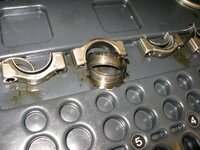
48bearing_shell.jpg
 
Back
Top Bottom