exdos said:
Guido, the bearing shells of my failed S54 engine showed signs of pitted corrosion caused by cavitation, as in the photo below, whereas the damage seen on Vanne's bearing shells looks more like wear although it still may be caused by cavitation?
I think Vanne's bearings show both sign of wear and cavitation erosion.
This is an interesting page with tell tale pictures of different kind of wear and damage to bearing shells:
http://162.74.99.105/Automotive_Systems/Products/Bearing%20Products/Bearing%20Damage%20rev.aspx
Cavitation erosion always begins at spots in the middle, like this:
Size and shape of spots can differ, as rpm range, oil viscocity, pressure, oil channel size etc vary, but it always take place at specific points where the oil channel is present. So always in the middle, and mostly at one specific spot where the conditions are so (movement vector, etc etc) where a cavitation starts over and over again eventually creating a bigger and bigger deep spot in the bearing surface.
And imho all S50, S54, S65 and S85 engine rodbearings get this wear pattern sooner or later, but it is obviously mileage dependant and drive dependant.
For example here are rodbearings, from an S50 (z3m), changed at 80k kilometers, from a guy who I know is very subtle with his car and a cautious driver (an elderly man):
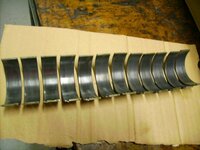
And these look fine. No sign of cavitation (or at least hardly), only some minor wear (the small scuffing lines in line with the rotating movement of the crank). But this is only 80dkm (less than 50k miles), and a very well kept car.
These are bearings from someone I know (again z3m s50), a bit more aggressive driving, but still no trackdays etc, and still very sensible with his car. Always heat up the car before going above 3k rpm etc etc. But now changed at 137dkm (85k miles):
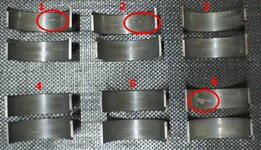
Already signs of early cavitation corrosion. The highlighted spots in the middle.
Here another set of bearings, randomly picked for the internet (from an e46 m3), and there are hundreds of pictures like this:
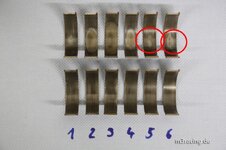
All with the tell tale sign of wear spots that originate in the middle and grow and grow. Even the larger spots, you can see that they have a distict deep spot on the middle.
And also Vanne's bearingshells have those signs:
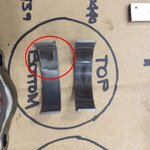
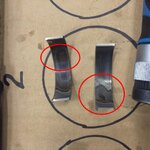
Of course high mileage, so the spots get bigger and bigger and normal wear also helps wearing away the lubricating lead layers obviously.
If it was normal wear it would be a fairly consistent wearspot (consistant in depth) over the width of the shell, and over a large part of the circumsize of the shell.
Your destroyed bearing is obviously a spun bearing. why and how evidence is destroyed when the bearing started to spin

.
You're lucky (or was alert enough) that the pistonrod didn't break and put a hole in the block
It happens.
Some bearings show indeed more of a coarse surface in the middle cavitation spots whereas others are more smooth. That might be a difference in how severe the cavitation is. For example does it occur on a track under very harsh conditions, or slowly over time bit by bit but on higher miles. Maybe even the type of oil can play a part in that.
The only other type of wear that can affect the centre is severe overheating. But overheating should show small spots where melting starts. Maybe your bearings in the picture could have shown some overheating, but it's hard to see.
I dont have a s50/s54 and no worn bearings (not that I know of), but if I would encounter that, the first thing I would do is plastigauge the spots, to see how much of the toplayer is actually worn away. To get an idea of how much wear is actually taken place.
But like I said, a lot of specialist that deal with s50/s54 advise to replace the rodbearings at 80dkm/60k miles, and that makes sense imho. Even if it is a fairly expensive fix. But that's the price you have to pay for an engine with motorsport pedigree. If you get a AJP8 (TVR) you're expected to completely rebuild every 15k miles :lol:
Who noticed the difference between s50 bearing shells and s54 bearing shells?


 )
)

