BMWZ4MC said:
John, the S54 engine in the early E46 M3 and late ///M Coupe / Roadster had a significant rate of BS failure, above that of the later iterations of the engine found in the Z4M and subsequent E46 M3. Although high engine speeds and cornering forces may have precipitated the failure in your case, I suspect that without the existing propensity you may have had not encountered the problem.
Richard, I've owned my Z3MC since 2003 and was aware of the BS failure problem early on. As a member of the z3mcoupe.com forum I learned of at least 8 UK Z3MC/Rs which had suffered catastrophic BS failure before mine joined the list, which amounted to around 4% of all those UK cars, and that's just those reported on forums, so the actual incidence must be much greater. As a group, we were in correspondence with BMW asking why it had omitted all S54 Z3MC/Rs from its recalls under its Service Information Bulletins (SIB) which it performed for the SAME S54 engine in ALL E46M3s. In the correspondence, BMW claimed that BS failure could not occur in the Z3 platform because it had set the redline at 7,600rpm, despite it knowing of all the BS failures in the Z3 platform. The fact that my engine failed after BMW told me in writing that BS failure could not occur left BMW no option but to replace mine FOC.
If you look at the parts lists for the S54 engine for the Z3MC/R you'll see that many of the internals have been discontinued and replaced with revised part numbers, including crankshaft, con rods, con rod bolts, bearing shells and pistons, and I presume that the replacement engine that I now have (fitted in 2009), is of the latest spec and the same as would be fitted in a 2008 Z4MC/R.
GuidoK said:
If you'd had oil starvation, the oil pressure light would flicker immediately.
So oil starvation always comes with a visual warning.
But this bearing wear does not come from oil starvation. That has a totally different wear pattern.
Guido, the bearing shells of my failed S54 engine showed signs of pitted corrosion caused by cavitation, as in the photo below, whereas the damage seen on Vanne's bearing shells looks more like wear although it still may be caused by cavitation?
My question is: what event suddenly converted a bearing shell like the one above to the one below?
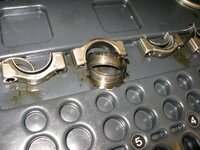


 then you'll hear it banging