tertius said:
I do agree that they are very close, but
a) I would much prefer to have a measured value for transmission losses rather than a guess;
Take a look at the thread comparing the S54 to the S65 here:
http://www.bimmerboost.com/showthre...erview-history-comparison-and-power-potential the author states:
“You may notice both motors follow the 15% drivetrain loss rule almost exactly.” Why should my Z4MC with the same S54 engine be much different?
tertius said:
b) From reading around it seems to be quite unusual for a standard S54 in a Z4M to actually meet or exceed the manufacturer figure, so you may have an exceptional engine or your method may be producing over-optimistic values
Au contraire. From my reading, it seems that BMW has managed to produce the S54 to very close tolerances and they all record very similar dyno figures to the published values for each different model the S54 engine is used. Only a few postings ago,
Original Guvnor posted: “
mine has recently been static dyno'd at 321bhp at 7300 rpm so I'd guess it will be near enough stock at 7900. It is also completely unmodified from factory as well.” Again, why should my Z4MC be much different?
tertius said:
I agree that you methodology is consistent, and (subject to some comments below) we are comparing apples with apples.
I’m glad you accept that my method is consistent. As I’ve always said; even if my DashDyno figures are not calibrated against a static dyno, that doesn’t actually matter at this stage. All I require to make progress with my R&D is a reliable and consistent method, which will show me gains or losses compared to my DashDyno recording of my Z4MC in OEM state to point me in the right direction. The information that I’m collecting is all relative to the same car and the same method.
tertius said:
The basis for challenge is simply that the results you are claiming are extraordinary and you seem unwilling to perform some more traditional/independent tests.
I will be more than happy to do such tests when I consider the time is right, and that’s when I’ve taken this project as far as I think it can be taken and I'm ready to patent or publish, and I’m not finished yet. As I’ve previously reported: “
I've been in arguments/discussion in the past about the effectiveness of the ram-effect and originally got into datalogging to find out for myself what is actually happening inside the air-intake system. Some folk demand the proof and if you don't provide it, then you're damned, and when you do produce it, you're damned again.” It seems to becoming the case in this instance. Are you happy to pay all my costs for the tests you suggest?
tertius said:
Additionally if we compare your “OEM” torque curve with other examples (e.g. here http://www.dyno-plot.co.uk/dyno/dynoplot/id%3D786%26but_sea%3Dqs%26frcd%3D161/BMW-Z4M.htm) you will see that your torques curve is unusually flat compared with the dyno-plot graph which drops off noticeably after the peak torque value. Now a flat torque is good, very good, but that difference does make me wonder if there is something odd about the way Dashdyno is estimating torque?
The reason why my DashDyno produces a flattish torque curve, is precisely the same reason I keep hammering the point that a static dyno cannot replicate the ram-effect. My DashDyno would produce the same flattish torque curve when hooked up to ALL Z4MCs being logged in real world conditions, where ram effect occurs, and not just mine. As I’ve said before, a 3rd gear run goes to speeds well above the speed of the fan used with most static dynos, consequently there is air-starvation of the Z4MC's OEM ram-intake on a dyno. In “real world” conditions the Z4MC OEM air-intake harnesses the ram effect, which maintains torque levels as does the Vanos system. Do you get how ram-intakes are supposed to work now?
tertius said:
You are bouncing around the chart and picking numbers at different RPMs and then comparing them. Remember we are trying to compare the same fundamental engine here so in order to really see what the differences are we should try to compare at similar points iin the rev range.
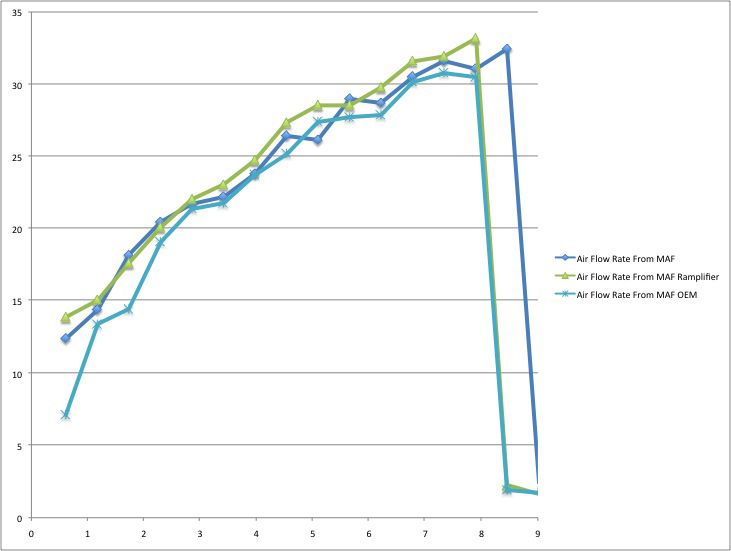
I’m not bouncing around the chart at all; I’m simply quoting the actual maximum torque values at their respective rpms (ignoring the so-called “artefact”). I don't decide the rpms at which peak torque occurs, I've simply looked at the data and stated the rpm at which the highest torque value has occurred. Are you disputing those values? Look at the graph again and you should be able to see precisely those points on the three plots. If you don’t agree with the figures I’ve used, please can you tell me the values we should use?
tertius said:
My 30% increase came from comparing the stock engine at peak power - 7900 rpm; with a BMEP of 11.8 - to your engine at peak power - in your case 7800 rpm, i.e an almost identical engine speed, a BMEP of 15.8 (over 33% greater).
You explained that in your last post, so that's why I performed the calculations using
BMEP at peak torque, and now I’ve demonstrated that the increase is
7%, and not 30% as you suggest. Now that I've worked to your method, you don't seem to like this by now claiming I’m “bouncing around the chart”, although you have conceded that my methodology is consistent. As I see this is another case of “Some folk demand the proof and if you don't provide it, then you're damned, and when you do produce it, you're damned again”. Déjà vu. :thumbsdown:
tertius said:
So not only have you increased peak torque value above the standard engine, you have kept the curve flat almost throughout the rev range AND shifted the point at which peak torque is made up the rev range, thus increasing the power output of the engine massively. And you did all this by just modifying the air intake.
Yes, but there’s a bit more to it than that. I could very easily tell you what I do, and then you’d easily see how this works, but because I’m still considering patenting my invention, I’m not willing to publicly divulge this information just yet, as I stated at the outset of this thread.
tertius said:
Just for a rough comparison, Manthey Motors (who are admittedly extraordinarily expensive) charge c. 9000 euros (plus VAT) to add 30 BHP (just under an 8% increase) to gen 2 996 GT3, and need a full exhaust system (right from the manifold back), to re-program the ECU and to update air filter/intake to do it.
My attitude has always been why pay that kind of money when a few simple air-intake mods and gutting the OEM silencers can work with the ECU without a remap, as I’ve publicly documented for my Z3MC elsewhere. Necessity is the mother of invention.
Someone once said that inventing is 99% perspiration and 1% inspiration. If you look at the history of development of almost any technology it’s mostly all evolution of what has gone before, where things move one step at a time. I have a great interest in lots of different things and my moment of 1% inspiration has been through making a connection between two other completely different things which, on the face of it, have no connection whatsoever to cars, but appeared to me in my thoughts to have some tenuous overlap. I simply couldn’t buy those thoughts.
tertius said:
By contrast your air intake work alone has increased peak power by nearly 27%!
I’ve explained previously how the spike in torque occurred in my ramcharger run, and the HP figure is solely a consequence of that. If you can find me any proper technical information about ram-intakes with lots of published data, I’d be obliged if you’d refer me to it. As it is, I consider that I'm in "unknown territory" but if you have better information to guide me, it would be most helpful.

FYI, the BMW E87 I M has a published BMEP of 305.9psi =
22.1Bar so even with my ramcharger mod, I’m well away from mechanical forced induction figures with a BMW engine, so to me at least, my figures are realistic.
<EDIT> A quick back of a fag packet calculation shows me that for my Z4MC to be able to achieve a BMEP of 22.1Bar, the MAF would have to record an airflow in the order of 48.5lbs/min, whereas, the highest figure I've seen to date is 33.4lbs/min. The absolute highest that I expect to see from a ram-intake is 35lbs/min with a rev limit set at OEM 8000rpm



 and it's ok, this thread has been largely quite interesting.....
 :exitright: