Rod bearing failure - what to do?

Sorry to hear this OP

I had mine changed in my M3 around 107,000 miles and caught it just in time.

Unfortunately the oil analysis shouldn’t be relied on in the case of bearing failure, too many horror stories saying my oil analysis said it was fine to find out a few months later the car has spun a bearing. I personally would take the result with a pinch of salt and save to get it done at a time where you think it’s becoming more of a risk.

I’d looked at is as maintenance on the S54 and say it is an issue where as most will still claim it isn’t.

I believe originally the S54 was run on LL04 spec then they started spinning bearings and BMW issued a recall and changed to 10W60. This was prior to the Z4 though.

I am also a keen believer of warming the car up properly and dropping the oil around 5000-7500 miles each time.

I’d find a used engine, fit a new head gasket, overhaul the vanos and do the bearings and enjoy it another 80,000 miles.

All the best moving forward with this OP.
 
Sounds like a right pain in the butt man... feel for ya. Makes me think twice about buying a high miler z4mc without bearings replaced. I

Anyway came a cross this randomly today... might be something to maybe jump on (especially if your looking at 5-8k to fix)

https://rover.ebay.com/rover/0/0/0?mpre=https%3A%2F%2Fwww.ebay.co.uk%2Fulk%2Fitm%2F362578265062

A zero mile s54 engine... would buy it myself if I had the spare funds...looks all legit it, but prob needs looking into in more detail.

Ps in case u do decide to sell car as is, give me a shout
 
Hu
shuey said:
Anyway came a cross this randomly today... might be something to maybe jump on (especially if your looking at 5-8k to fix)

https://rover.ebay.com/rover/0/0/0?mpre=https%3A%2F%2Fwww.ebay.co.uk%2Fulk%2Fitm%2F362578265062

A zero mile s54 engine... would buy it myself if I had the spare funds...looks all legit it, but prob needs looking into in more detail.

Photo 7 looks interesting... paid ‘0’, owing £15k :rofl:
 
shuey said:
Sounds like a right pain in the butt man... feel for ya. Makes me think twice about buying a high miler z4mc without bearings replaced. I

Anyway came a cross this randomly today... might be something to maybe jump on (especially if your looking at 5-8k to fix)

https://rover.ebay.com/rover/0/0/0?mpre=https%3A%2F%2Fwww.ebay.co.uk%2Fulk%2Fitm%2F362578265062

A zero mile s54 engine... would buy it myself if I had the spare funds...looks all legit it, but prob needs looking into in more detail.

Ps in case u do decide to sell car as is, give me a shout

How does that work?

The receipt looks BMW esque...but BMW don’t sell engines...they sell cars.
 
Don’t have a clue... how sweet would be to have a brand new s54 engine tho... I’d just hold onto it for 20 years and install it when everyone has electric left right and centre
 
PDJ said:
I am not convinced that oil sampling is that reliable for predicting a rod failure.

I am an engineering technician and worked on CCGT and CHP plants for around 15 years plus steel works, paper mills, large NH3 fridge plants (39ton 40 would have been COMAH) and food processing and packaging equipment. Built a Westfield and a 255BHP Duratec to go in it.

When I have done oil conditioning training (with Castrol) it has been for large volume oil systems so the cost is large to change the oil, but the principles have got to be the same, the thing that came round time and time again was a snap shot sample has little value, the condition has to be trended, over time to see a change.

So if you sampled a Gas Turbine oil every week or month or hour run and plotted the results you would see an increase in the white metal content as PPM and as this increased you would note that the main bearings are wearing or the thrust pads as this is where the white metal is in the ones I worked on. This would then allow engineers and accountants to plan to change the oil/overhaul the turbine to prevent a failure.

So in a car engine to see a trend you would need to sample as soon as you change the oil to get a base line/datum then re sample several time during the life of the oil before you change the oil.
You would also need to know what and where the deferent materials are in the engine that the oil passes by so to try and identify where the particles are from that may show up in an oil sample analysis.

Changing the oil will as I see it re set the datum as you have flushed away the suspended particles in the old oil. and then you would get a much better result if tested after an oil change.

This is just my thought from my experience and I have no real alternative for checking other than a physical on ie. remove and inspect, by which time you may as well replace them on a time/mileage basis.

Also so I have no real answer for the OP with regards as what to do, other than I will follow the thread as I am looking at buying a Z4M or a 3.0si

Hope the above ramblings make sense (not a typist)

Paul.

I take a sample of oil just before mine is drained every two years, this to me will give me the best type of sampling.
and will generate a pattern.

I don’t think anybody would take one sample and make a decision on just that.
 
The oil analysis information is interesting. I’m considering an E92 M3 as a family car so I’ve been doing a fair amount of research about bearing shells lately. BMW changed the bearing shell material in the S65 around 2009 reducing the incidence of the problem, but not fixing it. I’ve more or less decided that I’ll immediately change the shells if I buy an M3.

zmaster007 said:
...I sent it to CPC as they are widely recommended for M car work - I thought they would be the most trustworthy place to go...

You sent it to the right place. Phil and his colleagues have been the only people I’ve trusted to work on my Zed in the last ten years of ownership. My biggest worry shipping the car to Sydney was finding as competent and honest a mechanic out here... I’ve even taken my RS4 to CPC despite them not being Audi specialists.

GuidoK said:
The advice from independant s54 specialists to change rodbearings at 50k miles isn't a hoax. Never cheap out on that, as per mile it's just a penny or so.

I had mine changed at 50k miles and they were fine, but I’ll change them again at 100k.

mmm-five said:
...spun a bearing...

————————

...busted my hip...

Sorry to hear about both. If you need any advice about your hip that wasn’t covered by your surgeon, you’re welcome send me a PM. As Mr Wilks said, you’re driving Trigger’s Zed!
 
Beginning to sound a little like Russian Roulette.

It’s gonna happen as time passes, the chambers reset when you have them done
 
BMWZ4MC said:
I had mine changed at 50k miles and they were fine, but I’ll change them again at 100k.
I seem to recall that I once asked for pics and that you didnt have any, is that correct? (long ago)

I've also seen bearings from other people that they claimed were fine, but they weren't (fine for s54 horrors, but not fine for how rodbearings should look like), so I'm always very sceptical right until the person shoves the proof right under my nose :lol:

PDJ said:
I am not convinced that oil sampling is that reliable for predicting a rod failure.
you're absolutely right. An oil sampling only paints a picture of the moment.
If you haven;t owned the car since new (or since new bearings), and meticulously taken samples at all intervals it doesnt say anything. And if you analyze something you still dont know were it's coming from (although with the s54 there's only 1 real wear area), or how bad it is. Regarding that last part, if a bearing wears more evenly, more material can be removed before a clearing gets out of spec than when all that material was taken from one spot.
I have yet to see a set of s54 bearings with 50k miles or more that didnt show any of the so characteristic wear signs of spots in the middle of the lower bearings (thats how it starts, my guess its a cavitation problem).
 
Yep, probably around 2011 or 2012. I don’t have any pictures but the ///M specialist who changed them (and who’s about to rebuild the OP’s engine) said they were unmarked. Importantly, I’ve owned it from early in its life, always thoroughly warmed the car before driving it hard and changed oil at least once myself between each scheduled service or inspection. At times it’s seen far fewer than 1000 miles between oil changes when most of those have been track miles.

Edit - of course I’ll have to eat my words if mine now spins a shell :cry:

This is an interesting video about the S65:

https://youtu.be/RUzwmryKu9A
 
BMWZ4MC said:
Yep, probably around 2011 or 2012. I don’t have any pictures but the ///M specialist who changed them (and who’s about to rebuild the OP’s engine) said they were unmarked.
My profession pretty much exists from second guessing specialists opinions so by nature I need that proof shoved right under my nose :lol:
(and I am a metal surface specialist, so that also includes the occasional bearing problems)
I mean from the hundreds (thousends?) of pictures to be found on the internet of s54 rodbearings imho there isnt a single one showing NO wear.
So imo the s54 rodbearings change at 50k is similar to a timing belt change on a normal car.
 
I’m a sceptic too, in my profession and in life in general so I hear what you’re saying.
I’ll let you see the photographs when I change them next but I suspect that’s going to be a few years yet...
 
BMWZ4MC said:
This is an interesting video about the S65:

https://youtu.be/RUzwmryKu9A
As interesting as that video is, lets play a game :lol:
Can anyone spot what huge technical error there is in that video? :roll:
Anyone who has hands on experience with this matter will notice that directly I think. :wink:

I also think that their explanation of why bearing spin can occur relating that on the wear on the tabs is a bit far fetched.
The notch is small, but I think its related to the loss of oil film (or at least insufficient oil film). When that happens, it doesnt matter how big that notch is, as it will spin. Also the s54, which shows similar wear patterns (both start with the characteristic round spots in the middle where the oil feed hole is from which the wear grows), has the big notch (all the way pressed through), similar to the m54 and most bearings, and s54 bearings spin too.
Or that wear is related to the tight bearing clearance. I mean, the s65 does have a very tight bearing clearance, but the s54 on the other hand has a very large bearing clearance. And has the same wear pattern with the same oil. In that regard its strange that they require the same oil weight. Their explanation that the wear is all due to not warm up the car properly.. that would mean that all those people with rodbearing wear all drove their cars inproperly. Also the s65 is much easier to warm up as it has an aluminium block so there is much more heat exchange.
 
I was a bit sceptical about the tab wearing too, rather the loss of a fluid film resulting in the shell binding and then spinning. I couldn’t see what would be responsible for eroding the tab. Nonetheless, it’s interesting to see the process and the shells they’ve removed.
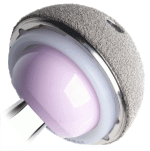
I didn’t spot the technical error but I’m more familiar with ceramic on polyethylene bearing surfaces:
806828E1-A705-4298-AEFE-B8D8DAA5296C.gif
 
Like to suggest a dedicated thread of when shells changed to include
- photos of old shells
- mileage changed
- when oil services done
- oil used
- summary of type of car usage

That way we might be able to see some patterns
 
GuidoK said:
Or that wear is related to the tight bearing clearance. I mean, the s65 does have a very tight bearing clearance, but the s54 on the other hand has a very large bearing clearance. And has the same wear pattern with the same oil. In that regard its strange that they require the same oil weight.

Agree this is odd. But we have to remember of course that BMW originally designed the S54 to use a 5W 30 grade oil. It was only late on in 2001 that they had some 'issues' and changed the spec to 10W 60 instead of doing a recall. Confusingly this didn't coincide with the early rod bearing failures (confirmed as a manufacturing defect at the time) so there must have been other reasons?? Maybe VANOS related.

I'm suspecting you might be thinking it would be ridiculous for a rod bearing that is designed to take a 30 weight oil to be equally good (or better) with a 60 weight oil. Can't help but partially agree with that, but that's what BMW did - and they didn't change the bearing. That was what formed the part of my reasoning previously that the quality of the base stock is likely to be more detrimental on these engines than the viscosity of the oil. But we still don't really know why the bearings suffer more on some of these cars and not others.
 
Jembo said:
Like to suggest a dedicated thread of when shells changed to include
- photos of old shells
- mileage changed
- when oil services done
- oil used
- summary of type of car usage

That way we might be able to see some patterns

Still no going to help Jem. Unless you've owned the car from new then no idea how its really been treated from day one.

Too many variables, oil brand, how often taken to red line, how hard driven etc.

As you say Russian roulette.
 
GuidoK said:
I mean from the hundreds (thousends?) of pictures to be found on the internet of s54 rodbearings imho there isnt a single one showing NO wear.

Here's one id love to know the answer to 8) you say each & every S54 shows signs of wear once opened up ( & i'm not arguing that point ) but there is no knowing just when that wear occurred , so it could have been initially done in first few hundred miles then never worsened & actually happens on every S54 ? Or gradually over a time got to that stage ?
Is it something that is related to cold starts ?
Is it something related to running at very high revs / thinning oil such as track use ?
Be great if someone actually had them re-checked once replaced after say 1k miles / 5k / 15k , i know that would not be prudent but it would be interesting
 
srhutch said:
Jembo said:
Like to suggest a dedicated thread of when shells changed to include
- photos of old shells
- mileage changed
- when oil services done
- oil used
- summary of type of car usage

That way we might be able to see some patterns

Still no going to help Jem. Unless you've owned the car from new then no idea how its really been treated from day one.

Too many variables, oil brand, how often taken to red line, how hard driven etc.

As you say Russian roulette.

Unless it's primarily down to some batch variance in the bearing shims themselves, in which case build date would help. It needs to be the date stamp on some easily removable / identifyable plastic part of the engine - not the car build date as the two can be many months apart.
 
Still think failure to change oil on running service and high revs from cold has a lot to do with premature bearing wear.
 
Back
Top Bottom