Rod bearing failure - what to do?

ph001 said:
Either way, I can’t imagine the wrong grade oil being responsible for bearing shell failure. The M isn’t particularly special in that area.
If anything can be responsible for a bearing shell failure (except a design flaw) its the wrong oil weight! :o
The weight of the oil in combination with the climate profile determines the oil film inside the bearing clearance. Thats how oil works.
And the bearing clearance (and bearing size) on the s54 is different than say on a m54 engine, and it can also run on a different temperature. (oil pressure is the same). These are all parameters specific for an engine and contribute in the choice of oil weight.

I would for sure get an experts opinion/test on what grade oil is used if there is no info on the invoice/service record.

BMW specifically requires 10w60 for the s54, and NOT LL04 per sé (that is, LL04 is not required).
See TIS:
https://www.newtis.info/tisv2/a/en/e85-z4-m-3.2-roa/repair-manuals/11-engine/11-00-engine/1PSryV8
https://www.newtis.info/tisv2/a/en/e85-z4-m-3.2-roa/repair-manuals/11-engine/11-00-engine/1VnZCGJeB7
 
GuidoK & TomK - thought so. Just talked to Millers - their analysis will confirm the grade. Stay tuned!
Edit: old invoices also say LL-04. Not holding out too much hope
 
I think i was the first one on the forum with spun bearings back in 2013. It cost me here in Cyprus about 5-6k sterling for a rebuild... brought in a used M3 crankshaft, used rods and new bearings, gaskets, bolts etc etc..

I feel your pain and hope it gets sorted soon whichever direction you decide to go to..
 
zmaster007 said:
GuidoK & TomK - thought so. Just talked to Millers - their analysis will confirm the grade. Stay tuned!
Edit: old invoices also say LL-04. Not holding out too much hope
To be fair, all my old dealer services state LL04 on the invoice, but after I saw that the first time they claimed that they just used the same ‘oil’ code on the computer system no matter what went into the car, and the job sheet would show the actual oil used.

If they can’t show/prove this to be the case, then I’d be pursuing the dealer for repair contribution.

I was also told valve clearances were recorded every time too...yet they could never provide a copy of them when I asked.

I do know that all my interim services used Castrol Edge/TWS, as that’s what my mechanic and I also use in our e34 M5s.
 
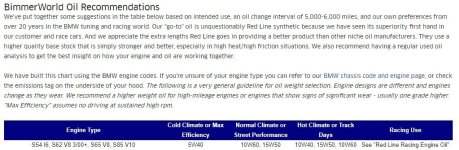
GuidoK - I totally get what you are saying, but there is also lots of evidence of bearing shell failure around where people definitely have used the correct grade oil. That's not to say that using the wrong grade oil is not a contributing factor perhaps but my instinct would say the quality of the base stock is more influential. You only have to look at the race guys or people like ECS tuning that routinely recommend using a different grade in the S54 depending on climatic conditions:


S54 oil.jpg


...ECS tuning own website promotes various grades for the S54 which I would think would be giving them problems with lots of angry customers if engines were blowing up within 2 weeks as a consequence... https://www.ecstuning.com/BMW-E46-M3-S54_3.2L/Maintenance/Engine/Oil/

This may all be by the by if the OP can get a case together inferring that by using LL-04 at least casts some doubt as to the longetivity of the engine. Lets face it, LL-04 used to be some crappy Long Life diesel oil back in the day. That seems to have changed somewhat in modern times.

Don't get me wrong, I would never risk anything else in my M than the originally specified Castrol TWS (Edge) 10W-60. I just think proving LL-04 oil was the fundamental reason for bearing shell failure could be arduous if BMW wanted to defend their position aggressively.
 
zmaster007 & mmm-five,

really sorry to hear about your troubles! :cry:

reading about it sent a shiver down my spine and makes me think one would be better off doing the big end shells at about 60K miles as a preventative measure. :(

zmaster007, keep us posted and best of luck with the investigation!
 
I was planning on replacing the shells at around 80k (that’s likely to be in 15 years time the way I’m going) where it’s had quite a few extra oil services in its lifetime - now I see a recommendation @ 50k

Interested to hear other peoples thoughts
 
Very sorry mmm-five and OP. Fair to say that bad luck is the only, known common denominator for premature bearing shell failure on these engines!

Jembo said:
I was planning on replacing the shells at around 80k (that’s likely to be in 15 years time the way I’m going) where it’s had quite a few extra oil services in its lifetime - now I see a recommendation @ 50k

Interested to hear other peoples thoughts

Personally, I would be thinking 50-60k unless I knew how the car had been treated every day of its life. Mine were replaced at 45k based on condition (part of a failure that was ultimately attributed to worn cam followers) and they were by no means terrible.

You'll find examples of spun shells at <30k (less so with latter S54s, admittedly) and pics of very healthy looking shells (no visible copper) at >60k, but I would say that, on balance, 50k seems like a sensible refresh point. You'd be buying yourself another ~50k miles of relative peace of mind (which may mean faster/cheaper diagnosis of other potential issues as the bottom end won't be dropped pre-emptively), insurance against £5k+ of peripheral damage in the case of a spun shell an ability to sell to the enthusiast community with more confidence.
 
It's a toughie. There are countless examples of the S54 engines going to >150k miles on the original shells. I'm not sure anybody has really pinned the problem down sufficiently enough to say if it was a manufacturing defect / batch problem or oil / service related. Perhaps it's down to number of cold starts or maybe the number of short drives where the car runs rich and additional petroleum vapour gets into the oil and changes the viscosity substantially.

Incidently Mr Vanos wrote an interesting piece on bearing shell failures (albeit on the V8 M):

https://www.facebook.com/MrVanos/posts/925018294267445

"After some questions around the S85 V10 and S65 V8 engines that seem to suffering more and more bearing failure, I've wrote a little bit of information with our take on it. This is purely our view and how we see it. We don't expect people to follow this and everyone has their own opinion.

Bearings were changed mainly due to new laws regarding copper. Now aluminium with tin coating. Some people say copper is better due to it being softer and can take oil contamination better. There isn't much oil debris these days due to clean engines and very good filtration.

Bearing shells produced in steel and lined with aluminum/tin or aluminum/tin/silicon have extremely effective anti-friction properties combined with high wear strength and exceptional resistance to corrosion. The fairly soft tin provides good conformability of the bearing to the crankshaft and is an excellent surface for embedment of dirt particles occurring as wear debris and primary dirt in the engine oil. Silicon, as an alloying element in aluminum bearings, is necessary when using cast iron crankshafts, especially “soft” shafts. The silicon smoothes the crankshaft surface to overcome any folded and smeared metal that might be covering up carbon inclusion.

Tin bearings work like Alusil blocks in that they need to have the silicone content brought out to bed in the piston rings. Same thing with the cranks, they bed in with the cranks, which copper based bearings will never do. This is good for bearing replacement as it will clean up the crank if there is any 'damage/light marking' from the original bearings contacting the crank. If a bearing has spun then it's to late and a new crank is the only option. The cranks are far to soft and a lot of material is taken off them when a bearing spins. There is no one in the uk who will warranty any repair work, ie. weld crank and regrind. I believe it can be done in the US, but i wouldn't want to warranty an engine with this done.

That being said the original bearings aren't the issue, never have been. The clearance is too tight for the oil thickness. It's that simple, 10w60 should never have been put in the engine, full stop. Nothing to do with temps either as the F10 uses 0w30/40 with 2 turbos and way higher engine temps that the S65/85 without issue, and bigger clearances on the rods. The thinner oil flows faster when cold, so the engine warms up quicker, and flows faster generally so the engine temps are slightly lower due to increase heat dissipation due to faster flow. Also, the original rod bolts are also 100% fine with no known issues, yes ARP's are stronger, but for normal use they don't fail and I've never heard off one failing. A supercharged E92 M3 or V10 would be a good idea to use ARP with the extra stress created but again it's not essential. A couple of supercharged M3s we built are running standard internals for the last 6 years now and one has covered 50k miles, no issue at all and perfect oil when it's changed. Uses Motul 300v 5w40 changed every 4K miles, has been tracked hard as well.

Common misconception is the thicker oil is better for higher temps, mobil 1 0w40 is rated to 150 degrees. If your engine sees oil temps that high the oil is the least of its worries . The safety cutoff is 125 on S65/S85. Above that it goes into limp mode. Some supercharged M3's have issues with high oil temps on track.

The 10w60 oil is like treacle when it's cold, combine this with not warming engine properly, 19000 mile oil changes, when the Castrol oil has been proven to break down after 5-7k miles and it's never going to end well.

However, an engine that's had regular oil (5-6k miles) changes, warmed up properly will be fine for big miles.

I've done a couple of rod bearing jobs on high mileage, 'over' maintained cars and they have been as new. My last V10 had 80k on it and 11 oil changes in the book. They were like new when I changed them.

Had to rebuild several very low mileage engines, less than 30k and only 2/3/4 oil changes in 10 years and engines are wrecked.

My recommendation is 5w40 race oil, Motul 300v, change every 5-6k mile and not worry about it. Use BMW bearings when changing, they are the only bearings on sale with a 2 year parts failure warranty.

All our rebuilds have to use 5w40 Motul as the oil for warranty. My own cars run Motul 300v as do all race bikes."
 
There’s another grand I’m going to have to hide from the misses...
 
Jembo said:
I was planning on replacing the shells at around 80k (that’s likely to be in 15 years time the way I’m going) where it’s had quite a few extra oil services in its lifetime - now I see a recommendation @ 50k

Interested to hear other peoples thoughts

We are all going to have differing views on this. I’ve had my car since 35k and doing 2k per year will use oil analysis every 2 years to help gauge when I might need to change. Think we are different to folk doing 2k every other month.

Mines on 50k now and just about to have it’s second oil analysis so will be interesting.
 
Jembo said:
Where in the country are you - there’s a list of trusted garages / indy’s circulating on here so maybe give one of them a call.

Good luck

CPC are well recommended and seem to do rod bearing services every week as per their Facebook page.

OP - sorry to hear this however if that was me I would get it written off and move on. :thumbsup:
 
srhutch said:
Jembo said:
I was planning on replacing the shells at around 80k (that’s likely to be in 15 years time the way I’m going) where it’s had quite a few extra oil services in its lifetime - now I see a recommendation @ 50k

Interested to hear other peoples thoughts

We are all going to have differing views on this. I’ve had my car since 35k and doing 2k per year will use oil analysis every 2 years to help gauge when I might need to change. Think we are different to folk doing 2k every other month.

Mines on 50k now and just about to have it’s second oil analysis so will be interesting.

I am on 83k now. Last oil analysis was done at 65k and showed no issues whatsoever. I am going to send off it's second analysis after it's oil service in about 1,000 miles.

My summation of received wisdom on here was shells at 100k, plus probably stuff like bushes & shocks. I will do another analysis at about that 100k and if it's clear won't bother with shells... However I will up the frequency of the analyses to at least every interim oil change after that.

When I asked my indy about the risk of this happening he said it's low if the car is treated with mechanical sympathy, and the best thing you can do is change the oil regularly. Seems like a no-brainer so that happens halfway between every service now, about every 7k miles.

EDIT - ref the oil weight discussion above, interestingly my first analysis came back saying that after 7.5k miles :

"Analysis reveals the viscosity is now a W50 grade of oil. No sign of wear was identified. The oil as examined in our opinion was found to be in good condition and suitable for further use."

So by 15k, the next service interval roughly, you could expect it to be at w40, assuming a straight line degradation, which may not be how it works - I am not an engineer. But, something to think about.
 
mmm-five said:
Z4M-2006 said:
This is where all the money is,it may be financially viable to get a second hand S54 and put in new shells and go in that direction.
I’m in the same position, but hadn’t mentioned it previously until I’d decided what I was going to do (strip & rebuild with new parts, or scrap the car, or wait for a low mileage S54).

It was driving normally, and we stopped to refuel, but sounde a bit noisy as I went to move off. Stopped and revved it slowly to about 1500rpm, and heard the bottom end knocking, so turned it off straight away & got it trailered to a specialist. They got me to start it and rev it slowly again and told me to turn it off immediately.

We took the oil filter out and could see a fair bit of metal, and to see if the filter had caught it all or if any had gone further into the engine we cut the filter apart...only to find as much inside as out. We then took the valve cover off and we could see ‘glitter’ :thumbsdown:

The difference I suppose to your’s is that mine is on 163,000 miles and has done a fair few track days and Ring trips...BUT it has been well over-serviced - some times 3 oil & filter changes in a month.

Murphy’s Law is that I had mine booked in for shells, vanos & CSL style carbon airbox & alpha-n during winter, to be ready for spring.

————————

Once we decided what to do (whilst I was in bed recovering from a fractured hip I injured skiing) I found it quite difficult to get a good Z4M S54 engine...they were either around 100,000 miles - and probably in need of shells & vanos too, or they were out of a crashed car and couldn’t be seen running. I finally got one after 3 months of looking and almost settling for an M3 S54.

Ultimately I only paid 10% more for Z4M version over an M3 version, but it makes the engine swap easier, as the Z4M S54 is slightly different to an M3 S54.

If you get an M3 version, then check that an earlier ones have the recall done on the bearings. You'll also need the loom to connect to the MSS70 ECU in the Z4 (M3 has MSS54).

Manifolds, MAF, airbox, dipstick, sump, etc will all need to be changed over from the Z4 engine to the M3 engine - but if there’s a lot of contamination you’d want to be raplacing bits instead to avoid leaving crap everywhere.

What you’ll save on an M3 engine, you might spend on replacement parts and extra labour to swap everything.

Ahh mate sorry to hear about this.

Did your car get up to 160,000 miles on the original bearings?
 
Sorry to read the issues you’re having OP, not good at all.

Knowing BMW’s pretty random servicing, ie, not changing oil or filter on occasions, It makes you wonder how many M’s went in for a running in oil change and left with the same oil still in.
 
R60BBA said:
Ahh mate sorry to hear about this.

Did your car get up to 160,000 miles on the original bearings?
Sort of :P

I had a new engine under warranty at 23,000 miles - and that was just after being picked up from the dealer after an Inspection 2, so they couldn't really argue about it being their fault (originally diagnosed as shim down into the engine, but all shims were accounted for; then diagnosed as spark plug electrode in the engine, but all spark plugs were fine; then vanos failure; then they gave up trying to diagnose and got a warranty replacement authorised).

So this 2nd engine has done 140,000 miles in my ownership on the original bearings - and there was no obvious/visible sign of metals in the oil or filter when we were doing any of the interim oil services, or during my annual Inspection 2 (no point doing an Insp.1 at this mileage).

Strangely, I've had more issues now that it's my second car doing 5,000 miles a year, than I ever did when I was doing 25,000 miles a year :x but that will be due to more 'hard' driving with no 2000 miles cruising commutes in between.

If the car had been standard, I would probably have sold it for spares, but a lot of the parts are aftermarket and I'd don't have the originals anymore as they were worn out when I replaced them.
 
mmm-five said:
R60BBA said:
Ahh mate sorry to hear about this.

Did your car get up to 160,000 miles on the original bearings?
Sort of :P

I had a new engine under warranty at 23,000 miles - and that was just after being picked up from the dealer after an Inspection 2, so they couldn't really argue about it being their fault (originally diagnosed as shim down into the engine, but all shims were accounted for; then diagnosed as spark plug electrode in the engine, but all spark plugs were fine; then vanos failure; then they gave up trying to diagnose and got a warranty replacement authorised).

So this 2nd engine has done 140,000 miles in my ownership on the original bearings - and there was no obvious/visible sign of metals in the oil or filter when we were doing any of the interim oil services, or during my annual Inspection 2 (no point doing an Insp.1 at this mileage).

Strangely, I've had more issues now that it's my second car doing 5,000 miles a year, than I ever did when I was doing 25,000 miles a year :x but that will be due to more 'hard' driving with no 2000 miles cruising commutes in between.

If the car had been standard, I would probably have sold it for spares, but a lot of the parts are aftermarket and I'd don't have the originals anymore as they were worn out when I replaced them.

Ahh yes I remember you telling me you had a new engine put in on another thread.

140,000 miles on OE bearings with quite a few track miles is pretty good, even though a shame that you were a tad late.

Your experience also further reinforces why owners should not rely on oil analysis reports and that doing a rod bearing service is worth it for peace of mind.

Mine have been changed twice; by BMW under recall in Feb 2005 @ 19,000 miles and by myself/Munich Legends in Nov 2018 @ 78,000 miles.

I reckon I will change again at 150,000 miles which I predict to be in 12 years time.
 
R60BBA said:
mmm-five said:
R60BBA said:
Ahh mate sorry to hear about this.

Did your car get up to 160,000 miles on the original bearings?
Sort of :P

I had a new engine under warranty at 23,000 miles - and that was just after being picked up from the dealer after an Inspection 2, so they couldn't really argue about it being their fault (originally diagnosed as shim down into the engine, but all shims were accounted for; then diagnosed as spark plug electrode in the engine, but all spark plugs were fine; then vanos failure; then they gave up trying to diagnose and got a warranty replacement authorised).

So this 2nd engine has done 140,000 miles in my ownership on the original bearings - and there was no obvious/visible sign of metals in the oil or filter when we were doing any of the interim oil services, or during my annual Inspection 2 (no point doing an Insp.1 at this mileage).

Strangely, I've had more issues now that it's my second car doing 5,000 miles a year, than I ever did when I was doing 25,000 miles a year :x but that will be due to more 'hard' driving with no 2000 miles cruising commutes in between.

If the car had been standard, I would probably have sold it for spares, but a lot of the parts are aftermarket and I'd don't have the originals anymore as they were worn out when I replaced them.

Ahh yes I remember you telling me you had a new engine put in on another thread.

140,000 miles on OE bearings with quite a few track miles is pretty good, even though a shame that you were a tad late.

Your experience also further reinforces why owners should not rely on oil analysis reports and that doing a rod bearing service is worth it for peace of mind.

Mine have been changed twice; by BMW under recall in Feb 2005 @ 19,000 miles and by myself/Munich Legends in Nov 2018 @ 78,000 miles.

I reckon I will change again at 150,000 miles which I predict to be in 12 years time.

Unless I missed it I don’t believe there was oil analysis done.
 
I am not convinced that oil sampling is that reliable for predicting a rod failure.

I am an engineering technician and worked on CCGT and CHP plants for around 15 years plus steel works, paper mills, large NH3 fridge plants (39ton 40 would have been COMAH) and food processing and packaging equipment. Built a Westfield and a 255BHP Duratec to go in it.

When I have done oil conditioning training (with Castrol) it has been for large volume oil systems so the cost is large to change the oil, but the principles have got to be the same, the thing that came round time and time again was a snap shot sample has little value, the condition has to be trended, over time to see a change.

So if you sampled a Gas Turbine oil every week or month or hour run and plotted the results you would see an increase in the white metal content as PPM and as this increased you would note that the main bearings are wearing or the thrust pads as this is where the white metal is in the ones I worked on. This would then allow engineers and accountants to plan to change the oil/overhaul the turbine to prevent a failure.

So in a car engine to see a trend you would need to sample as soon as you change the oil to get a base line/datum then re sample several time during the life of the oil before you change the oil.
You would also need to know what and where the deferent materials are in the engine that the oil passes by so to try and identify where the particles are from that may show up in an oil sample analysis.

Changing the oil will as I see it re set the datum as you have flushed away the suspended particles in the old oil. and then you would get a much better result if tested after an oil change.

This is just my thought from my experience and I have no real alternative for checking other than a physical on ie. remove and inspect, by which time you may as well replace them on a time/mileage basis.

Also so I have no real answer for the OP with regards as what to do, other than I will follow the thread as I am looking at buying a Z4M or a 3.0si

Hope the above ramblings make sense (not a typist)

Paul.
 
PDJ said:
I am not convinced that oil sampling is that reliable for predicting a rod failure.

I am an engineering technician and worked on CCGT and CHP plants for around 15 years plus steel works, paper mills, large NH3 fridge plants (39ton 40 would have been COMAH) and food processing and packaging equipment. Built a Westfield and a 255BHP Duratec to go in it.

When I have done oil conditioning training (with Castrol) it has been for large volume oil systems so the cost is large to change the oil, but the principles have got to be the same, the thing that came round time and time again was a snap shot sample has little value, the condition has to be trended, over time to see a change.

So if you sampled a Gas Turbine oil every week or month or hour run and plotted the results you would see an increase in the white metal content as PPM and as this increased you would note that the main bearings are wearing or the thrust pads as this is where the white metal is in the ones I worked on. This would then allow engineers and accountants to plan to change the oil/overhaul the turbine to prevent a failure.

So in a car engine to see a trend you would need to sample as soon as you change the oil to get a base line/datum then re sample several time during the life of the oil before you change the oil.
You would also need to know what and where the deferent materials are in the engine that the oil passes by so to try and identify where the particles are from that may show up in an oil sample analysis.

Changing the oil will as I see it re set the datum as you have flushed away the suspended particles in the old oil. and then you would get a much better result if tested after an oil change.

This is just my thought from my experience and I have no real alternative for checking other than a physical on ie. remove and inspect, by which time you may as well replace them on a time/mileage basis.

Also so I have no real answer for the OP with regards as what to do, other than I will follow the thread as I am looking at buying a Z4M or a 3.0si

Hope the above ramblings make sense (not a typist)

Paul.

I can see where you are coming from, you need to sample over a period of time, not just a snapshot once in a while but sampling straight after an oil change won’t yield valuable results surely? You need to actually circulate the oil and use it to find anything of value really, unless the engine is so far gone and your ppm for wear metals is high after minimal mileage on fresh oil.

My last two samples, both taken after 4000 miles of oil use have yielded near as makes no difference the same results. Both have been less than 20ppm for Copper, Lead and Iron) I’m planning to stretch to 8000 miles for the next oil change / sample and see how the ppm increases based on the mileage.

I wouldn’t say oil sampling is a hard fast guarantee of the health of your bearing shells, but it is a good indicator if they are on the way out.
 
Back
Top Bottom