
You are using an out of date browser. It may not display this or other websites correctly.
You should upgrade or use an alternative browser.
You should upgrade or use an alternative browser.
Bilstein B16/PSS-10 makes noises. Fails! Opinions?
- Thread starter Franzino
- Start date
Finally have some time to go online and give an update on the suspension. The week after reporting the noise; I went back to my dealer. We did a test run together inside the car and put the car on the bridge. There was 1 bolt at the rear that was not 100% fastened and this made the metal sounding noise… The bolt was tight, but not 100% and the damper could move just a tiny bit over the bolt and this made most of the noise. It was the bolt that connects the downside of the rear damper with the frame that holds the wheel and brakes (I don't know the English name of that frame). There is still some slight noise coming from the front when hitting uneven things on the street, but I'm not 100% sure if this is coming from the Bilstein suspension or something else that makes this noise on the car when the suspension absorbs the shocks… Need some time to examine this further! So the noise issue is 85% cured and I'm searching from what that front noise is coming from.
Then there is the handling; the damping and ride control (body movement) is great with the Bilstein PSS-10 (on road and track)… Still need to experiment with the ideal hardness/softness setting of the suspension. I'm now driving with 4F and 4R on the street (1 setting softer then the middle setting of the 10 settings). The car has now the total standard factory alignment and the height is exactly the same as with OEM dampers and Eibach springs.
There is one thing that I noticed when driving the car; the turn in feel, feels slower and less aggressive then before. In my opinion the car turn in feel was sharper and a bit more aggressive with OEM dampers and Eibach spring. The steering feel was also more enjoyable. Very strange…? I would think that with the harder dampers the turn in would be also a little bit more direct. The dealer and I were thinking about the alignment, but my car never had an aggressive alignment before and was always set-up pretty standard. Besides fitting the Bilstein suspension and the RTAB limiters (with new rubbers) nothing was changed about the car. I also noticed that my TC light flashes more then before fitting the PSS-10… I would think that with a harder suspension there would be more grip and the TC would intervene less.
Then there is the handling; the damping and ride control (body movement) is great with the Bilstein PSS-10 (on road and track)… Still need to experiment with the ideal hardness/softness setting of the suspension. I'm now driving with 4F and 4R on the street (1 setting softer then the middle setting of the 10 settings). The car has now the total standard factory alignment and the height is exactly the same as with OEM dampers and Eibach springs.
There is one thing that I noticed when driving the car; the turn in feel, feels slower and less aggressive then before. In my opinion the car turn in feel was sharper and a bit more aggressive with OEM dampers and Eibach spring. The steering feel was also more enjoyable. Very strange…? I would think that with the harder dampers the turn in would be also a little bit more direct. The dealer and I were thinking about the alignment, but my car never had an aggressive alignment before and was always set-up pretty standard. Besides fitting the Bilstein suspension and the RTAB limiters (with new rubbers) nothing was changed about the car. I also noticed that my TC light flashes more then before fitting the PSS-10… I would think that with a harder suspension there would be more grip and the TC would intervene less.
The paper gaskets was in place...exdos said:I presume that your rear top mounts were also changed. Did you fit Rogue, or similar inverted top mounts? If so did they use the paper gaskets that should be inserted between top mounts and wheel arches on both sides?
I had no idea about the inverted top mounts…. Nobody ever told me it would be a good idea to change them or refresh the OEM top mounts when fitting the new suspensionexdos said:See: http://www.rogueengineering.com/rogue/S_BUSH/RSM.htmlFranzino said:Inverted top mounts? Sorry; no idea what you are talking aboutWhy should those needed to be changed?
Whilst you're going to the trouble of removing the rear suspension, it's an opportunity to refresh the OEM top mounts. Inverted top mounts also mean that the rear dampers can easily be removed from inside the wheel arch without the need to dismantle the trim in the boot, more of a problem in the Coupe than the Roadster..
I asked my dealer, they checked the OEM top mounts when fitting the Bilstein; the condition of the top mounts was still good or otherwise he would have replaced them. If I knew this was a weak point I would have told them to replace those when fitting the Bilstein… To late now!Franzino said:Finally have some time to go online and give an update on the suspension. The week after reporting the noise; I went back to my dealer. We did a test run together inside the car and put the car on the bridge. There was 1 bolt at the rear that was not 100% fastened and this made the metal sounding noise… The bolt was tight, but not 100% and the damper could move just a tiny bit over the bolt and this made most of the noise. It was the bolt that connects the downside of the rear damper with the frame that holds the wheel and brakes (I don't know the English name of that frame). There is still some slight noise coming from the front when hitting uneven things on the street, but I'm not 100% sure if this is coming from the Bilstein suspension or something else that makes this noise on the car when the suspension absorbs the shocks… Need some time to examine this further! So the noise issue is 85% cured and I'm searching from what that front noise is coming from.
Then there is the handling; the damping and ride control (body movement) is great with the Bilstein PSS-10 (on road and track)… Still need to experiment with the ideal hardness/softness setting of the suspension. I'm now driving with 4F and 4R on the street (1 setting softer then the middle setting of the 10 settings). The car has now the total standard factory alignment and the height is exactly the same as with OEM dampers and Eibach springs.
There is one thing that I noticed when driving the car; the turn in feel, feels slower and less aggressive then before. In my opinion the car turn in feel was sharper and a bit more aggressive with OEM dampers and Eibach spring. The steering feel was also more enjoyable. Very strange…? I would think that with the harder dampers the turn in would be also a little bit more direct. The dealer and I were thinking about the alignment, but my car never had an aggressive alignment before and was always set-up pretty standard. Besides fitting the Bilstein suspension and the RTAB limiters (with new rubbers) nothing was changed about the car. I also noticed that my TC light flashes more then before fitting the PSS-10… I would think that with a harder suspension there would be more grip and the TC would intervene less.
Franzino, I'm glad you seem closer to discovering the cause of the noise and I hope you can cure it completely very soon.
You posted the quote below in another thread so I've moved it into this thread:
Franzino said:Little bit of topic and maybe I asked this before (sorry :wink: ). What were the Bilstein PSS-9 settings you used on your 2 days driving on the ring? Did any experimentation with the balance front and rear?
On my ACS Racing suspension the scale is 9= Soft and 1= Hard. Over the past 12 months, for road use I've had the dampers set at 4 all round on OEM Contis. A few months ago I got new 265 Michelin PSS for the rears and found no need to change the settings for road use, however, I fitted new 235 PSS to the front but found that this made the suspension feel much firmer all round (too stiff for road use) but I decided not to bother changing it because I would try these settings at The Ring as my starting point.
After a few laps with these damper settings with cold tyre pressures of 2.1 bar (F) and 2.2 bar (R), I started to play with the damper settings. On the first day I adjusted the fronts to damper setting 3 then 2 and found the handling improved progressively the more I stiffened the settings, so I then did the same at the rear. For the next day, I dropped the tyre pressures to 2.05 bar cold all round and then drove a few laps with the dampers set at 2 all round. I then tried the fronts set at 1 and finally I set the rear dampers at 1 and the handling improved some more. So I now have the dampers at their stiffest settings and the tyre pressures lower than recommended. After leaving the track I reset the dampers to 3 all-round and the car feels far too stiff for UK roads, so I'll reset them to 6 all-round and then I'll find the right fast-road settings for the Michelin PSSs.
I know that people say that The Ring is very bumpy, and it is if you consider it as a racetrack, but if you consider it as a public road, it's just about the smoothest road I know, although it is very undulating, and the fact that I find that the stiffest suspension settings on my ACS kit works best doesn't surprise me at all. I find exactly the same with the damper settings of the KWV3 coilover suspension on my Z3MC = Stiffest at The Ring and fairly soft for fast road.
With regard to the turn in of your car I find that 0 toe angle front and rear is best. It's geometry that affects turn-in more so than damping. You must remember that the geometry settings are "best compromise" settings for the dynamic situation and that the F/R balance of the suspension on Bilstein PSS10 is better than the OEM system, with less pitching and lifting at the front, therefore different geometry is required.

Franzino said:I had no idea about the inverted top mounts…. Nobody ever told me it would be a good idea to change them or refresh the OEM top mounts when fitting the new suspension
It's not a very difficult job to DIY on the Z4MC. The hardest part is getting access to the top mounts under the rear trim, but I don't know how difficult that might be for the MR.
Franzino said:Finally have some time to go online and give an update on the suspension. The week after reporting the noise; I went back to my dealer. We did a test run together inside the car and put the car on the bridge. There was 1 bolt at the rear that was not 100% fastened and this made the metal sounding noise… The bolt was tight, but not 100% and the damper could move just a tiny bit over the bolt and this made most of the noise. It was the bolt that connects the downside of the rear damper with the frame that holds the wheel and brakes (I don't know the English name of that frame). There is still some slight noise coming from the front when hitting uneven things on the street, but I'm not 100% sure if this is coming from the Bilstein suspension or something else that makes this noise on the car when the suspension absorbs the shocks… Need some time to examine this further! So the noise issue is 85% cured and I'm searching from what that front noise is coming from.
Then there is the handling; the damping and ride control (body movement) is great with the Bilstein PSS-10 (on road and track)… Still need to experiment with the ideal hardness/softness setting of the suspension. I'm now driving with 4F and 4R on the street (1 setting softer then the middle setting of the 10 settings). The car has now the total standard factory alignment and the height is exactly the same as with OEM dampers and Eibach springs.
There is one thing that I noticed when driving the car; the turn in feel, feels slower and less aggressive then before. In my opinion the car turn in feel was sharper and a bit more aggressive with OEM dampers and Eibach spring. The steering feel was also more enjoyable. Very strange…? I would think that with the harder dampers the turn in would be also a little bit more direct. The dealer and I were thinking about the alignment, but my car never had an aggressive alignment before and was always set-up pretty standard. Besides fitting the Bilstein suspension and the RTAB limiters (with new rubbers) nothing was changed about the car. I also noticed that my TC light flashes more then before fitting the PSS-10… I would think that with a harder suspension there would be more grip and the TC would intervene less.
I think the PSS10 coilovers factor in some lowering of the car both front and rear, but I'm bot 100% sure. Otherwise if your car is feeling skittish or loose it could well be that the suspension is working the tyres that much harder making them heat up real quick. Check the pressure and let some air out if needed. I was warned about this by the guys who set up my chassis but I was surprised that it felt so strange after 3 laps on a track. Thinking that this new set had confused the traction control etc and even that the set up was a mistake I even got an instructor to drive it! Well lets just say that after 2 laps, one very nervous instructor and WTF passenger (me) got out and took some air out: 1 bar at front and 1.4 at the rear!!! She's been perfect since!
Dude, you've got lots of race teams workshops at the Ring, why not ask them to set up the suspension for you. It will be a few hundred €Euros only and they will make it work for your level of experience, road and track. More importantly, you'll have not only a set up that PERFORMS but also the comfort of knowing that its safe and EXPLOITABLE at the limit of grip. Take my word for it its money well spent! That Bilstein is an expensive and serious bit of kit (GT3 and CSL owners fit them too) so you might as well get 100% of the potential out of it.
They'l probably add a few bits if you've bot done so like ARBs, reinforced mounts etc. and set up the geometry.
I know there is no way I would go back to OEM or do differently on my car bow. I have a few friends who are way better drivers and a couple of seasoned racers and all reckoned that the set up is as good as it can be for this car bow. If I change tyre type though, I've got to get it set up again for those small tweeks.
I went back to the ring this month… It was 35*; so way too hot for some really good testing. The Michelin Supersports tyres got too hot and slided more then normal.exdos said:On my ACS Racing suspension the scale is 9= Soft and 1= Hard. Over the past 12 months, for road use I've had the dampers set at 4 all round on OEM Contis. A few months ago I got new 265 Michelin PSS for the rears and found no need to change the settings for road use, however, I fitted new 235 PSS to the front but found that this made the suspension feel much firmer all round (too stiff for road use) but I decided not to bother changing it because I would try these settings at The Ring as my starting point.
After a few laps with these damper settings with cold tyre pressures of 2.1 bar (F) and 2.2 bar (R), I started to play with the damper settings. On the first day I adjusted the fronts to damper setting 3 then 2 and found the handling improved progressively the more I stiffened the settings, so I then did the same at the rear. For the next day, I dropped the tyre pressures to 2.05 bar cold all round and then drove a few laps with the dampers set at 2 all round. I then tried the fronts set at 1 and finally I set the rear dampers at 1 and the handling improved some more. So I now have the dampers at their stiffest settings and the tyre pressures lower than recommended. After leaving the track I reset the dampers to 3 all-round and the car feels far too stiff for UK roads, so I'll reset them to 6 all-round and then I'll find the right fast-road settings for the Michelin PSSs.
I know that people say that The Ring is very bumpy, and it is if you consider it as a racetrack, but if you consider it as a public road, it's just about the smoothest road I know, although it is very undulating, and the fact that I find that the stiffest suspension settings on my ACS kit works best doesn't surprise me at all. I find exactly the same with the damper settings of the KWV3 coilover suspension on my Z3MC = Stiffest at The Ring and fairly soft for fast road.
[youtube]watch?v=Qf8ylG_KYD0#ws[/youtube]
http://www.youtube.com/watch?v=Qf8ylG_KYD0#ws
I did some talking with other people with Bilstein PSS-10 and PSS-9 who drive their car's (in this case e36 M3) on the ring. They all had the same conclusions as me and we found 1 setting harder then the middle the best setting for the ring. This means 6 front and rear on my PSS-10 and 4 front and rear on the PSS-9. AC Schnitzer advises even softer settings (6-5) on their PSS-9 AC-Bilstein suspension for the e46 M3 when driving on the ring. The BMW driving academy instructors for the Nurburgring also advise to put the EDC suspension of the e92 M3 on normal and not the hardest sport setting.
Some people like there settings harder (like you) on the ring. It's also driver style orientated and with what kind of tyres your car is equipped. I sometimes see car's on the ring where the rear tyre's bounce over the road surface on bumpy area's of the track. I have seen a race prepared e92 M3 jump almost out of the carousel because the rear tyres started bouncing and not the suspension. IMO if I go harder on the ring then the grip on my car would be less and the car would also become too jumpy on certain area's where the ring is really bumpy. I drive with 19" Michelin Supersports (235/35x19 front & 265/30x19 rear ) on street and track. They have a lower profile then 18" tyres, so are also a little harder. The tech people of Michelin advised me to put the pressure (when hot) on 2.2-2.25 bar front and 2.3-2.35 bar rear… They advised me to always keep a difference of 0.1 bar between front and rear and to not exceed 2.4 bar. I must say that this set-up feel better then driving with 2.4 bar all round (when hot) like I use to do in the past. I noticed that with the new (harder) Bilstein suspension the tyres get a little warmer on track…so I have to let more air out of them to get to my desired "hot" tyre pressure of 2.25 / 2.35 bar
For driving on the street I used to drive with setting 4 all round (1 setting softer then the middle setting). I found that in heavy rain the rear would slide faster and that in short corners (were you go on the gas early) the rear would feel bouncy (on bad city roads). This made the TC flash more regular then in the past and I felt the car bounce more at the rear. So I left the front on setting 4 and put the rear suspension setting softer on to number 3 (on PSS-10 setting 1 is soft and setting 10 is hard). This made an improvement for street driving in wet and dry and for the moment I'm keeping this.
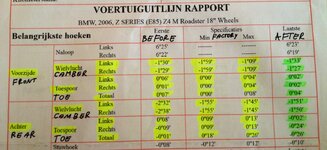
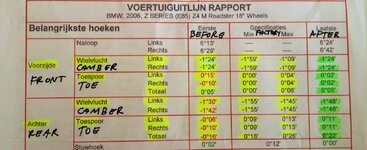
Here is a copy of my geometry settings before and after fitting of the Bilstein. The steering response before the Bilstein was alway very nice. I know with the first geometry setting they did something strange with the rear toe… the difference between the left and right is to big, but the steering felt fine and overall feel thru corners was very nice. But this was in the past and they corrected that toe settings with a new geometry after fitting the Bilstein PSS-10.exdos said:With regard to the turn in of your car I find that 0 toe angle front and rear is best. It's geometry that affects turn-in more so than damping. You must remember that the geometry settings are "best compromise" settings for the dynamic situation and that the F/R balance of the suspension on Bilstein PSS10 is better than the OEM system, with less pitching and lifting at the front, therefore different geometry is required.
What would you advise as geometry settings (camber, toe) on my car (keeping in my mind my steering wishes)… For the moment there is still a slight delay when turning in (that was not there before). Would my car benefit from getting it corner weighted by a suspension specialist?
Geometry 1 (with oem dampers and Eibach springs)
Geometry 2 (after fitting the Bilstein PSS-10)
Side note; When comparing the BMW factory settings of the Z4M roadster vs Z4M coupe there is a difference in recommended geometry setting between the two. The numbers are the minimum and maximum settings advised by the factory. As you can see the maximum camber setting are less aggressive on the Z4M coupe then on the Z4M roadster and the coupe has a little more positive toe (when leaving the factory).
Z4M Coupe recommended by BMW
Front Camber: -1*25' <-> -0*45'
Front Toe: 0*03' <-> 0*07'
Rear Camber: -1*55' <-> -1*45'
Rear Toe: 0*12' <-> 0*16'
Z4M Roadster recommended by BMW
Front Camber: -1*59' <-> -1*09
Front Toe: 0*00' <-> 0*04'
Rear Camber: -1*55' <-> -1*45'
Rear Toe: 0*09' <-> 0*13
Franzino said:I did some talking with other people with Bilstein PSS-10 and PSS-9 who drive their car's (in this case e36 M3) on the ring....
Personally, I'm not bothered what the manufacturer's recommended settings are or what settings other people use; what I want from adjustable suspension is a sufficient range of useful adjustment from soft to hard and with the right spring rates for the car, so that I can test drive and adjust the dampers to eventually find the optimum settings that suit my driving style on the roads and track. As you know, I think the Z4MC's OEM suspension is far too stiff at the rear, particularly for road use, so I wouldn't say I like a hard set up unless the road conditions suit. I think that for relatively slow speeds, hard suspension finds all the bumps and makes for a very uncomfortable ride, but at higher speeds on track I think stiffer damper settings give a decent ride with more feedback through the steering and the seat of the pants, whereas with softer settings I find that there is a delay in the feedback because the dampers "dampen" the feedback. I'm using the OEM 18" wheels with the PSS in larger than OEM size which have higher sidewalls, so my suspension settings can tolerate being stiffer than with 19" wheels shod with lower profile tyres. I also like to run my tyre pressures in accordance with what you've been advised by the Michelin techies otherwise the tyres get far too hot and squeal and reach their limits at lower speeds.
Franzino said:What would you advise as geometry settings (camber, toe) on my car (keeping in my mind my steering wishes)… For the moment there is still a slight delay when turning in (that was not there before). Would my car benefit from getting it corner weighted by a suspension specialist?
I know that on the US Z4 forum they are keen on corner weighting, but I think that most of the advocates of that do "Autocross" driving short courses around cones in very flat car parks. I cannot see how corner weighting can really be of any benefit when driving The Ring.
Looking at your two different geometry settings, in your first one, after adjustment, you had toe out at the rear, which would definitely make the car turn much quicker, whereas in your second settings, you have toe in at the rear. I have my front and rear set at almost zero toe and I find that this gives me a predictable steering response and turn-in. I see you also still have the possibility to increase front camber, so it might be worthwhile increasing it too, because this will also increase turn-in.
exdos said:I know that on the US Z4 forum they are keen on corner weighting, but I think that most of the advocates of that do "Autocross" driving short courses around cones in very flat car parks. I cannot see how corner weighting can really be of any benefit when driving The Ring.
Looking at your two different geometry settings, in your first one, after adjustment, you had toe out at the rear, which would definitely make the car turn much quicker, whereas in your second settings, you have toe in at the rear. I have my front and rear set at almost zero toe and I find that this gives me a predictable steering response and turn-in. I see you also still have the possibility to increase front camber, so it might be worthwhile increasing it too, because this will also increase turn-in.
Your evaluation is 100% correct… I was thinking exactly the same thing.
I want to try the following settings and see how the result feels...
Front camber: -1*40 / -1*45 (if possible)
Front toe: standard settings
Rear camber: standard settings
Rear toe: -0*20'
If you get another alignment done to your desired settings, you should get the technician to measure the rear toe settings at maximum and minimum points of adjustment, before setting up to your requirements, so that you know the range of adjustment. If after test driving at The Ring you are not completely happy with the settings you have, you could easily readjust (i.e. increase or decrease toe) as a DIY by adjusting equally on both sides. Until you've tried a few different settings you can never know whether the set-up is optimum for you or not, and the reason why I do my own alignments is so that I can easily experiment with settings to arrive at the handling I like best.
I hope those settings work best for you!
I hope those settings work best for you!
pressumably if you move to 18" wheels ( even going as far as forged ) you can have a lower damper setting whilst maintaining effective the spring rate as if you where on harder dampers and 19"?
ChawenHalo said:pressumably if you move to 18" wheels ( even going as far as forged ) you can have a lower damper setting whilst maintaining effective the spring rate as if you where on harder dampers and 19"?
For a fixed rolling radius, it's more related to the height of the sidewall of the tyre, which of course is related to the diameter of the alloy rim. The larger the sidewall of the tyre the stiffer the damper setting can be, so as the sidewall height reduces the suspension needs to get progressively softer. The physics for this is two springs in series: i.e. suspension spring + tyre wall. Different makes and models of tyre, even of the same tyre wall height, and tyre pressures can produce different effective "spring rates" for the tyre.
This is the reason why I think that manufacturer's (and any one else's) recommended settings for adjustable suspension should be used as a guide only, because the suspension needs to be adjusted by a "suck and see" approach and because different tyres have a very big influence on the suspension settings required: the only way to find out what is best is by trial and error and for me, there's nobody better for adjusting suspension and tyre pressures and test driving your car than yourself.
I went on holiday and my Z4M stayed for 2 weeks with my M-specialist to check out the noise that was still coming from the front of the car when hitting small bumps on the street. The noise started after the fitment of the Bilstein suspension in 2014.
They now checked every bit of the front suspension and found nothing was technically wrong or damaged.... They checked if the firewall braces were tight enough. It is common knowledge that if the bolts of the firewall braces are loose they can make noise. But every bolt was correctly fixed and there was zero movement when pulling the firewall brace by hand. As a final test they removed the OEM BMW strutbrace and the firewall braces and did the same test run. The typical rattling noise was gone...! They fitted the OEM BMW strutbrace again and the noise was still gone...so back to fitting the firewall braces and yes the noise was back... I went home and I did the test myself (removing and refitting the firewall braces) and had the same result when test driving on a bumpy road!
So afters hours of testing it is finally know what makes the noise.... The strange thing is, this noise started from day 1 after the Bilstein suspension was fitted (never heard it before). So what to do now??? The firewall braces need to be fitted and so the the annoying noise is coming back.... When pulling the firewall braces, then there is zero movement! When closely investigating the firewall braces mounting point on the strut towers, then you can see some really small cracks in the mounting points under the mounting plate of the strutbrace (but nothing alarming in my opinion)... I will try to make pictures of the cracks this week (so you guys can see what I mean with small cracks). In my opinion it does not make 100% sense that these small cracks could make the firewall braces move and create the noise... If the firewall brace mounting plates would be loose (like in this case: http://www.zpost.com/forums/showthread.php?t=298573) then it could totally explain the noise... But in my opinion is now not the case, because there is no movement in the firewall braces mounting plates. So maybe the problems is the firewall braces themselves.....but how could they create noise if they are not moving?
You can say; do a test! Order 2 now mounting points for the strut tower and get them spot welded on....do a test drive and see if the noise is gone. That not so expensive to do and sounds like something that can be done. The official BMW dealer will not do this (already checked), but my M specialist or a body repair shop can do this welding. Problem; welding on the chassis is not legal for the yearly MOT vehicle inspection in my country... If they notice it on the inspection then it will result in a car that will be denied road access! It's true; I know about people who had this happen after the MOT inspection spotted a small aftermarket spot welding on the chassis. This resulted is a really expensive operation to get the car back to street legal....
So then there is the option of buying the rather expensive Rogue engineering race brace (http://www.ca-int.co.uk/variants-cGFyZW50X2lkPTE4OTMjNTI0MQ==.html)
This Rogue engineering strutbrace that has some extra stiffening on the spot were the firewall braces are connected on the struts. http://www.zpost.com/forums/showthread.php?p=12491034
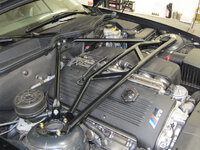
But I have read that the fitment of this item is not 100% and it needs a lot of tweeking to fit correctly? 2 other downsides; for work on the engine you will always have to remove the entire strutbrace (and not only the middle part as on the OEM BMW strutbrace I have fitted now). The other downside may be that the noise is still there....and I have bought something that I did not needed and is no solution for my problem.
The OEM firewall braces are hollow, so maybe they are some sort of resonance room and create noise...? A firewall brace from strong strut is not hollow and could maybe delete the noise? http://www.ca-int.co.uk/variants-cGFyZW50X2lkPTEzMjE=.html
They now checked every bit of the front suspension and found nothing was technically wrong or damaged.... They checked if the firewall braces were tight enough. It is common knowledge that if the bolts of the firewall braces are loose they can make noise. But every bolt was correctly fixed and there was zero movement when pulling the firewall brace by hand. As a final test they removed the OEM BMW strutbrace and the firewall braces and did the same test run. The typical rattling noise was gone...! They fitted the OEM BMW strutbrace again and the noise was still gone...so back to fitting the firewall braces and yes the noise was back... I went home and I did the test myself (removing and refitting the firewall braces) and had the same result when test driving on a bumpy road!
So afters hours of testing it is finally know what makes the noise.... The strange thing is, this noise started from day 1 after the Bilstein suspension was fitted (never heard it before). So what to do now??? The firewall braces need to be fitted and so the the annoying noise is coming back.... When pulling the firewall braces, then there is zero movement! When closely investigating the firewall braces mounting point on the strut towers, then you can see some really small cracks in the mounting points under the mounting plate of the strutbrace (but nothing alarming in my opinion)... I will try to make pictures of the cracks this week (so you guys can see what I mean with small cracks). In my opinion it does not make 100% sense that these small cracks could make the firewall braces move and create the noise... If the firewall brace mounting plates would be loose (like in this case: http://www.zpost.com/forums/showthread.php?t=298573) then it could totally explain the noise... But in my opinion is now not the case, because there is no movement in the firewall braces mounting plates. So maybe the problems is the firewall braces themselves.....but how could they create noise if they are not moving?
You can say; do a test! Order 2 now mounting points for the strut tower and get them spot welded on....do a test drive and see if the noise is gone. That not so expensive to do and sounds like something that can be done. The official BMW dealer will not do this (already checked), but my M specialist or a body repair shop can do this welding. Problem; welding on the chassis is not legal for the yearly MOT vehicle inspection in my country...
If they notice it on the inspection then it will result in a car that will be denied road access! It's true; I know about people who had this happen after the MOT inspection spotted a small aftermarket spot welding on the chassis. This resulted is a really expensive operation to get the car back to street legal....So then there is the option of buying the rather expensive Rogue engineering race brace (http://www.ca-int.co.uk/variants-cGFyZW50X2lkPTE4OTMjNTI0MQ==.html)
This Rogue engineering strutbrace that has some extra stiffening on the spot were the firewall braces are connected on the struts. http://www.zpost.com/forums/showthread.php?p=12491034
But I have read that the fitment of this item is not 100% and it needs a lot of tweeking to fit correctly? 2 other downsides; for work on the engine you will always have to remove the entire strutbrace (and not only the middle part as on the OEM BMW strutbrace I have fitted now). The other downside may be that the noise is still there....and I have bought something that I did not needed and is no solution for my problem.
The OEM firewall braces are hollow, so maybe they are some sort of resonance room and create noise...? A firewall brace from strong strut is not hollow and could maybe delete the noise? http://www.ca-int.co.uk/variants-cGFyZW50X2lkPTEzMjE=.html
so från are you saying that basically your firewall brace mounting points on the turrets have failed? That mount point bmw decided looked good was never sufficient really when you look at it, I'm hoping that since I've had the Strut brace on my car fro pretty much day one its helped minimise flex and keep these strong, i see no sort of hairline crack on my firewall brace mount points, i hope that continues to be the case but i think as these cars get older we will see more failures!
im also seen the fire wall braces themselves crack at the crush point in the middle FYI...
im also seen the fire wall braces themselves crack at the crush point in the middle FYI...
If I would fit firewall braces from strong strut...do I lose the crush point? In case of an big accident is would be nice the firewall brace bend and not penetrate the dashboard (or me)...Beedub said:im also seen the fire wall braces themselves crack at the crush point in the middle FYI...

Any opinions about the Rogue engineering race brace?

Franzino said:Problem; welding on the chassis is not legal for the yearly MOT vehicle inspection in my country...
I'm not disputing this because I've no knowledge of your laws, but how do cars in Belgium get fixed after road accidents which can be repaired but require welding?
Franzino said:If I would fit firewall braces from strong strut...do I lose the crush point? In case of an big accident is would be nice the firewall brace bend and not penetrate the dashboard (or me)...Beedub said:im also seen the fire wall braces themselves crack at the crush point in the middle FYI...
Any opinions about the Rogue engineering race brace?
the crush point appears to be gone but i can't be sure of that.
They replace big parts....but small spot welding on the chassis is not approved.exdos said:Franzino said:Problem; welding on the chassis is not legal for the yearly MOT vehicle inspection in my country...
I'm not disputing this because I've no knowledge of your laws, but how do cars in Belgium get fixed after road accidents which can be repaired but require welding?