Anywhere in the UK you can take your Zed to see what it will do?

  • Thread starter Thread starter Anonymous
  • Start date Start date
buzyg said:
john-e89 said:
buzyg said:
As it indeed would. At first the driver would feel weightless in the car, however as the rate of acceleration reduced, due to the air pushing upward, the driver would start to feel their weight within the vehicle. At this point all the way to the beach the extra weight of the driver increases the downward force slightly and therefore the acceleration, relative to if they where not present. Doesn't help them much though as the change in medium density at the beach creates a bit of a mess.

Can we do wave theory next week. I enjoy that too being an ex surfer. :D

Neither of us are going out in that Buzy.....not unless we want to discuss at first hand, drowning..... :P
That is an amazing photo. I have surfed some big waves in my time, probably the some of biggest the UK can offer. But that is in a different league all together. 8) :thumbsup:

Nazare’ in Portugal....as mental as it gets. Even when I was swimming competively and surfing at weekends I wouldn’t have gone anywhere near that...!! You couldn’t pay me enough....no point having a few quid n your waterlogged coffin Buzy.... :lol:
 
john-e89 said:
No one’s explained my candle experiment yet...... :lol: :P

You just need better controls and measuring equipment John. The rules are the same. Back when I was at Manor High School I came home from an A level Physics lesson one evening and spent hours doing that experiment with different object from around the house. Like you I only had very primitive equipment. But I got there in the end. :)
 
john-e89 said:
buzyg said:
john-e89 said:
Neither of us are going out in that Buzy.....not unless we want to discuss at first hand, drowning..... :P
That is an amazing photo. I have surfed some big waves in my time, probably the some of biggest the UK can offer. But that is in a different league all together. 8) :thumbsup:

Nazare’ in Portugal....as mental as it gets. Even when I was swimming competively and surfing at weekends I wouldn’t have gone anywhere near that...!! You couldn’t pay me enough....no point having a few quid n your waterlogged coffin Buzy.... :lol:
Free diving is your aid to survival here. Teaches you to hold your breath for a surprisingly long time. Assuming it doesn't kill you first. I suspect I might not be here otherwise, there have been some long hold downs over the years. Another reason I have returned to rock climbing at the tender age of 59, it's a lot safer than big wave surfing. But I think that's a whole other thread.
 
MrPT said:
buzyg said:
If you feel the mood there is a full proof in the link below.

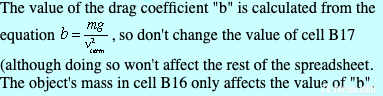
No there isn't, it even says...

Screenshot 2020-11-17 at 11.28.14.png

...!!!

It says plain as day in the section you just quoted that the drag coefficient is effected by the mass of the body. The drag coefficient limits terminal velocity. In order to reach any terminal velocity you have to reduce the rate of the acceleration to Zero. Sit back and take another look, You are not seeing the wood for the trees.
 
buzyg said:
MrPT said:
buzyg said:
If you feel the mood there is a full proof in the link below.

No there isn't, it even says...

Screenshot 2020-11-17 at 11.28.14.png

...!!!

It says plain as day in the section you just quoted that the drag coefficient is effected by the mass of the body.

...and that it isn't used in the spreadsheet.
 
MrPT said:
buzyg said:
MrPT said:
No there isn't, it even says...

Screenshot 2020-11-17 at 11.28.14.png

...!!!

It says plain as day in the section you just quoted that the drag coefficient is effected by the mass of the body.

...and that it isn't used in the spreadsheet.
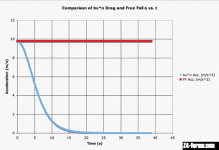
Step back from the trees. It's all in NASA link. View it along side the graph for how a body accelerates. I hope that helps your eventual understanding.

https://www.grc.nasa.gov/WWW/K-12/airplane/termv.html

freefall vs drag.gif

I'm at a bit of a loss to explain it any more simply than they do. :cry:
 
MrPT said:
BMWZ4MC said:
I say that two otherwise identical bodies of different density (and so different mass) will accelerate at the same rate.

So, [ref]Pbondar[/ref], do you still refute this? BMWZ4MC seems to have “chosen life” now, so I’m picking up his drum and banging it. :)

You’ve quoted a lot of terminal velocity stuff, but the above isn’t about tv. It’s two aerodynamically identical bodies of different masses (one Z4 without driver and spare wheel; one with) accelerating in free fall, i.e. below the point at which - and you’ve said a lot about this yourself but the point is moot - the accelerative force equals drag. You can only solve for this force via purely observational means at tv, which is what the NASA page is about.

At school they teach you that this will confuse people because it’s counterintuitive (using the Galileo/Aristotle example). You spend ages arguing with the teacher about it and begrudgingly admit defeat. And then at uni, once equipped with this insight, you’re told to stop using Newton’s laws because they aren’t quite right. So you turn to drink as the only way forward...

I'm not sure why I keep on this..must be bored with desk work..

To address your points:

Newton's 2nd law of motion states force=mass x acceleration so BMWZ4MC is either correct (I say that two otherwise identical bodies of different density (and so different mass) will accelerate at the same rate.) and the rest of the world is wrong and has been for a very long time and all computations for space flight / ballistics have just been lucky..

His misunderstanding is that gravity is not acting on the two objects with equal force..the gravitational pull varies based on its mass.. the result of this ratio of gravitational pull to mass results in the constant of 32 feet per second per second..

So, in a vacuum, the feather has less force pulling it down than the lead ball, but, that neatly is offset by the 2nd law of Newtonian mechanics.. so the mass varies, the force varies but the net result is that they accelerate at the same rate ie 32 feet per sec per sec on earth, slower on the moon..

On the earth in air, drag ruins it all as it affects the two identical objects of differnet mass (in BMWZ4MCs example) because whilst the drag remains the same for both objects gravity is acting on the heavier version with more force..that force overides the drag for a longer period than the lighter object of the same shape..

So the golf ball hits a higher terminal speed because its heavier than the ping ball.. the dimples do have an effect but that's a second order calculation.

At school I didn't argue the with the teacher..

At university (where I studied Solid State Physics and Computing) it did make my brain hurt trying to understand how a photon can behave like a wave and/or a particle and has mass.. ion drive anyone? .. I did resort to Theakston's Old Peculiar at times but that wasn't anything to do with course work..
 
Not quite uk, but nice road with history, if you exit the roundabout at 40 ish you should be ok before you get to the other end.
Good enough for stirling moss ,so you should be ok.
 

Attachments

  • Screenshot_20201117-124232_Maps.jpg
    Screenshot_20201117-124232_Maps.jpg
    87 KB · Views: 364
AlienZed said:
Not quite uk, but nice road with history, if you exit the roundabout at 40 ish you should be ok before you get to the other end.
Good enough for stirling moss ,so you should be ok.

OK, so how come, according to that, it'll take you 25 minutes to walk it, but only two minutes if you're carrying a case and waving to someone. Is it all to do with the mass of the case, or the increased area of your raised arm. :D
 
buzyg said:
The acceleration has to reduce over time or the object would never reach terminal velocity. This applies to a car falling off a cliff. if you accept that terminal velocity is governed by weight as one of it's components, as you say you do. Then this graph demonstrates how that terminal velocity requires a change in acceleration before it is reached. Therefore if you add a driver to the car, falling from beachy head, then it will hit the beach sooner. Than with out him on board. All other things being equal.

I've used the links you provided - thank you - and plugged in the numbers for an E89-ish car (0.34Cd, 1525kg, 0.6m^2) with and without driver off Beachy Head. The difference is not a lot (3cm), but the effect of additional drag is more than I would have thought over such a small distance! By the same logic, you'd need a couple of kms drop to see a car length's difference. So apologies, I stand corrected and have learned something. :)
 
MrPT said:
buzyg said:
The acceleration has to reduce over time or the object would never reach terminal velocity. This applies to a car falling off a cliff. if you accept that terminal velocity is governed by weight as one of it's components, as you say you do. Then this graph demonstrates how that terminal velocity requires a change in acceleration before it is reached. Therefore if you add a driver to the car, falling from beachy head, then it will hit the beach sooner. Than with out him on board. All other things being equal.

I've used the links you provided - thank you - and plugged in the numbers for an E89-ish car (0.34Cd, 1525kg, 0.6m^2) with and without driver off Beachy Head. The difference is not a lot (3cm), but the effect of additional drag is more than I would have thought over such a small distance! By the same logic, you'd need a couple of kms drop to see a car length's difference. So apologies, I stand corrected. :)
A fine acknowledgement sir. The earth is indeed round. :thumbsup:
 
Pbondar said:
On the earth in air, drag ruins it all as it affects the two identical objects of differnet mass (in BMWZ4MCs example) because whilst the drag remains the same for both objects gravity is acting on the heavier version with more force..that force overides the drag for a longer period than the lighter object of the same shape..

Ok, had a further think about this, and while I appreciate now that you can't ignore air resistance if you are having a freefall Z4 race off Beachy Head (with very good timing gear :D), I still don't understand the above.

Drag (force due to air resistance) remains the same for identical objects of different mass - yep
Gravity acts on the heavier version with more force - yep
That force overrides the drag for a longer period of time than for the lighter object - yes, but this only explains the higher terminal velocity, it doesn't directly explain why there are different rates of change of acceleration in the first place.

The acceleration due to gravity is the same as it would be in a vacuum (i.e. constant because mass nets out when you account for inertia). It's the effect of the drag force that causes the differing rates of change of acceleration. The force is the same for both objects but the lighter object has less inertia. Right? :?
 
Back
Top Bottom