
You are using an out of date browser. It may not display this or other websites correctly.
You should upgrade or use an alternative browser.
You should upgrade or use an alternative browser.
Anywhere in the UK you can take your Zed to see what it will do?
A
Anonymous
Guest
BMWZ4MC said:Buzy, I’m not being stubborn, I’d like to be educated so please explain!
Dropped not thrown off Beachy Head, John. To avoid ambiguity, let’s use a 10m cliff instead so there is no risk of reaching terminal velocity. I’m saying that the rate of acceleration and velocity attained over that 10m will be the same for both oil drums.
If you drop them from a ‘plane at 1000m then the drum of lead will continue to accelerate after the polystyrene-filled drum has reached a constant velocity. Subsequently, the heavier drum will also reach a constant velocity which will be greater than that of the lighter drum.
Your first statement is incorrect...you could say, that a first order approximation over 10m is that two different density objects of identical shape and volume would accelerate at the same rate..but that’s because you can’t be bothered / or doesn’t matter the small delta difference ..that’s your choice...
Then perversely you then agree that it does change with density in the second statement....

The laws of Newtonian mechanics remain the same whether you reached terminal velocity or not...
The equation can be easily re-arranged to calculate the speed an oil drum with any mass would reach over a prescribed distance..
To return to and summarise the original Beachy Head point...
You wouldn’t reach terminal velocity over the available distance..
Assuming the descent attitude of the car was stable the speed at which you would hit the ground would be much higher if you went nose first as CdA x area is around 0.35 x 2.5sq m = 0.875 vs 0.95 x 10 = 9.5...so basically 10 times more drag going bottom of car down vs nose down..
If you threw a dart off the cliff versus a coin shape of the same mass the dart would be travelling faster and hit the ground sooner than the coin...
I hope that helps...
Pbondar said:BMWZ4MC said:Buzy, I’m not being stubborn, I’d like to be educated so please explain!
Dropped not thrown off Beachy Head, John. To avoid ambiguity, let’s use a 10m cliff instead so there is no risk of reaching terminal velocity. I’m saying that the rate of acceleration and velocity attained over that 10m will be the same for both oil drums.
If you drop them from a ‘plane at 1000m then the drum of lead will continue to accelerate after the polystyrene-filled drum has reached a constant velocity. Subsequently, the heavier drum will also reach a constant velocity which will be greater than that of the lighter drum.
Your first statement is incorrect...you could say, that a first order approximation over 10m is that two different density objects of identical shape and volume would accelerate at the same rate..but that’s because you can’t be bothered / or doesn’t matter the small delta difference ..that’s your choice...
Then perversely you then agree that it does change with density in the second statement....
The laws of Newtonian mechanics remain the same whether you reached terminal velocity or not...
The equation can be easily re-arranged to calculate the speed an oil drum with any mass would reach over a prescribed distance..
To return to and summarise the original Beachy Head point...
You wouldn’t reach terminal velocity over the available distance..
Assuming the descent attitude of the car was stable the speed at which you would hit the ground would be much higher if you went nose first as CdA x area is around 0.35 x 2.5sq m = 0.875 vs 0.95 x 10 = 9.5...so basically 10 times more drag going bottom of car down vs nose down..
If you threw a dart off the cliff versus a coin shape of the same mass the dart would be travelling faster and hit the ground sooner than the coin...
I hope that helps...
My 3 candles hit the floor at exactly the same time from 6ft.....explain
A
Anonymous
Guest
John-89...
Several reasons.......
Within your ability with your timing equipment ..
At the distance travel given the speed attained by the candles drag was a negligible factor
You doubled the mass of one group but you double the drag area so you would expect them broadly to fall at the same rate
You need more precision from your timing gear...suggest you use an atomic clock..or a GPS..
Several reasons.......
Within your ability with your timing equipment ..
At the distance travel given the speed attained by the candles drag was a negligible factor
You doubled the mass of one group but you double the drag area so you would expect them broadly to fall at the same rate
You need more precision from your timing gear...suggest you use an atomic clock..or a GPS..
Pbondar said:John-89...
Several reasons.......
Within your ability with your timing equipment ..
At the distance travel given the speed attained by the candles drag was a negligible factor
You doubled the mass of one group but you double the drag area so you would expect them broadly to fall at the same rate
You need more precision from your timing gear...suggest you use an atomic clock..or a GPS..
I didn’t double the drag area, I dropped them both from the position you would light them. I thought we were talking about objects that don’t reach terminal velocity, Ok I have no idea of these candles reached it or not from 6ft, I’ll happily drop them again from a lower height or a higher one ok.


BMWZ4MC is right. Mass isn't in the drag equation and that's what you're bound by below tv (all other things being constant).
The only way a driver and spare wheel would make a difference would be if the roof was down, the driver was wearing a sombrero and the wheel was attached "Monte Carlo or Bust!"-style.
The only way a driver and spare wheel would make a difference would be if the roof was down, the driver was wearing a sombrero and the wheel was attached "Monte Carlo or Bust!"-style.

Ok lets try and make a real world example that works for us all and explains this. Take a golf ball and a ping pong ball and drop them 10m. The golf ball will reach the ground first. Even before the ping pong ball reaches it's terminal velocity the golf ball will be ahead. The only possible explanation for this is the golf ball has accelerated faster. This is because regardless of their similar shape and size, the golf ball is heavier.
It's the air resistance due to the density of the atmosphere that is effecting the result so it's easier to see with a huge difference in weight, but the same applies, in an atmosphere for any difference in the weight. it's just hard to measure.
Try it in the bath, starting at the bottom for an even easier to see result. The ping pong ball has the same forces acting on it as the golf ball, but in this case the force upward is greater than that down ward, so guess what happens. Or try it with a football and a helium balloon.
If you still don't think the relative weight of the two objects effects the acceleration in an atmosphere then I'm running out of ways to show you. So please just go back to the NASA equation, it's all there for acceleration as well as terminal velocity.
As per my earlier post. It's about two opposing forces, one up and one down. The equation for force is mass x acceleration. If you change the mass, all other things being equal. the acceleration has to change to balance the equation.
It's the air resistance due to the density of the atmosphere that is effecting the result so it's easier to see with a huge difference in weight, but the same applies, in an atmosphere for any difference in the weight. it's just hard to measure.
Try it in the bath, starting at the bottom for an even easier to see result. The ping pong ball has the same forces acting on it as the golf ball, but in this case the force upward is greater than that down ward, so guess what happens. Or try it with a football and a helium balloon.
If you still don't think the relative weight of the two objects effects the acceleration in an atmosphere then I'm running out of ways to show you. So please just go back to the NASA equation, it's all there for acceleration as well as terminal velocity.
As per my earlier post. It's about two opposing forces, one up and one down. The equation for force is mass x acceleration. If you change the mass, all other things being equal. the acceleration has to change to balance the equation.
As it indeed would. At first the driver would feel weightless in the car, however as the rate of acceleration reduced, due to the air pushing upward, the driver would start to feel their weight within the vehicle. At this point all the way to the beach the extra weight of the driver increases the downward force slightly and therefore the acceleration, relative to if they where not present. Doesn't help them much though as the change in medium density at the beach creates a bit of a mess.MrPT said:You were talking about the mass of a driver and spare wheel in a falling car making a difference.
Can we do wave theory next week. I enjoy that too being an ex surfer.

The ping pong thing, maybe - ping pong balls are draggy as they don’t have dimples - but with the first example, all the masses net out apart from the mass of the air (which is assumed to be constant). Even the mass of the earth nets out, it’s just supermassive relative to a car so only moves a super-tiny amount.
Drag is the only thing that matters up to tv. Drag is independent of mass.
Drag is the only thing that matters up to tv. Drag is independent of mass.
buzyg said:As it indeed would. At first the driver would feel weightless in the car, however as the rate of acceleration reduced, due to the air pushing upward, the driver would start to feel their weight within the vehicle. At this point all the way to the beach the extra weight of the driver increases the downward force slightly and therefore the acceleration, relative to if they where not present. Doesn't help them much though as the change in medium density at the beach creates a bit of a mess.MrPT said:You were talking about the mass of a driver and spare wheel in a falling car making a difference.
Can we do wave theory next week. I enjoy that too being an ex surfer.
Neither of us are going out in that Buzy.....not unless we want to discuss at first hand, drowning.....

Attachments

A
Anonymous
Guest
This failure to understand and/or accept a drag / acceleration equation reminds me of the flat earth society..
Mass or density of an object always affects the acceleration profile
A large spaceship takes more fuel to accelerate than a smaller ship even in a vacuum..
On the moon gravity accelerates all objects at the same rate because the force acting on it exactly balances the mass..so the force accelerating the feather is less than the gravitational force accelerating the lead weight...you just can’t see it / feel it..
If you accelerate a car horizontally the heavier the car the slower the rate of acceleration..until drag and rolling resistance equals power produced then that’s the terminal velocity...so a heavier car takes a longer distance to get to terminal velocity than a lighter car..
If you drop the car of a cliff it’s exactly the same set of equations...the difference is gravity accelerates all objects at the same rate but the force created is directly related to the mass ..by definition a 1 tonne car is pressing downwards by twice the force of a 0.5 tonne car..
Terminal velocity is when the total drag equals the force ..so a 1 tonne car will always reach a higher terminal velocity than a 0.5 tonne car assuming drag coefficient multiplied by surface area are the same..
Because drag is a square law function, like many concepts (COVID virus replication) does not become apparent until it’s really making an obvious impact..
Mass or density of an object always affects the acceleration profile
A large spaceship takes more fuel to accelerate than a smaller ship even in a vacuum..
On the moon gravity accelerates all objects at the same rate because the force acting on it exactly balances the mass..so the force accelerating the feather is less than the gravitational force accelerating the lead weight...you just can’t see it / feel it..
If you accelerate a car horizontally the heavier the car the slower the rate of acceleration..until drag and rolling resistance equals power produced then that’s the terminal velocity...so a heavier car takes a longer distance to get to terminal velocity than a lighter car..
If you drop the car of a cliff it’s exactly the same set of equations...the difference is gravity accelerates all objects at the same rate but the force created is directly related to the mass ..by definition a 1 tonne car is pressing downwards by twice the force of a 0.5 tonne car..
Terminal velocity is when the total drag equals the force ..so a 1 tonne car will always reach a higher terminal velocity than a 0.5 tonne car assuming drag coefficient multiplied by surface area are the same..
Because drag is a square law function, like many concepts (COVID virus replication) does not become apparent until it’s really making an obvious impact..
BMWZ4MC said:I say that two otherwise identical bodies of different density (and so different mass) will accelerate at the same rate.
So, [ref]Pbondar[/ref], do you still refute this? BMWZ4MC seems to have “chosen life” now, so I’m picking up his drum and banging it.

You’ve quoted a lot of terminal velocity stuff, but the above isn’t about tv. It’s two aerodynamically identical bodies of different masses (one Z4 without driver and spare wheel; one with) accelerating in free fall, i.e. below the point at which - and you’ve said a lot about this yourself but the point is moot - the accelerative force equals drag. You can only solve for this force via purely observational means at tv, which is what the NASA page is about.
At school they teach you that this will confuse people because it’s counterintuitive (using the Galileo/Aristotle example). You spend ages arguing with the teacher about it and begrudgingly admit defeat. And then at uni, once equipped with this insight, you’re told to stop using Newton’s laws because they aren’t quite right. So you turn to drink as the only way forward...

BMWZ4MC said:I say that two otherwise identical bodies of different density (and so different mass) will accelerate at the same rate.
Pbondar said:...If you drop the car of a cliff it’s exactly the same set of equations... the difference is gravity accelerates all objects at the same rate but the force created is directly related to the mass ..by definition a 1 tonne car is pressing downwards by twice the force of a 0.5 tonne car..

The flat earth society where eventually turned. So it shall be here. Education matters. :wink:MrPT said:BMWZ4MC said:I say that two otherwise identical bodies of different density (and so different mass) will accelerate at the same rate.
So, [ref]Pbondar[/ref], do you still refute this? BMWZ4MC seems to have “chosen life” now, so I’m picking up his drum and banging it.
You’ve quoted a lot of terminal velocity stuff, but the above isn’t about tv. It’s two aerodynamically identical bodies of different masses (one Z4 without driver and spare wheel; one with) accelerating in free fall, i.e. below the point at which - and you’ve said a lot about this yourself but the point is moot - the accelerative force equals drag. You can only solve for this force via purely observational means at tv, which is what the NASA page is about.
At school they teach you that this will confuse people because it’s counterintuitive (using the Galileo/Aristotle example). You spend ages arguing with the teacher about it and begrudgingly admit defeat. And then at uni, once equipped with this insight, you’re told to stop using Newton’s laws because they aren’t quite right. So you turn to drink as the only way forward...
If you feel the mood there is a full proof in the link below. Though the original NASA link is also a full proof, but folk don't seem to get it.
http://www.batesville.k12.in.us/physics/APPhyNet/Dynamics/Newton%27s%20Laws/air_resistance/spsheet_solution.htm
The graph shows the change in acceleration of and object due to drag.
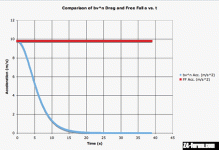
The acceleration has to reduce over time or the object would never reach terminal velocity. This applies to a car falling off a cliff. if you accept that terminal velocity is governed by weight as one of it's components, as you say you do. Then this graph demonstrates how that terminal velocity requires a change in acceleration before it is reached. Therefore if you add a driver to the car, falling from beachy head, then it will hit the beach sooner. Than with out him on board. All other things being equal.
That is an amazing photo. I have surfed some big waves in my time, probably the some of biggest the UK can offer. But that is in a different league all together. 8)john-e89 said:buzyg said:As it indeed would. At first the driver would feel weightless in the car, however as the rate of acceleration reduced, due to the air pushing upward, the driver would start to feel their weight within the vehicle. At this point all the way to the beach the extra weight of the driver increases the downward force slightly and therefore the acceleration, relative to if they where not present. Doesn't help them much though as the change in medium density at the beach creates a bit of a mess.MrPT said:You were talking about the mass of a driver and spare wheel in a falling car making a difference.
Can we do wave theory next week. I enjoy that too being an ex surfer.
Neither of us are going out in that Buzy.....not unless we want to discuss at first hand, drowning.....