Undercar Aerodynamics

I think smoothing the flow and directing it towards a rear diffuser is a good thing, but as dario states you also need to help the front too.

Lift is a function of a velocity difference between two surfaces, air over the top of the car is always going to be faster than that underneath.
 
toplad said:
Always interested to read your post exdos

You mention you don't want front lip but due to reduced ground clearance, but have you thought of making a flat front lip. The thinking being when the air hits the front of the car it can either go over the bonnet or under the car, with a protruding lip a larger proportion of the air is directed to the lip and veers off to either side instead. This will help reduce air flow under the car without a doubt, it's a bit DTM style, but won't reduce ground clearance
Like this

http://www.zpost.com/forums/showthread.php?t=403119&highlight=Front+lip&page=11

I have a personal rule that I will not break when modding and that is I won't damage any original OEM part unless I have the same part as a spare. If I can obtain another ///M bumper, I will happily make a front splitter, possibly like the one in the link, where I can strengthen the bumper and make points of attachments behind the bumper. :thumbsup:

stlymch said:
At university we were always told that trying to direct air using any more than a 13 degree angle is futile as it will prefer to just skip over what ever is in the way and cause more turbulence. Taking this into consideration I would think that the 45 degree pieces you've added behind the front wheels will not be doing anything of use. Perhaps you would be better off extending the side skirt starting at the inside of the front wheel and extending backwards at a 13 degree angle until it reaches the outside of the car. This would straighten up the turbulence caused by the front wheels and also force the air around the outside of the car thus creating a lower pressure under the car which is always good for down force.

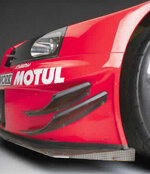
I've heard that, but what about canards like this?

Canards_03.jpg

I've not had chance to take the car out in the wet with all these parts and I think the spray patterns on the car will help me see what really happens.

sars said:
I think smoothing the flow and directing it towards a rear diffuser is a good thing, but as dario states you also need to help the front too.

Lift is a function of a velocity difference between two surfaces, air over the top of the car is always going to be faster than that underneath.

As you say, the air travelling over the top of the car is always going to be faster than beneath. Therefore, what I'm hoping to achieve is to minimize the speed difference by attempting to make the air travel in a direct line from front to rear (i.e. the shortest path). As I see it, the 4 strakes at the rear of the car act will act like 4 rudders which tend to keep the car travelling in a straight line and the air passing between the strakes will be less turbulent than without them, consequently the turbulence in the wake of the moving car will happen at a point further behind the rear bumper than would normally occur. If this actually happens, then this will lessen the difference in speeds of airflow over and under the car, thus reducing aerodynamic lift.
 
Ex,

have you considered adding the APR wing? Lots of nice feedback from the peeps that had that on their rides. Not to deer either, and adds to the overall look. Anyways, I love what your doing underneath. : )
 
exdos, the air travels faster on the low pressure side because it has further to go, think of it like a wheel the larger the diameter the faster a point on the outside of the wheel travels given the same rpm. Making the floor flat doesn't increase the velocity of the air, just makes the flow less turbulent so you can do something productive with it
 
Vanne said:
Ex,

have you considered adding the APR wing? Lots of nice feedback from the peeps that had that on their rides. Not to deer either, and adds to the overall look. Anyways, I love what your doing underneath. : )

Vanne, I have considered fitting a rear wing but as I've said, I don't want to drill my hatch door to do this. I have considered buying a second-hand hatch to do this, but all of those that I've seen come stripped of internal plastics and lock etc, and I wouldn't want to mess with my original hatch.
 
sars said:
exdos, the air travels faster on the low pressure side because it has further to go, think of it like a wheel the larger the diameter the faster a point on the outside of the wheel travels given the same rpm. Making the floor flat doesn't increase the velocity of the air, just makes the flow less turbulent so you can do something productive with it
Sars, Thanks for your input. :thumbsup:

I understand precisely what you are saying. As I see this project, even if/when I fit a front spoiler and rear wing, the work I've been doing under the car should help those parts to work better. Hopefully, I will also have reduced drag a little too?

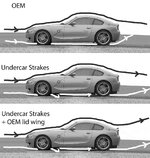
I've knocked up 3 diagrams for comparison regarding the point you've made, as below. The middle diagram shows what I'm hoping to achieve with my under car mods. What I said in my earlier reply to you was "consequently the turbulence in the wake of the moving car will happen at a point further behind the rear bumper than would normally occur. If this actually happens, then this will lessen the difference in speeds of airflow over and under the car, thus reducing aerodynamic lift". If the air does travel faster under the car with these mods, then the distance that the air travelling behind the car must increase before reuniting with the air travelling above the car and will be relatively further than it is OEM. Please note my use of the word "if"! So, if this does happen then the speed difference between over/under car airflows will be less, so aerodynamic lift would be less.

In the last diagram, I've added the BMW OEM tail wing (i.e. Gurney flap) , and I know a lot of people think these are merely cosmetic parts, but I think that they must really work in the way that I've shown in the diagram. If this is the case then this would work along the lines I've just described, thus reducing aerodynamic lift.

I'd appreciate your comments.

aerowing_zpsd45115b6.jpg
 
stlymch said:
At university we were always told that trying to direct air using any more than a 13 degree angle is futile as it will prefer to just skip over what ever is in the way and cause more turbulence. Taking this into consideration I would think that the 45 degree pieces you've added behind the front wheels will not be doing anything of use. Perhaps you would be better off extending the side skirt starting at the inside of the front wheel and extending backwards at a 13 degree angle until it reaches the outside of the car. This would straighten up the turbulence caused by the front wheels and also force the air around the outside of the car thus creating a lower pressure under the car which is always good for down force.

The 13 degree you mention is about the limit angle of attack relative to air flow before the boundary layer comes away from the surface and produces less lift and stalls the wing,/aero equipment, that's not related to Exdos's aero pieces.
This is about directing airflow which can be done at different angles above or below 13 degrees
 
toplad said:
stlymch said:
At university we were always told that trying to direct air using any more than a 13 degree angle is futile as it will prefer to just skip over what ever is in the way and cause more turbulence. Taking this into consideration I would think that the 45 degree pieces you've added behind the front wheels will not be doing anything of use. Perhaps you would be better off extending the side skirt starting at the inside of the front wheel and extending backwards at a 13 degree angle until it reaches the outside of the car. This would straighten up the turbulence caused by the front wheels and also force the air around the outside of the car thus creating a lower pressure under the car which is always good for down force.

The 13 degree you mention is about the limit angle of attack relative to air flow before the boundary layer comes away from the surface and produces less lift and stalls the wing,/aero equipment, that's not related to Exdos's aero pieces.
This is about directing airflow which can be done at different angles above or below 13 degrees

I disagree. At the speeds where lift becomes an issue, those 45 degree angle pieces will deffinately not be directing air as you expect because the boundary layer will have separated and air will just be skipping over them and will be squished into the ground which is more likely to give you lift and drag. I suggest you guys read some hucho books before adding these things to your car.
 
stlymch said:
toplad said:
stlymch said:
At university we were always told that trying to direct air using any more than a 13 degree angle is futile as it will prefer to just skip over what ever is in the way and cause more turbulence. Taking this into consideration I would think that the 45 degree pieces you've added behind the front wheels will not be doing anything of use. Perhaps you would be better off extending the side skirt starting at the inside of the front wheel and extending backwards at a 13 degree angle until it reaches the outside of the car. This would straighten up the turbulence caused by the front wheels and also force the air around the outside of the car thus creating a lower pressure under the car which is always good for down force.

The 13 degree you mention is about the limit angle of attack relative to air flow before the boundary layer comes away from the surface and produces less lift and stalls the wing,/aero equipment, that's not related to Exdos's aero pieces.
This is about directing airflow which can be done at different angles above or below 13 degrees

I disagree. At the speeds where lift becomes an issue, those 45 degree angle pieces will deffinately not be directing air as you expect because the boundary layer will have separated and air will just be skipping over them and will be squished into the ground which is more likely to give you lift and drag. I suggest you guys read some hucho books before adding these things to your car.

Of course there will be some lift and drag, but the quoted 13 degrees is more to do with spoiling airflow of a wing isn't. Not all aero parts. If that's the case why do race teams with massive budgets, wind tunnels and very intelligent individuals produce and install aerodynamic accoutrements which angles above and below 13 degrees

Btw the way how do you know any of us haven't read hucho's book on car aero?

Us pilots know a thing about aerodynamics too :-)
 
Interesting discussion going on about 13degrees of separation I'm just waiting for Kevin Bacon to appear :)
you won't know until it can be visualised, however, I would go with the "probability" of what top lad is saying that the vanes are acting turning vanes and is in an area of what is probably already turbulent air as opposed to clean laminar flow that you'd associate with aerofoils, not ideal conditions like the LFA Undertray but the vanes should still contribute to directing air...

Would still love to try the gopros and smoke gen to see the flow under the car at speed :P
 
exdos said:
You're on the same page as me with this idea. I might make my own longer version of the OEM rubber airdam part.

The thing about the wheelhouses is that you want to create low pressure within them otherwise they generate aerodynamic lift, therefore getting the air out of them is important as well as maintaining a flow for brake cooling. When I was testing after only fitting the front end parts, I noticed that after a run, the front tyres were warmer than the rears, when normally the rears are usually warmer. Is that evidence of improved front end grip (i.e. less lift) and/or increased cornering forces.

I was thinking of extending what you already have to close off the wheel wells a bit more from the centre part of the car-I guess leaving the rear edge of the wells open should mean it can still exit cleanly enough but it's such a complicated area that short of a wind tunnel or hundreds of bits of string tied under the car and a sacrificial go-pro it will be difficult to know for sure.

How much string have you got lying around exdos..... :poke:
 
exdos said:
beanie said:
Perhaps you could try extending the front 'air dam' a little ( the small lip thats set back under the front bumper) instead of going the splitter route. Might be a good idea to fence-in the wheel wells and sills a little more too in order to better control the air.

You're on the same page as me with this idea. I might make my own longer version of the OEM rubber airdam part.

The thing about the wheelhouses is that you want to create low pressure within them otherwise they generate aerodynamic lift, therefore getting the air out of them is important as well as maintaining a flow for brake cooling. When I was testing after only fitting the front end parts, I noticed that after a run, the front tyres were warmer than the rears, when normally the rears are usually warmer. Is that evidence of improved front end grip (i.e. less lift) and/or increased cornering forces.

It would be impressive if you'd managed to improve front end grip which yields an increase in tire temp already. Maybe less cold air swilling around the arch plays a part.
The chaps with flat lips installed have mentioned the the front of the car grounds more over certain roads/tracks, which is a good indicator
All interesting stuff, top work :-)
 
Great drawings

Focusing on the under tray first, smoothing and directing flow is all well and good but you have to make use of it afterwards with a decent diffuser. Diffusers gradually increase the volume along their length which causes air to expand, travel faster and thus pressure drops. If you add a decent diffuser then you will have to use in coming air at the front to increase downforce too. The picture you supplied of the front of a race car previously is a great example of what's needed. Just smoothing under flow will not reduce lift per se, but will make your car easier to move through air at speed (drag). Wheels create lots of turbulence and directing air away from them is indeed desirable.

Spoilers do exactly that they spoil the flow over a surface that follows, however they also increase drag, there is some benefit in fitting a rear spoiler on cars, the turbulence created by a spoiler can reduce the wake effect behind the car. That is when a body moves through air it leaves a lower pressure zone behind which in effect sucks the car back, filling that void with turbulent air reduces the effect. However what works with your car is the difficult part. Dependant on size of spoiler there can also be some increase in down force, though at the cost of increased drag. Aero foils are better at producing downforce.

What I'm trying to say is that you need to decide what you want to achieve and to achieve that is going to cost you somewhere else. Ultimately anything that makes your car significantly more efficient below is going to come at the cost of ground clearance.

As I have been writing this, it has occurred to me why not fit a diffuser to each side starting from the front and ending just behind the wheel facing out, hmmmmmm.......

Feel some simulations coming and that really is the crux, to do it properly, your car that is, you could spend a fortune on trying different bits and configurations, however a few days on Ansys :D
 
sars said:
As I have been writing this, it has occurred to me why not fit a diffuser to each side starting from the front and ending just behind the wheel facing out, hmmmmmm.......

Feel some simulations coming and that really is the crux, to do it properly, your car that is, you could spend a fortune on trying different bits and configurations, however a few days on Ansys :D

I am afraid you're not a pioneer of this idea ;P as whole underbody diffusers are popular among racecars
Here's a picture of seat leon supercopa diffuser:
images

Actually shortens the lap time for moreless 1 second on moderatelly fast 3,0km track

Here you can see a solution for a roadcar, particulary honda s2000:
2422L.jpg


And a front section only of lancer evo:
img0207s.jpg


And one more complete solution (not sure for what car):
ReynardFloorrA6J4mSW.jpg


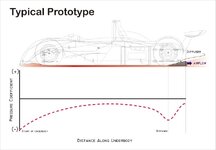
And here's a simplified graph of how and what you would like to achieve while designing an underbody diffuser
diffuser5.jpg

There are actually two drawbacks on this solution:
1. cost
2. lowering the car which can be hard to use as a daily driver (you want to "seal" the front by adding a lowering front lip and side skirts, to force the air to flow under the whole lenght of the car.

I don't know if only directing the flow of air under the z4 floor will make any difference, we have to wait for exodos to report back
 
McKoval said:
sars said:
As I have been writing this, it has occurred to me why not fit a diffuser to each side starting from the front and ending just behind the wheel facing out, hmmmmmm.......

Feel some simulations coming and that really is the crux, to do it properly, your car that is, you could spend a fortune on trying different bits and configurations, however a few days on Ansys :D

I am afraid you're not a pioneer of this idea ;P as whole underbody diffusers are popular among racecars
Here's a picture of seat leon supercopa diffuser:
images

Actually shortens the lap time for moreless 1 second on moderatelly fast 3,0km track

Booo, thought I might have a new job at McLaren
 
stlymch said:
I disagree. At the speeds where lift becomes an issue, those 45 degree angle pieces will deffinately not be directing air as you expect because the boundary layer will have separated and air will just be skipping over them and will be squished into the ground which is more likely to give you lift and drag. I suggest you guys read some hucho books before adding these things to your car.

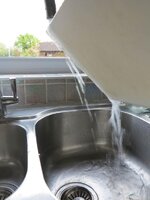
In the case of mud flaps which extend below the level of the cills, and placed at 90 degrees to the direction of the wheel rotation, you're definitely right. However, I can't yet see why air hitting a surface angled at 45 degrees will not be deflected sideways in the same way that a hovercraft rudder works. Since you've questioned this, I've also tested this with air and water against a flat plate and it definitely gets deflected sideways and rearwards. My photo below shows how it works, and water even attaches itself to the other side. The deflectors that I've made can be adjusted, and I'll probably settle on a cambered wing shape which should help to evacuate air from under the car.

waterhittimgboard_zpse1144c76.jpg

From all the literature that I've been able to find, the studies of airflow in and around the wheelhouse focus entirely on just one wheelhouse in isolation, when we know that cars have a rear wheel following behind a front wheel. Therefore, for me, experimentation has a place.

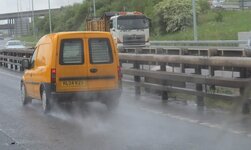
Here's a photo of the spray pattern behind the wheels of a vehicle.

Spraypattern_zpsb7bc70df.jpg

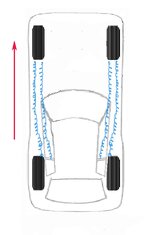
If you watch vehicles in the wet, for most vehicles, the spray leaving from behind the front wheel gets swept inwards as in my diagram below, and my front wheel deflector part is intended to redirect the jetting vortices so that they take a wider path and act as a curtain to prevent air getting under the rear of the car. My rear deflector part hopefully prevents air getting more inboard than it would normally do without the deflector.

sidevortex_zpsf9ccc727.jpg

sars said:
Great drawings

Focusing on the under tray first, smoothing and directing flow is all well and good but you have to make use of it afterwards with a decent diffuser. Diffusers gradually increase the volume along their length which causes air to expand, travel faster and thus pressure drops. If you add a decent diffuser then you will have to use in coming air at the front to increase downforce too. The picture you supplied of the front of a race car previously is a great example of what's needed. Just smoothing under flow will not reduce lift per se, but will make your car easier to move through air at speed (drag). Wheels create lots of turbulence and directing air away from them is indeed desirable.

Spoilers do exactly that they spoil the flow over a surface that follows, however they also increase drag, there is some benefit in fitting a rear spoiler on cars, the turbulence created by a spoiler can reduce the wake effect behind the car. That is when a body moves through air it leaves a lower pressure zone behind which in effect sucks the car back, filling that void with turbulent air reduces the effect. However what works with your car is the difficult part. Dependant on size of spoiler there can also be some increase in down force, though at the cost of increased drag. Aero foils are better at producing downforce.

What I'm trying to say is that you need to decide what you want to achieve and to achieve that is going to cost you somewhere else. Ultimately anything that makes your car significantly more efficient below is going to come at the cost of ground clearance.

As I have been writing this, it has occurred to me why not fit a diffuser to each side starting from the front and ending just behind the wheel facing out, hmmmmmm.......

Feel some simulations coming and that really is the crux, to do it properly, your car that is, you could spend a fortune on trying different bits and configurations, however a few days on Ansys :D

The Z4M already has a basic OEM diffuser in-between the two silencers. My two central rear strakes, by descending further downwards towards the road, should help to increase the volume of air that must pass through this area, which should make the OEM diffuser more effective. Likewise, each silencers has a strake on each longitudinal side, which also ensures that air passing beneath the silencers must pass over the domed shape: this will create a Coanda effect under both silencers, which will both increase the speed of air beneath the silencers and also produce low pressure in this area. As I see it, fitting long strakes at the rear of the car should help to reduce lift.

I have now done mods of this type to two different cars and having experienced the way that both cars handle with longitudinal strakes, they definitely make the car feel very stable at higher speeds. The way that I think of this is that the underside of a car with strakes is somewhat analogous to a speedboat which also has longitudinal strakes on the hull, and these give a speedboat directional stability. If the air under a car can be longitudinally "straightened", even if there is still some turbulence beneath the car, at least the turbulence is parallel to direction the car is travelling. I've not seen anything in the literature about this subject as yet.
 
Exdos,

As I understand it, at low speed your explanation of what happens to air stands true. But above say 70, I don't think things happen the way you think they will anymore.
If you say they have deffinately improved the handling then I would ask what you have sacrificed for this gain? Almost certainly more drag and probably a less stable car in strong side winds.
I still believe you would see a bigger improvement by adding a side skirt starting at the inside of your front wheel, trailing rearward at a 13 degree angle towards the outside of the rear wheel. This will force the turbulent air from the front wheel to reattach to the side of the car and also allow any air under the car to expand and therefore increase in velocity as it passes through to the diffuser. The faster the air entering your diffuser section the more "free" down force you will get.
 
stlymch said:
Exdos,

As I understand it, at low speed your explanation of what happens to air stands true. But above say 70, I don't think things happen the way you think they will anymore.

Why would around 70mph be a critical speed which might change the aerodynamics?

stlymch said:
If you say they have deffinately improved the handling then I would ask what you have sacrificed for this gain? Almost certainly more drag and probably a less stable car in strong side winds.

Apart from the 2 parts fitted at 45 degs behind the insides of the front wheels, all the other parts are located longitudinally with a minimal total frontal area, so this shouldn't increase drag by much. However, if these parts make the air flow longitudinally under the car, then surely this should reduce turbulence under the car and consequently reduce overall drag?

With regard to side winds: if you look at the profile photo of my car in my original posting and also the one above which shows the rear strakes attached to the silencers, you'll see that those strakes are not much different in profile to the silencers, so they shouldn't really alter the side area of the car so should have minimal impact upon the performance in strong side winds.

stlymch said:
I still believe you would see a bigger improvement by adding a side skirt starting at the inside of your front wheel, trailing rearward at a 13 degree angle towards the outside of the rear wheel. This will force the turbulent air from the front wheel to reattach to the side of the car and also allow any air under the car to expand and therefore increase in velocity as it passes through to the diffuser. The faster the air entering your diffuser section the more "free" down force you will get.

Wouldn't adding side skirts create the instability in side winds that you envisage even more than the parts that I've already added? In the same way that the flexible rubber part that fits in the centre of the Z4M's OEM bumper is curved upwards in the middle for ground clearance, a side skirt on a road car would also need to be curved upwards in the middle to give ground clearance when crossing all the traffic calming junk on our roads, and that's the reason why I've fitted the parts behind the front wheels and in front of the rear wheels.
 
70 was chosen as an example no physical reason. I agree that the longitudinal sections will add little drag, my gripe is with the 45 degree sections.
It would be awesome of you to do a couple of coast down runs with and without these sections attached, this would give an indication as to how much of a difference in drag these sections are adding to your car.
I've just had a thought about the outer sections next to the exhaust, it might help to angle them outwards at 13 degrees :) thus collecting some rear wheel turbulence and allowing the hot air passing around the exhaust some expansion room. Fractions of difference in air velocity but in theory it should be an improvement :thumbsup:
 
stlymch said:
It would be awesome of you to do a couple of coast down runs with and without these sections attached, this would give an indication as to how much of a difference in drag these sections are adding to your car.

I have an ECU datalogger and already have quite a lot of data for the car. It's just a case of getting down to logging the car sometime.

stlymch said:
I've just had a thought about the outer sections next to the exhaust, it might help to angle them outwards at 13 degrees :) thus collecting some rear wheel turbulence and allowing the hot air passing around the exhaust some expansion room. Fractions of difference in air velocity but in theory it should be an improvement :thumbsup:

I see where you're coming from on this, but I expect that since these parts would be much larger than the parts behind the front wheels that if angled at even 13 degs they would increase drag. Further, as I've said in an earlier posting, I think that the 4 strakes arranged longitudinally at the rear give stability, so angling the two outer strakes would undo this somewhat.
 
Back
Top Bottom