UK "NETT ZERO" ENERGY POLICY VERY TROUBLING

axelleveau said:
MikeyH said:
I heard that they would convert gas boilers to run off hydrogen?

:rofl:

Sorry not laughing at you, laughing at the people publishign those kind of news... Doing that change will be SO complicated, and probably dangerous... And inefficient when you factor the electricity-H2-burn-water-room conversion versus electricity-heat pump 400%-room :fuelfire:
I'm a technician in the oil and gas industry and ALL new gas boilers are hydrogen ready it just requires a conversion kit which involves a replacement injector, and gas valve . The biggest issue is the water vapour in hydrogen that will corrode any non plastic gas pipes, also the pressures involved are troublesome. A test site has been built to test the feasibility but probably a 30/70 gas mix is looking like the best option at the moment.
I personally think hydrogen is also a non starter as the main byproduct of burning hydrogen is water vapour which if you research climate forcing gases is more of a greenhouse gas than co2. Conclusion......we're all doomed so get out in that Z and enjoy the pleasure of driving. :thumbsup:
 
Forgot to say......this climate stuff and its regulations and restrictions in my opinion is just a way to control society and get them to give up their God given rights and freedoms willingly through guilt and coercion.
If the last 3 years taught my anything it was this.........our government leaders are untrustworthy in deeds and actions, and "following the science " form so called government appointed scientists are no better........ :thumbsup:
 
TOMGREEN413 said:
The biggest issue is the water vapour in hydrogen
I think the biggest issue will be the infrastructure of the gas supply system. It has been woefully underfunded and is decades out of date (even for street gas), so sticking hydrogen down it is a non-starter IMHO.

There is another problem, apparently, with producing millions of tonnes of H2. It is very expensive to convert from the atmosphere. Then of course we have the additional water it produces. There are no easy answers! :)
 
axelleveau said:
And inefficient when you factor the electricity-H2-burn-water-room conversion versus electricity-heat pump 400%-room

Not sure if you were eluding to heat pumps being 400% efficient. I can assure you they are NOT. The headline figures may say they are, but only for maybe 1 day a year.

On a 'normal' winter's day in the UK, with ambient temp at around 5 deg C and humidity at 70%, they will be around 150% at most. Which practically will freeze your bollox off in your house, as the water supply temp will reduce to a useless amount where the TD is negligible!
 
Pondrew said:
TOMGREEN413 said:
The biggest issue is the water vapour in hydrogen
I think the biggest issue will be the infrastructure of the gas supply system. It has been woefully underfunded and is decades out of date (even for street gas), so sticking hydrogen down it is a non-starter IMHO.

There is another problem, apparently, with producing millions of tonnes of H2. It is very expensive to convert from the atmosphere. Then of course we have the additional water it produces. There are no easy answers! :)
I'm in total agreement with you Sir :thumbsup:
 
As far as cars are concerned the sensible way forward is cleaner engines and or synthetic fuels. This stuff is already in existence its just how to produce it cheaply.

Re the domestic stuff, read about a potential cost / issue not being mentioned in the MSM, but no doubt someone more knowledgeable will comment. If we turn off the gas completely, there may be a problem with the infrastructure that distributes the gas around the country. When not in use the pipework will overtime collapse. If this happens, imagine all the damage that would cause above the pipes. The piece I read may be scaremongering but the thought was to prevent this happening the whole system would have to be pressurised or filled in to solidify the pipes. Either way it sounds expensive if correct.
 
Pondrew said:
axelleveau said:
And inefficient when you factor the electricity-H2-burn-water-room conversion versus electricity-heat pump 400%-room

Not sure if you were eluding to heat pumps being 400% efficient. I can assure you they are NOT. The headline figures may say they are, but only for maybe 1 day a year.

On a 'normal' winter's day in the UK, with ambient temp at around 5 deg C and humidity at 70%, they will be around 150% at most. Which practically will freeze your bollox off in your house, as the water supply temp will reduce to a useless amount where the TD is negligible!

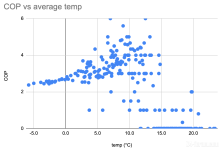
Why do you say 150% at 5C ambient? Is that based on matching the flow temperature of a typical gas boiler?

The below is about a year's worth of daily data from ours (with a fair few outliers due to the dodgy onboard metering, but the trend looks pretty clear). This is for DHW and heating; the COP for heating alone is a fair bit higher due to the lower cycling frequency.

Screenshot 2023-10-01 at 21.21.22.png

But yes, the capital outlay is hard to swallow, particularly for older houses (we had our decision made for us, somewhat, as it's a new house with no mains gas). We also had a pretty bad experience trying to get one due to the levels of hype/misinformation - silly lead times and “engineers” who didn’t really understand what they were selling.
 
MrPT said:
Why do you say 150% at 5C ambient? Is that based on matching the flow temperature of a typical gas boiler?
TBH I made it up but knowing about the way heat pumps work it was an educated guess!

My point is that ASHPs are currently the UK Govs 'go to' solution for domestic heating. They have been sold the idea that 'retrofitting' a traditional wet system to an ASHP is a 'no brainer' for their ECO remit. The reality is very, very different. Heat pumps are not really suited to a traditional radiator heating system; the supply temperatures are too low. So retrofitting increases the radiator sizes to compensate to get over the TD shortfall. It is a bodge job at best.

I built a new house a few years ago and the LABC would not entertain the idea of anything but an ASHP (especially as where it was there was no mains gas so had to be oil).

I convinced them to allow me to put in a condensing oil boiler. I did have to go down the heat recovery ventilation route to get it through building control but was worth it for many many reasons. It was much cheaper (and I can get ASHPs at trade cost) and gave utterly reliable heat no matter what the ambient conditions. That cannot be said for an ASHP. The way that a reverse cycle heat pump works (it is just a 'fridge working in reverse) is completely dependent on how efficiently it can draw heat from the ambient air and make it useful. Every day the criteria of that efficiency changes. It is basic physics. You can't change the laws of physics.

I hate ASHPs as I know they are being used for an application they were not designed for, purely to give the UK Gov 'brownie points' in their commitment to their 'climate change' protocol. It is an easy fix as far as they are concerned. It really isn't!

And you are right; they are being sold to, and by, 'plumbers' who don't have the first idea of how they work or what they do TBH. That was another mistake by the industry and the Gov.
 
ASHP,s are also very noisy apparently and take up a lot of room in your garden.

On the subject of climate change and our net zero ambitions, just returned from a holiday in the Italian Lakes. Over the week we travelled around a lot and did not see a single wind turbine, not one electric charging point on garage forecourts and diesel fuel was about 10p per litre cheaper than petrol.

Suspect the Italians have not engaged with much of this climate change stuff
 
Don’t know if anyone heard Richard Tice speech to the Reform UK conference?

The bit on Net Zero was particularly interesting and was basically as below,

We all hear about greenhouse gases and in particular CO2. But do people understand how little greenhouse gases make up the planet’s atmosphere?

Greenhouse gases consist of Carbon dioxide which comprises 0.04% of the atmosphere, methane 0.00018% and nitrous oxide 0.00003%. Round that up to 0.05% which is generous.

Of that only 50% at most,  is produced by mankind, reducing that amount we are able to cut down to 0.025%of the atmosphere.

Of that we in the UK produce at most 1% which reduces the amount we can cut to 0.00025%of the planets atmosphere.

Question, is such an upheaval of our life and businesses in the UK worth it so we can reduced the planets greenhouse gases by 0.00025%?

He questioned What will such a minuscule reduction do to change the planets climate and reduce the planet’s temperature?
 
Nanu said:
Don’t know if anyone heard Richard Tice speech to the Reform UK conference?

To be honest, with that as an opener, I assume the rest is arrant nonsense (IMHO). I don't have the figures, science or otherwise, but it's about balance and the possibilities of reaching tipping points that lead to catastrophic runaway changes.

That things are changing, and changing fast, should be beyond doubt. I know that people always say "but things have changed in the past" which is true, this is a subject area where specialists (not geologists, can't think of the term) tend to talk in eons rather than decades. "Over the course of a few thousand years" is the sort of bag and we've been industrialised for what, 300 years? And the big changes only really started in the 19th century, so 150 years tops.

I have joined the "eat, drink and be merry for tomorrow we're roasted out of existence" party.
 
smorris_12 said:
Nanu said:
Don’t know if anyone heard Richard Tice speech to the Reform UK conference?

To be honest, with that as an opener, I assume the rest is arrant nonsense (IMHO). I don't have the figures, science or otherwise, but it's about balance and the possibilities of reaching tipping points that lead to catastrophic runaway changes.

That things are changing, and changing fast, should be beyond doubt. I know that people always say "but things have changed in the past" which is true, this is a subject area where specialists (not geologists, can't think of the term) tend to talk in eons rather than decades. "Over the course of a few thousand years" is the sort of bag and we've been industrialised for what, 300 years? And the big changes only really started in the 19th century, so 150 years tops.

I have joined the "eat, drink and be merry for tomorrow we're roasted out of existence" party.
IF you believe that the scientists are correct.
Remember that scientists also say that it is theoretically impossible for bumble bees to fly.
 
And they keep saying we are near to having nuclear fusion generators and a working warp drive :headbang:
 
Nictrix said:
IF you believe that the scientists are correct.
Remember that scientists also say that it is theoretically impossible for bumble bees to fly.

Scientists don't say that, they never have. People say that quoting a French entymologist from 100 years ago who didn't understand physics. No self-respecting person should ever point at something distinctly observable and say "this cannot be." Just because they may not understand it doesn't make it wrong (see all conspiracy theorists.)

And trying to say "they were wrong about this, therefore they're wrong about that" is a logical fallacy. Exactly the call to arms used by politicians, think tanks and other organisations that want something that supports their (often fallacious) arguments to achieve whatever short term goal they're after.

I find it all rather depressing. I don't want to hear the news. I don't particularly want to be part of the problem with a 2.5l petrol engine. But damned if I'll deny there is a problem.
 
Humans have been on this Earth for milliseconds of its existence, we simply don’t have the data to know if the climate change we are seeing is unusual or not.
 
Scubaregs said:
Humans have been on this Earth for milliseconds of its existence, we simply don’t have the data to know if the climate change we are seeing is unusual or not.
I think it is the speed that is the problem, fuelled (pun intended) by ourselves.
Nature does things over many millennia with a very gentle 're-organisation' of things. We seem to be giving nature a major headache by 'forcing it's hand'. It don't like it so is going a bit off script and we (and all the poor animals who have no choice) will be the ones to suffer. The planet will be fine; it has always bounced back and will for many billions of years to come.

Problem I see is that we are so far down the 'evolved' living route, with economies and 'standards of living' being so important that the Politicians cannot see a way forward (they talk a good job yes but do very little really) without a MAJOR shift in the way we all live. And that is not something they are prepared to discuss, as it will make them unpopular. So nothing really will change and we will be wiped out (at some stage).

As Mr Morris said above, it is quite depressing, so just carry on as normal (everyone else is)!

All IMO of course. :)
 
If you look at the miniscule proportion of what are termed "Greenhouses gases" that make up the planets atmosphere, then it's illogical to assume that a minor change to a minor amount will make a major difference.

What people are quoting as evidence of man made climate change is just weather. Nothing more nothing less and El Nino which is active in the Pacific this years has more influence on the planets weather systems than anything mankind or womankind does.

The biggest "Greenhouse gas" of all rarely ever gets a mention. Perhaps because it has the greatest effect and we cannot influence it. Water Vapour or to you and me, clouds.

PS. Looking forward to a 6 cylinder engine, hopefully in the not too distant future. :D
 
Nanu said:
If you look at the miniscule proportion of what are termed "Greenhouses gases" that make up the planets atmosphere, then it's illogical to assume that a minor change to a minor amount will make a major difference.

Like when you go from having a polonium-free diet to just sprinkling a little bit on your cereal in the mornings?
 
Back
Top Bottom