pilchardthecat said:
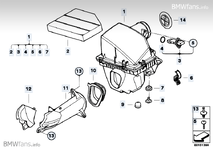
I'm not convinced that the exhaust is the most restrictive part of the system. Have you tested your modifications with/without the stock exhaust? I do have a second pair of stock back boxes which i am currently butchering. I haven't touched part 11 yet, just 1 and 12.
I haven't measured my power gains, since my goal is noise without impacting power negatively, and i have done that bit pretty well. My car sounds better than the Simota intake, especially between 2k and 5k rpm.
I have done some analysis of pressure drops between various parts of the system, which revealed some interesting results which really surprised me. There is absolutely no point buying aftermarket filters, for example, unless you are going to remove other restrictions elsewhere in the intake.
I have made a nice carbon fibre composite ram-air scoop, amongst other things, the scoop cost me about £20 in materials and a couple of hours work (it only took that long because i'd never made anything from cf before).
You've obviously become as interested in this subject as I am, but be warned: it becomes addictive!
No doubt you've read a fair bit about air-intakes from the Autospeed website as here:
http://autospeed.com/cms/title_Eliminating-Negative-Boost-Part-1/A_0629/article.html There's some good information on that website but it's gone off at a tangent in the last 3 years.
The S54 engine is reported amongst the engineering community as delivering a Volumetric Efficiency (VE) of 106%, and that will be with an OEM air-intake. Therefore, if a normally aspirated engine can produce more than 100% VE, the air intake system just cannot be restrictive, otherwise it would produce less than 100% VE. So, as I see it, there is no problem of restriction on the intake side of the engine in the Z4M. Having said that, the OEM air-intake can be improved upon, but only by making relatively minor tweaks and not from a total redesign or replacement with aftermarket stuff.
The Honda S2000 engine (NA) achieves a VE of 115% and both the S54 and the Honda 2000 get these high VE figures from variable valve timing methods (Vanos and VTec) but also from their air-intake systems which use both ram-effect and wave resonance to assist cylinder filling. My hunch is that part of the explanation of the superior VE achieved by the Honda is due to it's superior air intake system to the BMW one.
Yes, I have tested my intake mods with both an OEM and modded set of silencers and I get a higher VE with the air-intake mod
and modded silencers on the car. I absolutely rely on my DashDyno datalogging recordings to point me in the right direction. In 1st gear, the S54 can only produce a VE of around 90%, but as the speed increases and you use higher gears the VE increases, which proves that the higher VE is created by the ram effect and an excellent air-intake system. When I tested the VE of my Z4MC when I bought it, the VE was 102%, after fitting modded silencers it remained at 102%, when I modded the air intake the VE went to 105.5%. I've presently refitted the OEM silencers so that I can do more work on the modded silencers and my VE has returned to 102%.
I have been through this entire process before with my S54 Z3MC and with that car I have now managed to achieve a VE of over 110%. from a combination of air intake and exhaust mods. I'm presently working on trying to obtain some more VE% on the Z4MC. I simply don't concern myself trying to make the car sound any noisier, but as the VE increases the car does roar more and gutted silencers are louder than OEM, so I take the noise as a by-product rather than a goal.
You say that you haven't impacted on your power negatively, but how do you know for sure? I can't feel the difference between 102% and 105.5% VE either way, which translates into an increase in torque at the wheels of 4.8% but I certainly can see and feel the difference of running my Z3MC with another Z3MC whilst I'm getting 110% VE. Here's a link to a vid of me chasing another Z3MC:
https://www.youtube.com/watch?v=ICLoOSJEkpY



 Liverpool