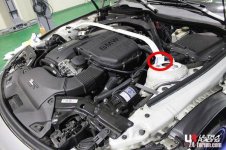
I have one that came from the previous owner (re-sprayed black to be more in keeping with the rest of the bay). I have never taken it off so I can't give a first hand impression of the difference, but as a consultant structural engineer I know a bit about stress, deflection, and design procedure.
From a frame design perspective, any twist or deflection of the frame is to be avoided, and during the design of the car the aim will have been to design the frame to be just stiff enough to transmit the loads where they need to go (i.e. into the suspension) without deflecting too much, and while leaving enough space to allow for access around the engine bay and while spending the least amount of money possible. This will not be the stiffest solution, but the best compromise for all the stuff the car needs to do.
If you turn a corner and put a horizontal load into the frame then the load will want to create a push/pull between the left and right suspension. To get the load from the left to the right side of the car it has to create a load path using the chassis, floor bracing, and diagonal struts. The more direct the load path, the less bending and tolerances to take into account, and the more linear the load to the suspension. The more linear the load to the suspension, the less accidental load thrown to other corners, and the less under/oversteer due to frame twist like on my old bendy Z3.
Currently, the horizontal load mentioned above has to deflect the right suspension mount, then transfer this load into the first diagonal strut, then along the second diagonal strut, and finally into the left suspension mount. The same route occurs along the underside of the car too, going along any bracing the floor to the suspension mount.
If you introduce a more direct load path, such as a central strut, then you shorten the load path, increase the overall stiffness of the frame, and give the suspension a much more linear load input. All of this just leads to the frame wobbling less, and evens out the force on the suspension allowing it to do it's job better. You could argue that this prevents the frame from behaving as a damper, but surely that's what the actual oil dampers are for in your suspension.
Does this mean that you need to increase the stiffness of your engine bay for driving to the shops? Absolutely not.
Does this mean that you need to increase the stiffness of your engine bay to set a new Nurburgring lap record? Almost certainly.
Does this mean that you need to increase the stiffness of your engine bay for your personal use of the car? Probably not but it depends what you want to do with the car.
Would I put a strut on my next weekend car? Probably, yes. It made a big difference on the Z3, and maybe makes a bit of difference on the Z4 with spirited driving.
Photos, because the post is long.

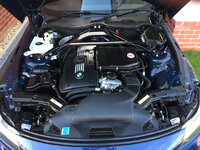


nice bit of bonnet bling.

 Nope, not moved it off the drive yet, it's behind everything else and couldn't be bothered to move them all.
 :evil: