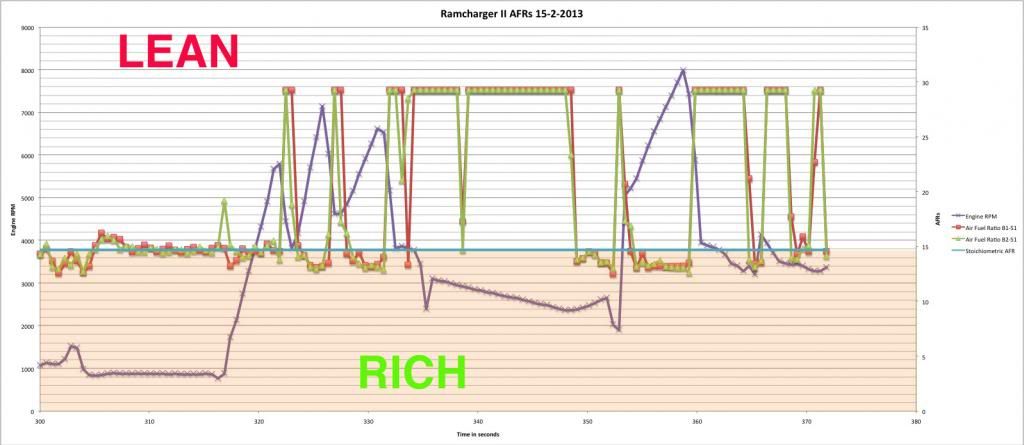
Here's another graph showing the Air-Fuel Ratios that I recorded with the Ramcharger II mod. The blue line represents the stoichiometric value of 14.7 : 1 (air etrol). When the engine is idling (305secs - 317secs) the AFR is at stoichiometric levels and when the car accelerates in 1st gear (317secs) the AFR immediately drops (i.e. the AFR becomes richer) but then it returns to stoichiometric values. This seems to be written into the ECU software as part of the traction control system to prevent wheel spin when accelerating from rest. When the car accelerates in 2nd and 3rd gears (at 323secs and 327secs, respectively) the AFR drops to around 13:1 (i.e. fuel richens). On lifting-off and decelerating (332secs - 348secs) the throttles close to their minimum opening and the AFRs lean right out to a recorded value of 29.26 : 1 (stoich x 2) to maintain engine tick-over. The same scenario occurs when my Z4MC is in OEM state, therefore, I've concluded that the ECU can easily accommodate the increased mass airflow that my Ramcharger mod is designed to achieve without any need for remapping.
Some have suggested that increasing the airflow will cause the AFR to become lean. Lean AFR's under WOT will cause "knock" and engine damage but, clearly, the evidence provided by the ECU to my datalogger is that this does not happen and that the OEM fuel maps are sufficiently "broad" to accommodate changes in the order that I'm able to achieve with an improved ram intake. 8)
etrol). When the engine is idling (305secs - 317secs) the AFR is at stoichiometric levels and when the car accelerates in 1st gear (317secs) the AFR immediately drops (i.e. the AFR becomes richer) but then it returns to stoichiometric values. This seems to be written into the ECU software as part of the traction control system to prevent wheel spin when accelerating from rest. When the car accelerates in 2nd and 3rd gears (at 323secs and 327secs, respectively) the AFR drops to around 13:1 (i.e. fuel richens). On lifting-off and decelerating (332secs - 348secs) the throttles close to their minimum opening and the AFRs lean right out to a recorded value of 29.26 : 1 (stoich x 2) to maintain engine tick-over. The same scenario occurs when my Z4MC is in OEM state, therefore, I've concluded that the ECU can easily accommodate the increased mass airflow that my Ramcharger mod is designed to achieve without any need for remapping.Some have suggested that increasing the airflow will cause the AFR to become lean. Lean AFR's under WOT will cause "knock" and engine damage but, clearly, the evidence provided by the ECU to my datalogger is that this does not happen and that the OEM fuel maps are sufficiently "broad" to accommodate changes in the order that I'm able to achieve with an improved ram intake. 8)