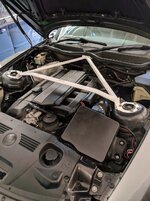
New Strut Brace.... Must have mod!!

malibudave said:
Shooter said:
What exactly does the bonnet sensor do ?

Check that the bonnet is shut properly?

In this case with the sensor removed, do you get a warning light on the dashboard, in the same way you would if the door/boot was open?
 
Mangozac said:
powerontap said:
Just a question while we're on the subject: If the installation goes well and nothing breaks, do we need a wheel alignment done after fitting one?
I don't think so, as the brace is not actually moving the strut towers, but rather stopping them from moving.

But as you remove the tower mounting nuts, won't the weight of the car pressure the struts out of their initial camber setting?
 
Aren't wheel alignments pretty cheap? It is $60 at my local tyre shop so who cares, but I don't remember my strut tops moving when I unbolted them. I am away snowboarding ATM, but I will get a wheel alignment when I return home.

Bonnet sensor is for the alarm, if someone tries to open the bonnet when car is locked an alarm goes off. If you remove the bonnet sensor there is no warning light. Mine was faulty when I bought the car, so I removed it for about 3 months with no issues. I have not been able to refit it yet, asit will require some sort of custom bracket to refit. But I will try a few ideas I have when I get home
 
Any movement that does occur after unbolting the tower mounting nuts would be too small to have any real impact on alignment. Camber isn't adjusted that way. Like Hotride says though, it's not like a Wheel alignment is that expensive...
 
Mangozac said:
Any movement that does occur after unbolting the tower mounting nuts would be too small to have any real impact on alignment. Camber isn't adjusted that way. Like Hotride says though, it's not like a Wheel alignment is that expensive...
If that's so, then what's this on about? http://www.bimmerfest.com/forums/showpost.php?p=5960602&postcount=8
I would say that if the little centering/alignment pin is still in place, and you are careful not to shift weight on the car during the procedure, nothing should move. But OTOH, to maximise the benefit of your new brace, a fresh alignment would be in order.
 
bcworkz said:
If that's so, then what's this on about? http://www.bimmerfest.com/forums/showpost.php?p=5960602&postcount=8
I would say that if the little centering/alignment pin is still in place, and you are careful not to shift weight on the car during the procedure, nothing should move. But OTOH, to maximise the benefit of your new brace, a fresh alignment would be in order.
Wow I stand corrected. I just couldn't believe that the tiny amount of movement afforded by the mounting holes in the strut tower would translate to enough adjustment in camber. Are the holes fairly elongated or something?
 
billygilly said:
Just set the torque wrench and I'm pretty scared, is it definately 32nm.. Seems pretty high

Well i snapped one of the strut top bolts using that setting. I would try about 25NM if I was you. The guy at the suspension shop was totally shocked when I told him the BMW recommended settings
 
You know, 32nm would be appropriate if the fastener is in a high strength class, otherwise 25nm would be more realistic. That said, neither torque is really that huge, I shouldn't think that in itself would cause a failure, there must be other contributing factors such as previous over torqueing, metal fatigue, corrosion, impurities in manufacturing process, etc.

But then consider this fastener isn't really load bearing, it only provides clamping force to the tower/brace to hold the strut top in proper position. There's not really much side load from the strut to the tower, the brace helps more by stiffening the entire front clip assembly, rather than just holding the towers in place. We don't really need a huge clamping force here, but there must be enough to hold the parts rigidly without any play at all. A low clamping force completely negates the purpose of a brace. In this light, 32nm IS reasonable IF the fastener material is of a high enough strength class. So, is it? I have no idea.

You can achieve higher clamping force with lower torque by using lubricant, but that could be detrimental the friction we are trying to develop. If it were me, I would sparingly apply moderate thread lock to provide some lubrication and insurance against loosening, then torque to 25nm.
Mangozac said:
Wow I stand corrected. I just couldn't believe that the tiny amount of movement afforded by the mounting holes in the strut tower would translate to enough adjustment in camber. Are the holes fairly elongated or something?
I'm with you on that, it just seems wrong! I've never had this apart, but based on the wide shouldered nuts, the holes are simply oversized, but not slotted. It's impossible for this to provide any significant adjustment. I think camber is roughly correct off the assembly line based solely on geometry of the parts. The adjustment provided is only for fine tuning. If your camber is truly off, then something is bent. Either replace or straighten the offending part or resort to aftermarket solutions.
 
bcworkz said:
In this light, 32nm IS reasonable IF the fastener material is of a high enough strength class. So, is it? I have no idea.
But BMW should know and should have specified the torque setting appropriately.

bcworkz said:
I've never had this apart, but based on the wide shouldered nuts, the holes are simply oversized, but not slotted. It's impossible for this to provide any significant adjustment. I think camber is roughly correct off the assembly line based solely on geometry of the parts. The adjustment provided is only for fine tuning. If your camber is truly off, then something is bent. Either replace or straighten the offending part or resort to aftermarket solutions.
I agree! I mashed up the control arm on my last car which in turn shunted the steering rack and a few bits and was only able to get the camber correct because I had previously fitted coilover suspension with camber adjustment plates. That's why I was so certain that there wasn't enough adjustment available in this case!
 
Thread resurrection!

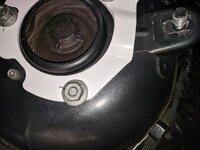
What did you do with the camber pin that protrudes where the strut sits? Does it have a void for this or did you remove it entirely?

Anything come of the alarm module issue?

Thanks
 
Thought I would necro this thread by adding my experience as it comes up on Google search (and was the first thread I personally read when researching this strut brace).

I've just installed it this morning and I can totally see why 35nm would/could snap the bolt clean off. When removing, it didn't take much force at all (just regular palm pressure with a regular socket wrench) and I've done a lot of kms with zero issues suspension wise. I should add that I also took time to inspect the bolts themselves for any corrosion etc.

For mine, I noticed that the brace didn't quite slot over the bolts as comfortable as I wouldve liked (it kept JUUUST fouling the edges of the bolts and I did not feel like forcing/flexing it over the threads). I ended up filing down some of the powder coating/finish and then it slotted on fine.

Then I fastened it down side by side so it could spread evenly - I noticed that the brace wasn't sitting 100% flat/flush over the tower but as I started fastening, it evened out.

In the end, having looked through this thread and other's experiences with torquing these down (and snapping them), i started at 18nm and worked my way up to ~20-22nm. Is that enough? I'm not sure, but if it loosens, it's an easy enough bit to tighten up and wouldn't be a total disaster if you were trotting around down.

I think one thing that the 35nm spec might not take into account is that with the brace in, the threads you're tightening over aren't the standard - they're further out. Whether this makes a difference I don't know as I'm not an engineer but that's something to consider i guess?
An actual explanation below....

1RCEmeJ.jpg

Just for the sake of it, marked with a sharpy the nut position.

xzhKqHg.jpg

What did you do with the camber pin that protrudes where the strut sits? Does it have a void for this or did you remove it entirely?

I know you asked this 5 years ago (lol) but for anyone else, the brace has a cutout for the pin (I'm assuming you were referring to the knobby on the top of the tower).
 
A quick point which might explain why torquing to 35nm can lead to snapping off.... the nuts are an engineered one-use self-locking type, BMW recommend new ones are used each time as the internal surface is designed to provide friction lock to stop them undoing. Re-using them means they no longer offer the same resistance and your torque readings are meaningless. Re-use can lead to incorrect torque readings, over-tightening and mushrooming/fracturing of the mounts as well.

The same part number is used on several BMW's and Mini's, they are a one-time use item and quite fragile and a LOT of Mini's in particular have reports of them fracturing when re-used. A set is expensive from BMW but it's an 'engineered' nut that can cause real problems if abused, personally I'd only use genuine ones, anything else (ebay etc) is an unknown quantity.
 
Ewazix said:
A quick point which might explain why torquing to 35nm can lead to snapping off.... the nuts are an engineered one-use self-locking type, BMW recommend new ones are used each time as the internal surface is designed to provide friction lock to stop them undoing. Re-using them means they no longer offer the same resistance and your torque readings are meaningless. Re-use can lead to incorrect torque readings, over-tightening and mushrooming/fracturing of the mounts as well.

The same part number is used on several BMW's and Mini's, they are a one-time use item and quite fragile and a LOT of Mini's in particular have reports of them fracturing when re-used. A set is expensive from BMW but it's an 'engineered' nut that can cause real problems if abused, personally I'd only use genuine ones, anything else (ebay etc) is an unknown quantity.

Are you saying that because the NUT is a one use, it's leading to incorrect force being applied to the BOLT on top of the strut mount plate, causing the snap?
 
The nuts when torqued on their first use are deformed by a predetermined amount (the torque setting given). When they are removed they do not return to their virgin/un-torqued state. If used again and tighted even to the same torque setting (adding the same degree of deformation) in reality there is a compound deformation (of the two attempts) which deforms them tighter then the design requires and beyond the force required to shear the bolt (don't know about you but I can't recall ever seeing a nut strip the threads its always the bolt that gives).

Engineers say that the 'ideal' torque for any nut and bolt is 'half a turn before the bolt snaps' - and no doubt BMW will be close to this the first time the fixing was used (albeit with a little safety margin). If its single use (very common on drive shaft hub bolts/nuts) that's just what it is - one use.

Single use nuts / bolts are expensive for a reason - try to resist the ebay 'pre owned' bargains :o My mate used 'pre owned' drive shaft bolts but that's another story.
 
tomrdy said:
Ewazix said:
A quick point which might explain why torquing to 35nm can lead to snapping off.... the nuts are an engineered one-use self-locking type, BMW recommend new ones are used each time as the internal surface is designed to provide friction lock to stop them undoing. Re-using them means they no longer offer the same resistance and your torque readings are meaningless. Re-use can lead to incorrect torque readings, over-tightening and mushrooming/fracturing of the mounts as well.

The same part number is used on several BMW's and Mini's, they are a one-time use item and quite fragile and a LOT of Mini's in particular have reports of them fracturing when re-used. A set is expensive from BMW but it's an 'engineered' nut that can cause real problems if abused, personally I'd only use genuine ones, anything else (ebay etc) is an unknown quantity.

Are you saying that because the NUT is a one use, it's leading to incorrect force being applied to the BOLT on top of the strut mount plate, causing the snap?

That's it, but a lot of people don't understand why a nut can only be used once (and relatively expensive) hence my attempt at a technical explanation, probably done better by Crazy Harry :)

Recommend procedures for fixings save a lot of grief :thumbsup:
 
Back
Top Bottom