malibudave said:Shooter said:What exactly does the bonnet sensor do ?
Check that the bonnet is shut properly?
In this case with the sensor removed, do you get a warning light on the dashboard, in the same way you would if the door/boot was open?

malibudave said:Shooter said:What exactly does the bonnet sensor do ?
Check that the bonnet is shut properly?
Mangozac said:I don't think so, as the brace is not actually moving the strut towers, but rather stopping them from moving.powerontap said:Just a question while we're on the subject: If the installation goes well and nothing breaks, do we need a wheel alignment done after fitting one?
If that's so, then what's this on about? http://www.bimmerfest.com/forums/showpost.php?p=5960602&postcount=8Mangozac said:Any movement that does occur after unbolting the tower mounting nuts would be too small to have any real impact on alignment. Camber isn't adjusted that way. Like Hotride says though, it's not like a Wheel alignment is that expensive...
Wow I stand corrected. I just couldn't believe that the tiny amount of movement afforded by the mounting holes in the strut tower would translate to enough adjustment in camber. Are the holes fairly elongated or something?bcworkz said:If that's so, then what's this on about? http://www.bimmerfest.com/forums/showpost.php?p=5960602&postcount=8
I would say that if the little centering/alignment pin is still in place, and you are careful not to shift weight on the car during the procedure, nothing should move. But OTOH, to maximise the benefit of your new brace, a fresh alignment would be in order.
billygilly said:Just set the torque wrench and I'm pretty scared, is it definately 32nm.. Seems pretty high
I'm with you on that, it just seems wrong! I've never had this apart, but based on the wide shouldered nuts, the holes are simply oversized, but not slotted. It's impossible for this to provide any significant adjustment. I think camber is roughly correct off the assembly line based solely on geometry of the parts. The adjustment provided is only for fine tuning. If your camber is truly off, then something is bent. Either replace or straighten the offending part or resort to aftermarket solutions.Mangozac said:Wow I stand corrected. I just couldn't believe that the tiny amount of movement afforded by the mounting holes in the strut tower would translate to enough adjustment in camber. Are the holes fairly elongated or something?
But BMW should know and should have specified the torque setting appropriately.bcworkz said:In this light, 32nm IS reasonable IF the fastener material is of a high enough strength class. So, is it? I have no idea.
I agree! I mashed up the control arm on my last car which in turn shunted the steering rack and a few bits and was only able to get the camber correct because I had previously fitted coilover suspension with camber adjustment plates. That's why I was so certain that there wasn't enough adjustment available in this case!bcworkz said:I've never had this apart, but based on the wide shouldered nuts, the holes are simply oversized, but not slotted. It's impossible for this to provide any significant adjustment. I think camber is roughly correct off the assembly line based solely on geometry of the parts. The adjustment provided is only for fine tuning. If your camber is truly off, then something is bent. Either replace or straighten the offending part or resort to aftermarket solutions.
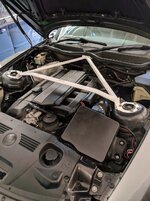
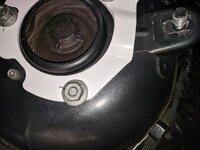
What did you do with the camber pin that protrudes where the strut sits? Does it have a void for this or did you remove it entirely?
Ewazix said:A quick point which might explain why torquing to 35nm can lead to snapping off.... the nuts are an engineered one-use self-locking type, BMW recommend new ones are used each time as the internal surface is designed to provide friction lock to stop them undoing. Re-using them means they no longer offer the same resistance and your torque readings are meaningless. Re-use can lead to incorrect torque readings, over-tightening and mushrooming/fracturing of the mounts as well.
The same part number is used on several BMW's and Mini's, they are a one-time use item and quite fragile and a LOT of Mini's in particular have reports of them fracturing when re-used. A set is expensive from BMW but it's an 'engineered' nut that can cause real problems if abused, personally I'd only use genuine ones, anything else (ebay etc) is an unknown quantity.

 My mate used 'pre owned' drive shaft bolts but that's another story.
tomrdy said:Ewazix said:A quick point which might explain why torquing to 35nm can lead to snapping off.... the nuts are an engineered one-use self-locking type, BMW recommend new ones are used each time as the internal surface is designed to provide friction lock to stop them undoing. Re-using them means they no longer offer the same resistance and your torque readings are meaningless. Re-use can lead to incorrect torque readings, over-tightening and mushrooming/fracturing of the mounts as well.
The same part number is used on several BMW's and Mini's, they are a one-time use item and quite fragile and a LOT of Mini's in particular have reports of them fracturing when re-used. A set is expensive from BMW but it's an 'engineered' nut that can cause real problems if abused, personally I'd only use genuine ones, anything else (ebay etc) is an unknown quantity.
Are you saying that because the NUT is a one use, it's leading to incorrect force being applied to the BOLT on top of the strut mount plate, causing the snap?

