You are using an out of date browser. It may not display this or other websites correctly.
You should upgrade or use an alternative browser.
You should upgrade or use an alternative browser.
Hand brake
- Thread starter Troy1998
- Start date



I may be both wrong and stating the obvious but……
Is the ratchet mechanism on these not known for failure and in need replacement? I seem to remember these occasionally popping up for sale on at what I thought seemed like pretty expensive prices, circa £150 for a good one. To the best of my recollection the teeth either wear or break making replacement the only option but no longer available new so good ones command a premium 2nd hand
Happy to stand corrected by more knowledgeable people
Is the ratchet mechanism on these not known for failure and in need replacement? I seem to remember these occasionally popping up for sale on at what I thought seemed like pretty expensive prices, circa £150 for a good one. To the best of my recollection the teeth either wear or break making replacement the only option but no longer available new so good ones command a premium 2nd hand
Happy to stand corrected by more knowledgeable people
 USA
USA
colb said:How sure are you that a cable is broken or seized?
Take a look at Pelican Parts how to for adjusting handbrake here
https://www.pelicanparts.com/techarticles/BMW_Z4M/92-BRAKES-Parking_Brake_Adjusting/92-BRAKES-Parking_Brake_Adjusting.htm
If you need new cables then the rear drum/discs will have to come off to get at the cable that end. Bit tight to disconnect at the handle end inside the car, limited access from underneath, prop and exhaust may need to be dropped.
UPDATE
Right after looking into adjusting. I have came to realisation that the hook on the service break lock is locked permanently on no matter wether it is up or down. I have tried getting back in but does not seem to want to go. Hook keeps just sliding back in to the lock position. Im going to get a mechanic to look at it tomorrow. But if this is broken, there would be no way to replace this without replacing that unit, correct? Thanks

That adjustment lock should only be compressed and latched when you carry out adjustment of the shoes in the rear disc/drums using the ratchet adjustment wheels inside the drums by flicking the ratchet up or down using a flat blade screwdiver through one of the wheel bolt holes. Pelican Parts How to on their site explains all.
When you say it keeps sliding back to the lock position then somthing is wrong, once unlatched the spring should return the lock to the off position and only be set to lock when its compressed so it latches, it can be compressed using a flat blade screwdriver although there is a tool available to do this that is shaped into two prongs that fit on the end cap of the adjuster lock and aids getting it to latch.
When you say it keeps sliding back to the lock position then somthing is wrong, once unlatched the spring should return the lock to the off position and only be set to lock when its compressed so it latches, it can be compressed using a flat blade screwdriver although there is a tool available to do this that is shaped into two prongs that fit on the end cap of the adjuster lock and aids getting it to latch.

 Attleborough, Norfolk

I wonder if the shoes have been adjusted at the wheels without having first set the adjustment latch at the handle end resulting in the cables being overtightened. Slacken off both adjusters at the whhel end so the shoes are backed off then go and latch the adjuster at the handle end so tension on the cables is taken off. With the handle in the off position go to the wheels and adjust the shoes up till the wheel cannot be spun, meaning the brake is applied. BMW Technical Info says back the adjuster off 7 clicks. Do this on both wheels then go and unlatch the handle end adjuster, once released the spring will re-tension the cables. Apply the handbrake and go and check both wheels are being held fast by the handbrake shoes. If you have too many clicks when applying the handbrake, re-engage the adjuster at the handle end and readjust each wheel adjuster to bring the shoes closer to the drum inside, De-latch the handle adjuster again and test the handbrake lever and check each wheel is having the brake applied enough to hold the car.
All of this assumes that your ratchet teeth on the handbrake lever are intact and working ok when the handle is pulled up, always press the release button when pulling the handle up, avoid letting the ratchet ride over the teeth as this will wear the teeth down over time. Release the button when you have raised the handle enough to hold the car, its ok to let it click over the last couple of clicks to its final setting position.
If your ratchet teeth are so worn its going to need the handle removing from the car and a replacement fitted, you might get away with filing the teeth back into shape so the ratchet pawl engages with the teeth better but either way its a job that requires the unit removed from the car from underneath by dropping the prop shaft and exhaust. It can be got out from above but entails some metal bodywork bending to get it out then re-bending it back when its replaced.
All of this assumes that your ratchet teeth on the handbrake lever are intact and working ok when the handle is pulled up, always press the release button when pulling the handle up, avoid letting the ratchet ride over the teeth as this will wear the teeth down over time. Release the button when you have raised the handle enough to hold the car, its ok to let it click over the last couple of clicks to its final setting position.
If your ratchet teeth are so worn its going to need the handle removing from the car and a replacement fitted, you might get away with filing the teeth back into shape so the ratchet pawl engages with the teeth better but either way its a job that requires the unit removed from the car from underneath by dropping the prop shaft and exhaust. It can be got out from above but entails some metal bodywork bending to get it out then re-bending it back when its replaced.
colb said:I wonder if the shoes have been adjusted at the wheels without having first set the adjustment latch at the handle end resulting in the cables being overtightened. Slacken off both adjusters at the whhel end so the shoes are backed off then go and latch the adjuster at the handle end so tension on the cables is taken off. With the handle in the off position go to the wheels and adjust the shoes up till the wheel cannot be spun, meaning the brake is applied. BMW Technical Info says back the adjuster off 7 clicks. Do this on both wheels then go and unlatch the handle end adjuster, once released the spring will re-tension the cables. Apply the handbrake and go and check both wheels are being held fast by the handbrake shoes. If you have too many clicks when applying the handbrake, re-engage the adjuster at the handle end and readjust each wheel adjuster to bring the shoes closer to the drum inside, De-latch the handle adjuster again and test the handbrake lever and check each wheel is having the brake applied enough to hold the car.
All of this assumes that your ratchet teeth on the handbrake lever are intact and working ok when the handle is pulled up, always press the release button when pulling the handle up, avoid letting the ratchet ride over the teeth as this will wear the teeth down over time. Release the button when you have raised the handle enough to hold the car, its ok to let it click over the last couple of clicks to its final setting position.
If your ratchet teeth are so worn its going to need the handle removing from the car and a replacement fitted, you might get away with filing the teeth back into shape so the ratchet pawl engages with the teeth better but either way its a job that requires the unit removed from the car from underneath by dropping the prop shaft and exhaust. It can be got out from above but entails some metal bodywork bending to get it out then re-bending it back when its replaced.
Thanks for the reply's. I have not adjusted anything yet going to do it tommorow. But I just went to examine the spring when you sent that link. That's when i realised the spring is all ready locked in so though of trying to just try disengage it with hook like it says on that link and the hook is just not going back in like it says it should. I will try adjusting it and releasing it again see it works that time.
Extract from BMW Technical Info System (TIS)
Perform inspection in the following manner:
When 1st ratchet is engaged, no braking force should be exerted.
The difference in wheel circumferential forces between the left and right wheels may deviate by max. 30 % from the greater value (measured on brake analyzer).
The parking brake must be readjusted in the event of greater deviations in the wheel circumferential force!
Braking with locked wheels must be possible with the parking brake.
The parking brake must be reset if the actuation stroke is greater than 10 teeth.
Note:
Accurate adjustment of the parking brake is only possible if the parking brake Bowden cables and all moving parts on the parking brake move easily and function correctly.
Basic setting of the parking brake is required whenever:
- When replacing parking brake shoes.
- When replacing brake discs.
- In event of excessive actuation stroke (10 teeth).
- When replacing parking brake Bowden cables
1. Setting instruction for brake shoes (basic setting)
Unclip parking brake lever trim (1) at rear and tilt forwards.
Lock adjuster unit (ASZE):
Actuate parking brake lever. Screw in special tool 32 1 030 partially. Release parking brake lever and press stop (2) of adjusting spring back to such an extent that retaining hook (3) engages in stop (2).
Completely unscrew one wheel stud on each rear wheel.
Installation:
Tightening torque 36 10 1AZ.
Turn wheel until adjustment screw is visible in tapped hole.
Turn adjusting screw with a screwdriver until the wheel is no longer able to turn.
Then unfasten the adjusting screw 9 notches.
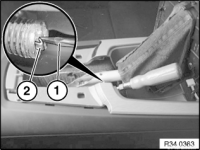
Unlock adjuster unit (ASZE):
Lever restraint hook (2) outwards with a suitable screwdriver (1).
Restraint hook (2) must disengage from stop of adjusting spring.
2. Setting instruction for parking brake Bowden cables
The parking brake lever must be applied 5 times to approx. 400 N actuating force.
2.1 On brake analyzer
0th tooth (parking brake released):
Vehicles with manual transmission: Shift lever in neutral position.
Vehicles with automatic transmission: Selector lever position ”N”.
Without locking differential ≤150 N.
With locking differential ≤ 200 N (possibly odd display).
1st tooth: No increase in braking force with regard to 0th tooth. Indicator lamp can be lit.
2nd tooth: Indicator lamp must be lit.
3rd tooth: Increase in braking force.
5th tooth: The brake force display must have reached ≥ 400 N.
Checking brake force differential at wheel:
Apply parking brake until a wheel circumferential force (brake force display) of min. 1000 N is reached.
Max. permitted brake force differential right/left ≤35 % (referred to greater brake value).
3. Braking in the duo-servo parking brake
The following braking-in procedures are applicable in case of insufficient braking effect or after replacing brake discs and/or brake shoes.
3.1 On brake analyzer
Apply parking brake lever until wheel circumferential force at first wheel is 800 N.
Lock parking brake lever in next lower tooth.
Release parking brake lever after approx. 2 minutes.
3.2 When driving on road
(If possible inside the company grounds or on an unused road)
At approx. 40 km/h apply parking brake lever until a braking effect can be felt.
Pull parking brake lever to next notch and drive on for approx. 400 m.
A basic requirement is that parking brake is adjusted uniformly.
Note:
If necessary, repeat braking-in procedure.
Allow brake to cool down sufficiently.
Perform inspection in the following manner:
When 1st ratchet is engaged, no braking force should be exerted.
The difference in wheel circumferential forces between the left and right wheels may deviate by max. 30 % from the greater value (measured on brake analyzer).
The parking brake must be readjusted in the event of greater deviations in the wheel circumferential force!
Braking with locked wheels must be possible with the parking brake.
The parking brake must be reset if the actuation stroke is greater than 10 teeth.
Note:
Accurate adjustment of the parking brake is only possible if the parking brake Bowden cables and all moving parts on the parking brake move easily and function correctly.
Basic setting of the parking brake is required whenever:
- When replacing parking brake shoes.
- When replacing brake discs.
- In event of excessive actuation stroke (10 teeth).
- When replacing parking brake Bowden cables
1. Setting instruction for brake shoes (basic setting)
Unclip parking brake lever trim (1) at rear and tilt forwards.
Lock adjuster unit (ASZE):
Actuate parking brake lever. Screw in special tool 32 1 030 partially. Release parking brake lever and press stop (2) of adjusting spring back to such an extent that retaining hook (3) engages in stop (2).
Completely unscrew one wheel stud on each rear wheel.
Installation:
Tightening torque 36 10 1AZ.
Turn wheel until adjustment screw is visible in tapped hole.
Turn adjusting screw with a screwdriver until the wheel is no longer able to turn.
Then unfasten the adjusting screw 9 notches.
Unlock adjuster unit (ASZE):
Lever restraint hook (2) outwards with a suitable screwdriver (1).
Restraint hook (2) must disengage from stop of adjusting spring.
2. Setting instruction for parking brake Bowden cables
The parking brake lever must be applied 5 times to approx. 400 N actuating force.
2.1 On brake analyzer
0th tooth (parking brake released):
Vehicles with manual transmission: Shift lever in neutral position.
Vehicles with automatic transmission: Selector lever position ”N”.
Without locking differential ≤150 N.
With locking differential ≤ 200 N (possibly odd display).
1st tooth: No increase in braking force with regard to 0th tooth. Indicator lamp can be lit.
2nd tooth: Indicator lamp must be lit.
3rd tooth: Increase in braking force.
5th tooth: The brake force display must have reached ≥ 400 N.
Checking brake force differential at wheel:
Apply parking brake until a wheel circumferential force (brake force display) of min. 1000 N is reached.
Max. permitted brake force differential right/left ≤35 % (referred to greater brake value).
3. Braking in the duo-servo parking brake
The following braking-in procedures are applicable in case of insufficient braking effect or after replacing brake discs and/or brake shoes.
3.1 On brake analyzer
Apply parking brake lever until wheel circumferential force at first wheel is 800 N.
Lock parking brake lever in next lower tooth.
Release parking brake lever after approx. 2 minutes.
3.2 When driving on road
(If possible inside the company grounds or on an unused road)
At approx. 40 km/h apply parking brake lever until a braking effect can be felt.
Pull parking brake lever to next notch and drive on for approx. 400 m.
A basic requirement is that parking brake is adjusted uniformly.
Note:
If necessary, repeat braking-in procedure.
Allow brake to cool down sufficiently.