To test whether any air-intake has any effect (positive or negative) on performance of a car in "real world" driving conditions is now dead easy. Get yourself a bluetooth OBD II adapter for around a fiver off ebay and use it in conjunction with an OBD app for an android device ( Torque app - free) and then simultaneously record 1. Airflow through MAF, 2. engine RPM, 3. Vehicle speed and 4. Intake Air Temperature. If you record these 4 parameters for "before and after" runs in 3rd gear accelerations from a rolling start from 2000rpm to the redline and save the files in .csv format, you can then compare the results in an Excel spreadsheet. If you see a significant increase in the airflow through the MAF at a given RPM, then this wil translate into an increased power output by the engine. Alternatively, if you look at the timestamp of the RPM data, and calculate the time it takes for the engine RPM to increase by say, 2000rpm, from 5000rpm to 7000rpm, if the time is shorter after making a physical change to the intake, then the intake has a positive effect on performance.
From the collection of the 4 parameters, it's also possible to calculate the Volumetric Efficiency in Excel for every line of data collected which shows the effect of the air-intake and whether the ram-effect is at work or not.


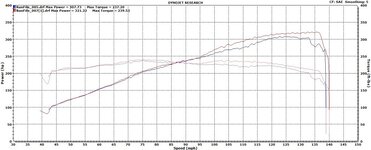
 but it was still only just long enough to have the car fully warmed up.