Decoking N20 engines inlet valves (or not)

  • Thread starter Thread starter Anonymous
  • Start date Start date
A

Anonymous

Guest
As readers may know, direct injection engines (like the N20, N54 and successors like B48/B58 ) inject fuel at high pressure direct into the combustion chamber. Just like modern diesels have been doing for years.

One down side is that compared to old carvburettor'd engines and early fuel injected engines, no clean, cool fuel gets washed over the inlet valves.

Allied to the pollution control equipment which routes crankcase gases (which are a mixture of oil mist and blow by gases) back through the inlet ports to burn these products off and a phenomenon of inlet coking takes place.

It can get so bad that the engine literally is deprived of air to run, poor starting, poor idle and down on power are the usual symptons with mysterious faults that appear like coil/plug issues.

Anyway..as a service to mankind I decided to have my inlets de-coked.

There are 3 main ways of doing this..

First there was crushed walnut shells blasted into the inlet port (valve closed please) and then the crap (walnet shell debris and coke being literally hoover'd out)

Then two new options..one essentially injecting a mixture of hydrogen and oxygen gases into the inlet and burning of the coke in a localised bonfire..

Finally, an updated version of the walnut shells with a type of beads, made of a proprietory compound injected under pressure and a powerful solvent added at the end to dissolve any bead residue and left over tar like deposits.

I booked myself into The Performance Centre in Sunderland for the latter treatment and a dyno run to see the before / after effect.

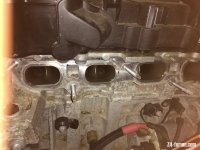
On arrival, one chap Mr Quiet stripped the inlet manifold off, then called me back, basically hardly any carbon for 47,000 miles..suggeested spending £360 a waste of time.

So after a long debate about the subject, why some engines do and some engines don't coke up, we agreed effectively a wire brush dentist style clean up only and pop on the dyno..not that Mr Taciturn expected any changes.

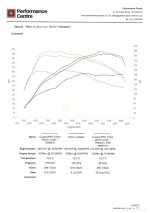
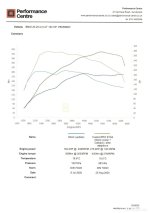
So onto the dyno we go and we get about 10 BHP and 27NM more torque..

Mr Taciturn does about 8 runs to try and figure what gives..

Where is the power coming from..mainly more boost around 2PSI in the low to mid range and slighly more stable ignition timing.

Mr Taciturn explains that the ECU adapts over time..seems like it needs a fair amount of time/mileage..in my case around 500 miles ish.

He explains that mixing lower grade fuels with higher grades causes issues so once you've started stick to the higher grades (does he work for Shell)..anyway enjoy the pictures and graphs.
 

Attachments

  • 2020-08-25 11.29.48.jpg
    2020-08-25 11.29.48.jpg
    153.6 KB · Views: 394
  • PB N20 stock, first and final.jpg
    PB N20 stock, first and final.jpg
    77.9 KB · Views: 394
  • PB N20 stock n final.jpg
    PB N20 stock n final.jpg
    69.1 KB · Views: 394
  • Carbon_deposit_or_not2.jpg
    Carbon_deposit_or_not2.jpg
    74 KB · Views: 389
Ah c'mon Peter, that's only three threads you've put your gimmicky dyno charts on. How do you expect anyone to find them hidden away like that :evil:
 
enuff_zed said:
Ah c'mon Peter, that's only three threads you've put your gimmicky dyno charts on. How do you expect anyone to find them hidden away like that :evil:

Not everyone is a fully paid up fan of Pbondar..so I've tried to relate matters to the relevant stories!

The book signing comes a bit later..! :thumbsup:
 
ronk said:
Did you get any "after" pictures of the valves Peter?

No..

Since there wasn’t much to clean off I lost interest..

I heard them using their air powered wire brush..then the next I heard was the dyno starting up ..watched that instead...
 
ronk said:
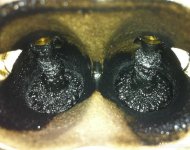
What are the gunged up valves in the photo?
Is it just a generic?

Yes, downloaded from a BMW geeks web site

The discussion around that picture was how tenacious the oil based deposits could become rather than the more brittle /hard carbon deposits..

They didn’t have any ‘database’ of good n bad engines..most of the BMW discussion revolves around the N54 series engines ..
 
So the photo of yours is the 'before'?
Even more encouraging as from that angle you can hardly see where they even needed to use a brush!
 
enuff_zed said:
So the photo of yours is the 'before'?
Even more encouraging as from that angle you can hardly see where they even needed to use a brush!

Correct..I was expecting a picture some way towards the top picture..when she was opened up there was, as you can hopefully see, bugger all crap in there (technical term)..so..for the sake of 2-3 hours work and £360 we decided on 60 minutes of wire brush / re-assemby..

Their view was that before n after there would be no impact on bhp etc but I insisted on the dyno run..they were suprised to see that it had 'self learned' as much as it had..lots of discussions about correction factors and we had a lot of looks at all sorts of data, air inlet temps, fuel flows, ignition advance, boost pressures etc etc and the conclusion was that it ended up where it was expected to be in the first place, giive or take a fatter torque curve and a de-cat fitted..

A great day out really as they were very communicative and I got lots of industry gossip which was illuminating..
 
Pbondar said:
enuff_zed said:
So the photo of yours is the 'before'?
Even more encouraging as from that angle you can hardly see where they even needed to use a brush!

Correct..I was expecting a picture some way towards the top picture..when she was opened up there was, as you can hopefully see, bugger all crap in there (technical term)..so..for the sake of 2-3 hours work and £360 we decided on 60 minutes of wire brush / re-assemby..

Their view was that before n after there would be no impact on bhp etc but I insisted on the dyno run..they were suprised to see that it had 'self learned' as much as it had..lots of discussions about correction factors and we had a lot of looks at all sorts of data, air inlet temps, fuel flows, ignition advance, boost pressures etc etc and the conclusion was that it ended up where it was expected to be in the first place, giive or take a fatter torque curve and a de-cat fitted..

A great day out really as they were very communicative and I got lots of industry gossip which was illuminating..

Definitely not a wasted trip. Peace of mind that your car is clean and healthy, plus a rapport with the blokes there that can only help in the future.
In addition, your input has possibly eased a lot of concerns from other N20 owners, so your time to document it all on the forum should be appreciated.
 
perhaps on modern engines, a correctly operating emissions system doesnt allow this to happen - after all, EGR valves and the like are only supposed to open when the engine is able to burn off the nasties.

i can see that if you have a fault in your EGR valve or crankcase breather valves where it is open when it's not supposed to be, and allowed to run like that for several years, you might get a build up on the inlet valve, but a low miles, well maintained engine wouldnt get much build up i'd have thought.

my 330d is about to tick over 160,000 miles, and still pulls just fine. it did have an EGR fault (it had coked up, and got stuck open) i imagine if this was allowed to continue, the inlet valves would have got coked up as a result of the fault.
 
Might it be a problem of never letting an engine get up to proper operating temperature, ie lots of short low speed journeys?

it worries me that people say they dont rev engines past 4500rpm, engines like to run to the redline once they are up to temperature!
 
brillomaster said:
perhaps on modern engines, a correctly operating emissions system doesnt allow this to happen - after all, EGR valves and the like are only supposed to open when the engine is able to burn off the nasties.

i can see that if you have a fault in your EGR valve or crankcase breather valves where it is open when it's not supposed to be, and allowed to run like that for several years, you might get a build up on the inlet valve, but a low miles, well maintained engine wouldnt get much build up i'd have thought.

my 330d is about to tick over 160,000 miles, and still pulls just fine. it did have an EGR fault (it had coked up, and got stuck open) i imagine if this was allowed to continue, the inlet valves would have got coked up as a result of the fault.

In one of the other threads, Peter did say that the chaps he went to told him that some other engines are much worse. I'd assume they have seen enough to be able to state that as a general observation, not just the odd one or two. Plus I'd hazard a guess that the people who take cars for dyno tuning etc. are maybe the least likely to drive them in such a manner as to coke up easily. In that case it would appear that, no matter the technology involved, some engines are much more susceptible than others.
 
The view from the techies was that certain engines are very prone like the N54 and for some reasons they don't understand the B48/B58 that was largely a follow on iteration of the N20 does it a lot more than N20s.

The N20 went out of its way to minimise oil pumping losses and a very clever fumes re-circulatory system..by the time they were designing it they knew what the faults were with the N54..many of which they addressed.

You'll see many reports of coked up direct injection engines on the internet..their view was that the better designed engines / better journey profile ones should only need to be looked at 100k ish miles.

I suspect the average punter will never discern/bother until it gets to the point where the car won't idle /start easily..

The fact that there are many people offering this service would tend to indicate that there is a degree of a problem for some engines / mileages..

Anyway I had the time and interest to explore the subject..so I think for N20 engined Z4 owners its one less thing to ponder about!
 
I don’t fancy the concept of wire brushing the gunked up valves in situ - I can see that leading to creating more problems than it cures.
 
ronk said:
I don’t fancy the concept of wire brushing the gunked up valves in situ - I can see that leading to creating more problems than it cures.

I'm sure an amateur could make a hash of it..these guys tweak engines for a living..based on watching how they go about things for nearly two days I'm chill with their approach..reputationally they have lots of repeats..I'm happy.. :thumbsup:
 
Interesting thread. I think if I ever had a direct injection engine an EGR delete would be top of my mod list.

I've been around a lot of dyno places over the years and the lack of consistency has always bothered me.. e.g. the same car posting figures 10% or more different depending on which day you go. In the end a very well regarded dyno tester admitted that you can get big differences depending on how hard you strap the wheels down on the rollers. He conceded that anyone wanting to do comparative testing should be using a hub dyno facility such as here...

https://bramracing.co.uk/work/dyno/

Hub dyno.png
 
Similar claims from these guys.... http://www.cskdyno.co.uk/html/dynapack.html

ADVANTAGES OF THE HUB DYNO OVER ROLLERS

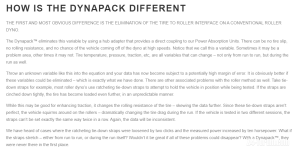
The Dynapack Hub Dyno replaces the drive wheels with two special adapters which fit into the dyno pods giving the nearest thing to an engine dyno whilst still leaving the engine in the car. However because the engine/car is as run on the circuit the results can take into consideration things like air flow round the engine and air intake, and the exhaust exactly as run on the car etc.

The car can't come off the rollers.

Far more accurate and repeatable results.

No wheel slippage giving more accuracy.

Higher tyre pressure gives higher power readings as there is less tyre drag, this variable is eliminated.

Toe in and camber angles give different results because of tyre scrub, this variable is eliminated.

Variable force used to strap down the car gives different results, this variable is eliminated.

The car can be held at any RPM (+ or - 5 RPM) indefinitely independent of throttle position meaning torque readings for fueling and timing can be far more accurately obtained for any throttle positions.

The dyno is virtually silent in use meaning it is far easier to hear the engine “detting”.
 
Re the consistency aspect, I witnessed two dyno runs on a 3.0l E85
Run one gave X and run two with the Sport button ON gave X Plus

Im reliably told that the sport button has no effect on output.
 
ronk said:
Re the consistency aspect, I witnessed two dyno runs on a 3.0l E85
Run one gave X and run two with the Sport button ON gave X Plus

Im reliably told that the sport button has no effect on output.

Correct. At wide open throttle there should be no difference whatsoever.
 
Back
Top Bottom