Convertible Top Diagnosis After Pump Motor Replacement

SlugV8

New member
 Boston, Massachusetts
I was warned that the convertible top motor on my E85 Z4MR was susceptible to water intrusion, and sure enough, it died. I followed the various online guides for extracting the pump assembly through the trunk (boot) and spent a lot of time crammed in there, but finally got it out. I swapped out the motor (the old one was horribly corroded) and should be back in business now, but things aren't working, though I can't figure out why.

Here are the symptoms I'm experiencing and debugging steps I've tried:
  • Pressing the top open button, the cowl panel motor spins for about half a second, then stops
  • Pressing the top open button repeatedly does eventually get the top fully unlatched
  • With top unlatched, the pump motor starts spinning, but same intermittent issue where it only spins for half a second, then stops until the button is released and pressed again
  • Same intermittent issue for closing the latches once the roof is opened manually
  • No error codes from CTM, and the readout from the switches behaves as expected, ruling out a wiring issue
  • I haven't checked all fuses, but everything is clearly getting power (CTM, cowl panel motor, pump motor)
  • The new motor read 0.6 Ohm and I heard somewhere that the OEM unit should be 0.2 Ohm, but there is no code for unexpected current draw, and the intermittent issue starts with the cowl panel motor before the pump motor even receives power
  • The pump reservoir is low on fluid, but again that shouldn't affect the cowl panel motor
  • Before I pulled out the pump assembly, the cowl panel motor worked as normal to latch and unlatch the roof with a single press of the open/close buttons
  • Probably unrelated, but the battery died due to leaving things open with lights on for too long while working on it over the winter (I now have a charger)
  • Haven't been able to find anyone experiencing a similar issue with the convertible top
What should I try next?
 
  • The new motor read 0.6 Ohm and I heard somewhere that the OEM unit should be 0.2 Ohm, but there is no code for unexpected current draw,

That's the sort of value I'd expect to see for a working motor.You won't get an accurate reading on that with an ordinary meter; it's just too small. If you just put the probes together you'll find it'll read some small but finite value. All you can really tell is that the motor will draw current.
 
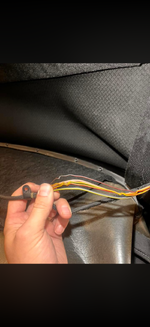
Check the roof loom for breaks.
It runs up the left side, just under the edge of the roof. With the roof folded about halfway back you can see it.
Around the area by the rear edge of the window the loom has to fold double and often you get breaks there. Sometimes you can feel lumps under the sheath, but failing that you have to strip the sheath back to inspect it.
 
Check the roof loom for breaks.
It runs up the left side, just under the edge of the roof. With the roof folded about halfway back you can see it.
Around the area by the rear edge of the window the loom has to fold double and often you get breaks there. Sometimes you can feel lumps under the sheath, but failing that you have to strip the sheath back to inspect it.
The roof loom looks to be in good shape. No creases and no lumps, though I have not stripped the sheathing and inspected the entire thing, just the section at the mid-roof joint as you suggested. The Hall Effect sensors and cowl panel motor appear to be working normally.
 
Strip the sheathing off

You’ll feel differently about it after
A few follow-up questions before I dive into taking apart the loom since I haven't done it before:
  • I haven't found much info on accessing the loom. Is the process to remove the roof > remove the loom > strip the loom, or are there any shortcuts?
  • Would it be worth doing a continuity check on the conductors in the loom before fully disassembling things?
  • Since things work briefly, but then stop after either the cowl panel or pump motor start spinning, it seems that the issue is related to the load of the motors causing voltage to droop. Could this be causing a false signal on one of the switch lines that then shuts off the motor?
  • I'm not sure how wiring could cause this issue, but I'm not an electrical engineer...
 
A few follow-up questions before I dive into taking apart the loom since I haven't done it before:
  • I haven't found much info on accessing the loom. Is the process to remove the roof > remove the loom > strip the loom, or are there any shortcuts?
  • Would it be worth doing a continuity check on the conductors in the loom before fully disassembling things?
  • Since things work briefly, but then stop after either the cowl panel or pump motor start spinning, it seems that the issue is related to the load of the motors causing voltage to droop. Could this be causing a false signal on one of the switch lines that then shuts off the motor?
  • I'm not sure how wiring could cause this issue, but I'm not an electrical engineer...
Keep it simple:
Roof half open until you can see the loom. Pull it towards you. There should be enough slack to be able to snip the sheath and push it back to expose the wires. If they are kinking it will usually be at that fold point, but could also be further back towards the hinge a bit.
If there is damage then to gain enough access you will need to undo the torx screws holding the plastic trim on the front edge of the roof. (There is one screw under the forward motor access panel and one either side hidden behind the side rails.)
With that panel lowered you can see the entire loom and loosen the P-Clips to get more working room.
 
Keep it simple:
Roof half open until you can see the loom. Pull it towards you. There should be enough slack to be able to snip the sheath and push it back to expose the wires. If they are kinking it will usually be at that fold point, but could also be further back towards the hinge a bit.
If there is damage then to gain enough access you will need to undo the torx screws holding the plastic trim on the front edge of the roof. (There is one screw under the forward motor access panel and one either side hidden behind the side rails.)
With that panel lowered you can see the entire loom and loosen the P-Clips to get more working room.
What he said
 
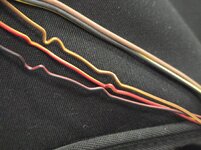
This is from a chap on FB with the same issue (sorry Ante if you are on here for unsung your picture)

A picture tells a thousand words and my experience is they all look like this when you strip the shielding away

IMG_4354.png
 
Back
Top Bottom