
You are using an out of date browser. It may not display this or other websites correctly.
You should upgrade or use an alternative browser.
You should upgrade or use an alternative browser.
Z4 + Snow
- Thread starter frankiefish
- Start date
Hi, i'm steve, and nearly wiping the front off my old man's brand new jag in HIS drive was my idea !!!
Lesson learn't, keeping your foot in is not always the best stratergy on a snow covered drive whilst trying to 180' it to be smart near to a brand new 30k Jag ... nearly cost me my xmas dinner at the folks house !! oops !
Lesson learn't, keeping your foot in is not always the best stratergy on a snow covered drive whilst trying to 180' it to be smart near to a brand new 30k Jag ... nearly cost me my xmas dinner at the folks house !! oops !
sk93 said:decreasing the pressure is designed to give yuo a bigger tyre footprint... RFTs won't allow this, as the sidewalls wont flex enough.
I ended up trying it on the way home - got all the way home then couldn't get up the slight incline to the driveway. I'd been chipping through the ice for 20 minutes and wasn't getting anywhere so decided to try letting the air out to see if it worked.
After letting the air out it definitely seemed to help, I had a bit more traction and could get up the path - it's difficult to see in the snow how much flatter the tyre goes with no air in it, but it certainly seemed to make a difference.
Guess I'll have to see how it goes in the morning on the way to work again :\
I'm starting to get tired of shovelling


Having had real issues before withe the old Z4, I was really dreading driving the E89 home from the train station carpark this evening. There was about 3 inches of fresh snow on the car and the carpark and exit road had a combination of fresh snow, slush and ice - it was showing -1 in the car. The exit to the carpark was a slight incline. I have to say that not once did the traction light blink - I was intnetionally driving as cautiously as I could, but the car was very well behaved. Not sure if the E89 has more weight at the rear or whether the 19" wheels helped, but definitely coped with the conditions really well.
OK then, Friday, about 1 inch of fresh snow, selector into drive, feather throttle, no probs negotiating the steep incline from my residence to the "nearly" salted main road, first set of traffic lights, turn left and observe in the rear view mirror as the woman following me turns a whiter shade of pale and has kittems as she observes 265 bhp unleashed in a major "tail wag". Oops I thought, this didn't happen in my TT Quattro ! Continue on the "nearly" salted roads and anything over 45 mph induced a weaving sensation, soooooooo . . .do the sensible thing and slow down a bit, grannies on push bikes queued up behind me frustrated by my slow progress! Thankfully after a day in a distant car park, there had been no more snowfalls, so head for home after work and "fishtail" all the way along a "semi-salted" dual carriageway, scaring the locals to death, but keeping them out of my "impact zone" lol. Arrive home safely, say a little prayer in thanks to Him above for being able to park my dent free baby safely in the garage and "chill" . . . . .ahhhhh.
Monday . . . .thought to oneself, "I'm not going to let a few inches of snow come between me and my driving pleasure" the Z4 is amazing and cannot be defeated by nature. And in any case the neighbours either side in their crappy Nissan Sunnys and Focusses have been in and out of the Close faster than a fiddlers elbow all day long. Soooo reverse up my drive, lock garage and set alarm, return to car, select reverse, foot off brake. . . and it sat there, slowly spinning a rear wheel against the massive 2 inch snow layer on my drive and WOULD NOT BUDGE !!!!!!!!!!!!
DTC on, DSC and DTC off . . . no discernible difference, give up, park car in garage and with a carefully disguised embarrased face, return indoors!
How can a car that is so brilliant in the dry, be so "RUBBISH" in a relatively small amount of white fluffy snow?
Monday . . . .thought to oneself, "I'm not going to let a few inches of snow come between me and my driving pleasure" the Z4 is amazing and cannot be defeated by nature. And in any case the neighbours either side in their crappy Nissan Sunnys and Focusses have been in and out of the Close faster than a fiddlers elbow all day long. Soooo reverse up my drive, lock garage and set alarm, return to car, select reverse, foot off brake. . . and it sat there, slowly spinning a rear wheel against the massive 2 inch snow layer on my drive and WOULD NOT BUDGE !!!!!!!!!!!!
DTC on, DSC and DTC off . . . no discernible difference, give up, park car in garage and with a carefully disguised embarrased face, return indoors!
How can a car that is so brilliant in the dry, be so "RUBBISH" in a relatively small amount of white fluffy snow?
DELBOY said:How can a car that is so brilliant in the dry, be so "RUBBISH" in a relatively small amount of white fluffy snow?
Think you`ll find that's nearly always the case. None of the high performance 'dry' cars I`ve had have really been any good in the snow,it's down to the suspension setup as well of course RWD and the tyres fitted.
Yesterday I was whisked around in a friends old crappy Citroen (worth <£500 probably) and it was fantastic in the snow. Looking at the tyre tread,you can see it's a compromise in the dry but on snow each tread block (or set of tread blocks) kind of leaves a criss-cross pattern like "X" embedded in the snow.
A
Anonymous
Guest
Took my Coupe out for a spin last night and was quite happy with how it behaved. Had the DTC on at all times. Went to local Tesco and painted some pretty tyre patterns in the car park
It was a wee bit dodgy pulling away sometimes but starting off in 2nd gear generally did the trick then quickly up the gears after that.
I reckon that playing rally games on the consoles, especially the ice stages, sets you up well for this weather
It was a wee bit dodgy pulling away sometimes but starting off in 2nd gear generally did the trick then quickly up the gears after that.
I reckon that playing rally games on the consoles, especially the ice stages, sets you up well for this weather
I have to confess my 2.0i roadster last year was a complete nightmare in snow but the coupe this year has been "manageable" - well, most of the time. With some careful use of the throttle and basic real wheel drive tactics she has been ok. Same wheels and tyres on both so maybe its just because the coupe is heavier?
Drove my Z4 from Wetherby in Yorkshire across the Pennines to Burnley at the weekend. Snow, slush or ice almost all the way. Car ran as sweet as a nut and went where it was pointed at all times. I'm very impressed how easy it was to control it. Had great confidence in a super motor. Kept it in "Normal setting" the whole time. 
Had no problems again today on the car parks and side roads - I'm convinced letting the air out of the tyres has made the biggest difference.
Here's my theory;
Even thought the tyres are run-flat and will maintain most of their shape without any air inside them, the way the tyre is structured it's the side walls which are stiffened. That means that with no air in the tyre it's effectively the edges of the tyre where most of the weight is borne.
That means there's more pressure on those edges and the tyre bites into the snow/ice better than when the tyre's properly inflated. I came to this conclusion by looking at the patterns made in the snow whilst driving along.
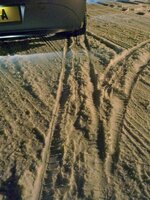
http://www.flickr.com/photos/siftah/4208754537/
It looks like the outer edges of the pattern have quite defined patterns, whereas the centre of the tyre the snow has barely been squashed.
That's my theory anyway - anyone care to comment?
Here's my theory;
Even thought the tyres are run-flat and will maintain most of their shape without any air inside them, the way the tyre is structured it's the side walls which are stiffened. That means that with no air in the tyre it's effectively the edges of the tyre where most of the weight is borne.
That means there's more pressure on those edges and the tyre bites into the snow/ice better than when the tyre's properly inflated. I came to this conclusion by looking at the patterns made in the snow whilst driving along.
http://www.flickr.com/photos/siftah/4208754537/
It looks like the outer edges of the pattern have quite defined patterns, whereas the centre of the tyre the snow has barely been squashed.
That's my theory anyway - anyone care to comment?

How much air have you let out?Siftah said:That's my theory anyway - anyone care to comment?
Let me add my thoughts on the run flats in snow.
Firstly I assume you have let all the air out or near enough all of it.
So you've now compromised the tyres and have just a few miles of road use in them then they are scrap. As you drive on the side walls the inside is ground to pieces and while it may look structurally good the tyre is seriously compromised. The idea is to get you to a garage without changing wheel then scrap the tyres. I've removed a damaged one that had a few miles on it flat and was full of a couple of handfulls of ground rubber. I purchased it for the rim but it came with said tyre. I suggest once you get back to dry roads buy a new set of tyres and don't risk your life.
Next comes the use of less pressure and this is a perfectly valid method of gaining traction. Having compted in off road events across Europe inculded in the Crosiere Blanche, Alps, entirely on snow, and numerous in the worlds bogs and swamps I can confirm the theory is to lower the pressure increase the footprint of the tyres and thus lays more rubber spreads the load prevents sinking and gains 'flotation traction.
The next step is what you've done and because the tyres are so wide they've collapsed in the centre and created 2 narrow tracks. These represent the second way of gripping in low traction situation of narrow tyres biting through to a more grippy lower surface. Think of Landrovers with very narrow tyres designed to bite through mud and snow to firnm ground underneath
Hope this helps
Firstly I assume you have let all the air out or near enough all of it.
So you've now compromised the tyres and have just a few miles of road use in them then they are scrap. As you drive on the side walls the inside is ground to pieces and while it may look structurally good the tyre is seriously compromised. The idea is to get you to a garage without changing wheel then scrap the tyres. I've removed a damaged one that had a few miles on it flat and was full of a couple of handfulls of ground rubber. I purchased it for the rim but it came with said tyre. I suggest once you get back to dry roads buy a new set of tyres and don't risk your life.
Next comes the use of less pressure and this is a perfectly valid method of gaining traction. Having compted in off road events across Europe inculded in the Crosiere Blanche, Alps, entirely on snow, and numerous in the worlds bogs and swamps I can confirm the theory is to lower the pressure increase the footprint of the tyres and thus lays more rubber spreads the load prevents sinking and gains 'flotation traction.
The next step is what you've done and because the tyres are so wide they've collapsed in the centre and created 2 narrow tracks. These represent the second way of gripping in low traction situation of narrow tyres biting through to a more grippy lower surface. Think of Landrovers with very narrow tyres designed to bite through mud and snow to firnm ground underneath
Hope this helps
Wondermike said:How much air have you let out?
Hmm, hard to guage - I didn't check the tyre pressures afterwards to be honest, just let out enough that the tyre appears deflated - probably quite a lot...
jan_tekin said:Might get you out of a sticky situation but you could compromise the Run flat tyre by damaging the side walls.
Yeah, I think you're probably right - definitely not something I'd want to do regularly. I've only covered short distance and at low speed (20mph and less and 2 to 3 miles)
I'm not saying its clever. But I drove around for 3mths on a punctured runflat, I didn't even know as the warning light didn't cme on. It was only when it went in for its service they found it. The tire held up for those 3mths with some spirited driving and when they replaced it there wasn't that much damage to the inner side wall of the tire.
I think they are tougher than people think! I've now got an M nd so glad it doesn' have runflats!! a much smoother drive
I think they are tougher than people think! I've now got an M nd so glad it doesn' have runflats!! a much smoother drive