 Scottish Borders
As requested by Pondrew..
Following on in the classical law of unintended consequences, I discovered that to use the potential of the TTE500 turbos (circa 550 BHP crank) that the low pressure fuel pump would have to be upgraded, probably to a Fuel-it version with a walboro 450 pump.
The LPFP is controlled by a box 'EKP' which receives signals from the DME and alters the speed of the pump to provide more fuel as the demand for power increases.
The EKP box is a simple device, and the same version fitted to all E89s is widely used on over 15 other BMW models.
FWIW it seems that generally, and especially in E89s its a reliable device. Its been iterated over 15 times in its life, mostly due to its internal parts becoming redundant, reducing costs and due to environmental issues.
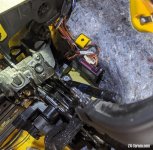
On the E89 its fitted in the rear luggage bay on the RH wall.
The issues are that the EKPs do fail, total failure results in car stopping, overheating (uncommon in E89s but happens in other models in warmer climates) results in a shut down then a magical restart about an hour later.
Cost of a new version 16147407513 is around £275..ebay 2nd user versions are £10-£40 and OE versions are £120-£240.
Given how widely they were used , second hand supply is plentiful and it appears that most versions will work in most cars, at the worst a modest bit of coding is called for with ISAP or Protool (other tools are avalable)
The possible issue is that if you use an uprated LPFP the electrical demand rises from around 17 amp peak to 27 amp peak.
The box then overheats and can fail in one of the ways described.
There is a 3rd party box for about £800 that is uprated but its out of production at the moment.
So to get ahead of the game, I've reseached the subject and plan to have a solution ready when I intsall the uprated LPFP and TTE500 turbos in the autumn.
The plan is quite modest..to improve the cooling and to avoid the failures.
To that end I bought 3 yes 3 ebay 2nd user versions and stripped them down.
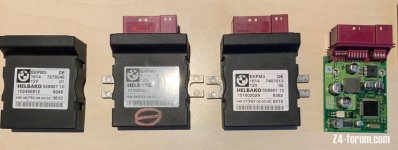
Not sure which version is in my 2011 35is but I got hold of the latest version, version 7 and its predecessor 16147276046, version 6.
Turns out that apart from firmware revisions version 7 looks physically just like version 6.
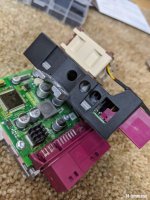
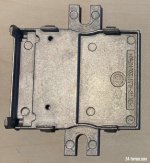
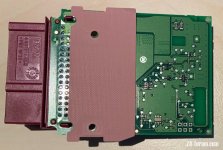
You can see that the board is mounted onto a large aluminium plate which is what is bolted to the car..the pink piece of what looks like paper is heat conductive material, taking heat from the back of the circuit board and directing it to the backing plate.
The two heat producing components on the board are the Infineon BTN7960 main controller circled in yellow and a choke circled in blue.
The plan is to put baby heatsinks on these two components. The pink heat transfer 'paper' is rated at 6w/mk and I'm sourcing some at 15-17 w/mk so about 2-3 times the heat transfer.
I'm going to also add some heat transfer material between the unit and where it mounts to further improve cooling and finally a few holes in the case for good measure.
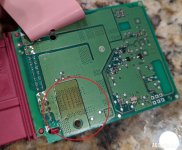
There is a picture of a board where you can see heat distress caused by overheating..circled in red..
Following on in the classical law of unintended consequences, I discovered that to use the potential of the TTE500 turbos (circa 550 BHP crank) that the low pressure fuel pump would have to be upgraded, probably to a Fuel-it version with a walboro 450 pump.
The LPFP is controlled by a box 'EKP' which receives signals from the DME and alters the speed of the pump to provide more fuel as the demand for power increases.
The EKP box is a simple device, and the same version fitted to all E89s is widely used on over 15 other BMW models.
FWIW it seems that generally, and especially in E89s its a reliable device. Its been iterated over 15 times in its life, mostly due to its internal parts becoming redundant, reducing costs and due to environmental issues.
On the E89 its fitted in the rear luggage bay on the RH wall.
The issues are that the EKPs do fail, total failure results in car stopping, overheating (uncommon in E89s but happens in other models in warmer climates) results in a shut down then a magical restart about an hour later.
Cost of a new version 16147407513 is around £275..ebay 2nd user versions are £10-£40 and OE versions are £120-£240.
Given how widely they were used , second hand supply is plentiful and it appears that most versions will work in most cars, at the worst a modest bit of coding is called for with ISAP or Protool (other tools are avalable)
The possible issue is that if you use an uprated LPFP the electrical demand rises from around 17 amp peak to 27 amp peak.
The box then overheats and can fail in one of the ways described.
There is a 3rd party box for about £800 that is uprated but its out of production at the moment.
So to get ahead of the game, I've reseached the subject and plan to have a solution ready when I intsall the uprated LPFP and TTE500 turbos in the autumn.
The plan is quite modest..to improve the cooling and to avoid the failures.
To that end I bought 3 yes 3 ebay 2nd user versions and stripped them down.
Not sure which version is in my 2011 35is but I got hold of the latest version, version 7 and its predecessor 16147276046, version 6.
Turns out that apart from firmware revisions version 7 looks physically just like version 6.
You can see that the board is mounted onto a large aluminium plate which is what is bolted to the car..the pink piece of what looks like paper is heat conductive material, taking heat from the back of the circuit board and directing it to the backing plate.
The two heat producing components on the board are the Infineon BTN7960 main controller circled in yellow and a choke circled in blue.
The plan is to put baby heatsinks on these two components. The pink heat transfer 'paper' is rated at 6w/mk and I'm sourcing some at 15-17 w/mk so about 2-3 times the heat transfer.
I'm going to also add some heat transfer material between the unit and where it mounts to further improve cooling and finally a few holes in the case for good measure.
There is a picture of a board where you can see heat distress caused by overheating..circled in red..

 At the summit of the picturesque fens