
You are using an out of date browser. It may not display this or other websites correctly.
You should upgrade or use an alternative browser.
You should upgrade or use an alternative browser.
Wheel size performance advantages?
- Thread starter Busterboo
- Start date
[youtube]mPyg3ilw3KU[/youtube]Player 1 said:The wheels themselves? Unless they're lighter than those they're replacing then the absolute square root of jack.
Not wheels necessarily, but different tyre profiles will affect handling according to this guy


 North West Surrey
warmasice said:19" are better because they cover more distance for each rotation.
Except they don't if you use the OEM tyre sizes, otherwise the speedo would be wrong!
But if you use run-flats you'll probably be able to damage more wheels on 19s. :lol:
I thought lower profile was to reduce side wall flex so better grip?
But RFT total negate the need for low profile as they already ride as though they are made of wood.
Going to normal one can feel the car is more stable as the flexing allows the car to compensate for minor road irregularities.
The extra inch, so she tells me, doesn't make much difference if anything a harsher ride.
But RFT total negate the need for low profile as they already ride as though they are made of wood.
Going to normal one can feel the car is more stable as the flexing allows the car to compensate for minor road irregularities.
The extra inch, so she tells me, doesn't make much difference if anything a harsher ride.

 1066 Country
Typically 19” wheels are heavier than 18” by a noticeable margin (unlike 17/18” weight difference) - that was my experience with AUDI wheels.... which translates into less fuel efficient.
If you look at the same new car with different wheel sizes, the CO2 emissions are different & am sure it has to do with this
If you look at the same new car with different wheel sizes, the CO2 emissions are different & am sure it has to do with this

Valor1 said:If you research wheels, like HRE and some BMW wheels, you can find lightweight 19 or 20. My 20 weigh less than the OEM 19.
That maybe true but surely you could find some smaller wheels which were lighter than your 20”s?
Rob
Valor1 said:If you research wheels, like HRE and some BMW wheels, you can find lightweight 19 or 20. My 20 weigh less than the OEM 19.
Nice looking car! Alloys look good.
Any more pics? Additionally what tyre sizes are you running with those alloys
Surely they should be weighed with tyres fitted to find out a true difference.Jembo said:Typically 19” wheels are heavier than 18” by a noticeable margin (unlike 17/18” weight difference) - that was my experience with AUDI wheels.... which translates into less fuel efficient.
If you look at the same new car with different wheel sizes, the CO2 emissions are different & am sure it has to do with this
The wheels alone will be heavier but surely the tyres will be lighter as there is less rubber due to smaller sidewall if you go for standard sizes.
Or am I talking crap?
sunnydays said:Valor1 said:If you research wheels, like HRE and some BMW wheels, you can find lightweight 19 or 20. My 20 weigh less than the OEM 19.
Nice looking car! Alloys look good.
Any more pics? Additionally what tyre sizes are you running with those alloys
Thanks. Tires are Michelin Pilot Sport 4S 255/19" front and 285/20" rear.
Attachments



Lazza said:Reducing tyre flex improves steering response but loses grip. Grip comes from maximising contact patch and keeping it in contact with the tarmac and tyres with more give in them do that better. That’s the main reason non run flats are so much better than run flats.
At last, someone who understands that tyre/suspension systems NEED controlled compliance to maintain grip, beyond a certain point bigger wheels, lower profiles and lower/stiffer suspension will do squat for performance on real UK roads :bow:
I would think that is why formula 1 cars dont have low profile tyres either.Ewazix said:Lazza said:Reducing tyre flex improves steering response but loses grip. Grip comes from maximising contact patch and keeping it in contact with the tarmac and tyres with more give in them do that better. That’s the main reason non run flats are so much better than run flats.
At last, someone who understands that tyre/suspension systems NEED controlled compliance to maintain grip, beyond a certain point bigger wheels, lower profiles and lower/stiffer suspension will do squat for performance on real UK roads :bow:
Of course! It's why the road tyres on my MX5 are 205/40/17 but the track tyres are 195/50/15, Which also gives the big advantage of lighter wheels. The deeper sidewalls also help to make the handling more predictable, allowing the tyres to slide in a more controllable way rather than all or nothing. If big wheels with rubber-band tyres were the way forward, F1 would have them.Ewazix said:Lazza said:Reducing tyre flex improves steering response but loses grip. Grip comes from maximising contact patch and keeping it in contact with the tarmac and tyres with more give in them do that better. That’s the main reason non run flats are so much better than run flats.
At last, someone who understands that tyre/suspension systems NEED controlled compliance to maintain grip, beyond a certain point bigger wheels, lower profiles and lower/stiffer suspension will do squat for performance on real UK roads :bow:
Lazza said:Of course! It's why the road tyres on my MX5 are 205/40/17 but the track tyres are 195/50/15, Which also gives the big advantage of lighter wheels. The deeper sidewalls also help to make the handling more predictable, allowing the tyres to slide in a more controllable way rather than all or nothing. If big wheels with rubber-band tyres were the way forward, F1 would have them.
Rubbish. Porsche 919, faster than an F1 car, 18" wheels. Regulations dictate wheel and tyre size in F1, they're aren't chosen for optimal performance.
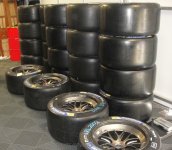
Please lets nail this one, tyres and suspension work together to provide the best grip and handling i.e keeping a big sticky patch of tyre actually in contact with the road. A 919 or go-cart race on a predicable relativity smooth surface so can afford to reduce compliance in the tyre/suspension. A rally car is at the opposite end of the spectrum and needs a very different set-up to provide travel and compliance to keep the contact patch on the road. A road car needs to be somewhere in between, if like me you spend a lot of time on s4ite UK A/B roads with potholes, mid-corner camber wobbles and ruts, then ultra-low profiles, big wheels and lowered suspension will not effectively keep the tyre stuck to the road.
If you track your car or just like the look of big wheels and lowered stance that's fine. If you want the car to perform in a controlled way then set your car up to suit your roads.
If you track your car or just like the look of big wheels and lowered stance that's fine. If you want the car to perform in a controlled way then set your car up to suit your roads.