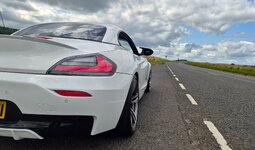
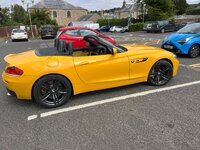
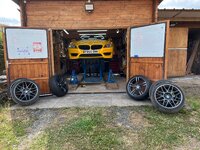
More a question of what I didn't do today..
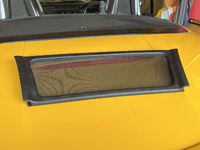
Nobody sets out to test what the wind deflector does. It arrives fitted, it stays fitted, and because it does its job silently you never form a picture of the cabin without it. I found out by accident. The mesh had collected enough dust to turn noticeably opaque — it does this slowly, so you never see it happen — and I washed it in warm soapy water, left it to dry, and forgot to refit it before a shopping run.
The first clue was the mirror. The view rearward was suddenly, conspicuously sharp — which tells you how much light a dust-loaded mesh had been scattering, and for how long I had failed to notice.
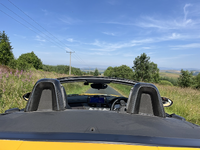
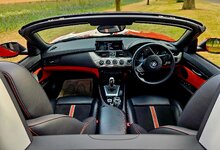
The second clue arrived with speed, and it was not where intuition says it should be. There was no great increase in buffeting around the head and shoulders. Instead the cabin filled from the bottom: a persistent draught pooling across the floor and footwells, then rising up the front of the seats and blowing into my face.
That is not random turbulence — it is the recirculation vortex the deflector exists to interrupt. With the roof down, air spilling over the windscreen header and around the A-pillars leaves a low-pressure void above the cockpit. That void pulls a reverse flow forward from behind the car, and it enters low: over the rear deck, down behind the seats, along the floor, and up into the occupants. Floor first, face second. The head-and-shoulder environment is mostly governed by the screen and side glass, which is why that part barely changed.
The mesh construction is the clever part. It does not work by being a wall. Air passes through it, but the coherent recirculating flow is shredded into fine-scale turbulence on the way, and fine-scale turbulence has no momentum to carry forward into the cabin. A perforated screen achieves nearly the effectiveness of a solid one while avoiding the solid panel's own drawbacks — its buffet contribution and a fully blocked mirror. Drive once without it and the whole design explains itself.


 Scottish Borders
.

 South Lanarkshire







 Abertawe
 Ware, East Hertfordshire
 Essex
Essex