Tyres and hello

Bahnstormer80

New member
Hi Folks,
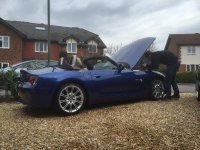
Hello! IMG_4398.JPGI have just picked up my new blue 2.5 Si sport, loving a proper naturally aspirated engine having come from a TT and constantly having to drive it on that knife edge of boost! The Z4 needs some new tyres, and I'd welcome any input / recommendations. It currently has these runflat jobbies and I'm told that it will improve handling and ride to go non-runflat. Questions are then; does anyone have any good recommendations (money not a bottomless pit!) and can I do one axle at a time? I imagine I'll have other questions as time marches on!
Cheers in advance for your thoughts
JB
 
Welcome! A nice looking motor indeed.

I've personally not had runflats on a zed, but i have a friend that swapped them out on his 335i and seemed pretty happy with the result.

You'll probably find the Michelin PSS are the tyre of choice on the forum, though they're probably not the cheapest. I guess if you let us know loosely the tyre budget, then that will dictate your brand limitations. Usually Michelin/Conti/Pirellis are the most expensive, Vredesteins and Eagle F1's are also pretty popular on the middleground.
 
Thanks Jimmybell, my budget is I guess what it has to be for something "middle of the road" I had some Vredestein Ultrac sessantas on my GTV V6 some years ago, I recall that they were reasonable in terms of cost... The zed needs two at least, if I can do one axle at a time that would help the pain on the wallet ... Cheers
 
I'm going to give Kumho Ecsta LE Sport KU39 a go when i change mine next month. Have a lot of good reviews and are a very reasonable price at around ~£87 per corner for the rears and ~£65 per corner for the fronts.

https://www.tyreleader.co.uk/car-tyres/kumho/ecsta-le-sport-ku39/
 
Swapping to non run flats will improve noise and reduce tram-lining, you will find that we all have our own preferences and I don't believe there is a forum favourite tyre, the ones we stick on are going to be the best, else why would you stick them on :D I like Goodyear F1's

As for doing the rears and then the fronts, unless you drive all four wheels and have a locking differential, I cannot see the problem, but some will say you shouldn't but cannot supply a scientific reason why, only that it seems wrong.
 
Bahnstormer80 said:
Hi Folks,
Hello! I have just picked up my new blue 2.5 Si sport, loving a proper naturally aspirated engine having come from a TT and constantly having to drive it on that knife edge of boost! The Z4 needs some new tyres, and I'd welcome any input / recommendations. It currently has these runflat jobbies and I'm told that it will improve handling and ride to go non-runflat. Questions are then; does anyone have any good recommendations (money not a bottomless pit!) and can I do one axle at a time? I imagine I'll have other questions as time marches on!
Cheers in advance for your thoughts
JB

This is a coincidence. I have the same colour and wheels as you and I have just put my car in today for service + wheel change. I'm looking around too.

Just out of interest, do you really notice the difference (in summer time) between good / average / poor tyres? This is my first 'fast' car so haven't had the chance to experience the difference really... thoughts?
 
Jez_m said:
I'm going to give Kumho Ecsta LE Sport KU39 a go when i change mine next month. Have a lot of good reviews and are a very reasonable price at around ~£87 per corner for the rears and ~£65 per corner for the fronts.

https://www.tyreleader.co.uk/car-tyres/kumho/ecsta-le-sport-ku39/

They are cheap tyres but I guess there's fitting on top of those quoted figures.

Back on topic IMHO tyres should always be changed in pairs if possible and never mixed on the same axle on a performance car...
 
If you go with non runflats. You should consider changing your tyre pressures as well.
The M which has non runflats as standard but is a good 100kg or so heavier than your car runs F 30 R 32. The runflats always run higher pressures, not sure why but its probably to protect their special/solid sidewalls.
My 3.0i with non runflats currently runs the M spec pressure and its much better than standard. I am considering trying try a few psi lower to compensate for the fact my car is a fair bit lighter than the M, especially on the front (most of the extra weight is in the M engine).
 
MACK said:
If you go with non runflats. You should consider changing your tyre pressures as well.
The M which has non runflats as standard but is a good 100kg or so heavier than your car runs F 30 R 32. The runflats always run higher pressures, not sure why but its probably to protect their special/solid sidewalls.
My 3.0i with non runflats currently runs the M spec pressure and its much better than standard. I am considering trying try a few psi lower to compensate for the fact my car is a fair bit lighter than the M, especially on the front (most of the extra weight is in the M engine).

I'm not sure where your getting your information MACK, but I don't believe you can use that comparison, why? His car was designed to use run flat tyres, an M was designed not to, thus the spring and dampers have been specified with that in mind. Run flat tyres have a much stiffer sidewall and therefore will be compensated by the springs/dampers. If you fit non run flat tyres to a car designed for them, then you need to compensate for having a less stiffer sidewall by increasing the tyre pressures.

When I first swapped to non run flats I noticed that steering feel and turn in had suffered, I found that a 2-3 psi increase solved this, though running the same or lower pressures may give you a more comfortable drive, depends what you want.
 
sars said:
MACK said:
If you go with non runflats. You should consider changing your tyre pressures as well.
The M which has non runflats as standard but is a good 100kg or so heavier than your car runs F 30 R 32. The runflats always run higher pressures, not sure why but its probably to protect their special/solid sidewalls.
My 3.0i with non runflats currently runs the M spec pressure and its much better than standard. I am considering trying try a few psi lower to compensate for the fact my car is a fair bit lighter than the M, especially on the front (most of the extra weight is in the M engine).

I'm not sure where your getting your information MACK, but I don't believe you can use that comparison, why? His car was designed to use run flat tyres, an M was designed not to, thus the spring and dampers have been specified with that in mind. Run flat tyres have a much stiffer sidewall and therefore will be compensated by the springs/dampers. If you fit non run flat tyres to a car designed for them, then you need to compensate for having a less stiffer sidewall by increasing the tyre pressures.

When I first swapped to non run flats I noticed that steering feel and turn in had suffered, I found that a 2-3 psi increase solved this, though running the same or lower pressures may give you a more comfortable drive, depends what you want.

To be honest you seem to have poo poo'd what I have said without also providing any credible evidence to back it up other than your subjective opinion, the same as me basically.

How do spring and dampers effect tyre inflation? The spring and dampers have no bearing on how inflated/under inflated a tyre will be at different pressures, that's down to the weight of the vehicle. Tyre wear will soon indicate if your running tyres at too low a pressure. Mine currently show no signs of under inflation after a few thousand miles at the lower pressures, early days I grant you.

Heres my argument/point of view (no doubt to be shot down in flames). :rofl:
Runflat tyres have sidewalls that are not designed to flex to anything like the same extent as non runflats ones, otherwise they wouldn't support the weight of a vehicle with a puncture. The rigid sidewalls of runflat tyres sidewalls would flex too much at lower pressures which would damage them over time. This is why your advised to drive no more than 50 miles on a flat runflat or replacement is necessary. Hence higher pressures are required to reduce this. But this level of flex is acceptable in none run flats with there more flexible sidewalls, hence why you can use lower pressures as long as the tyre isn't under inflated on the vehicle.

Suspension wise, its not like none M E85/6's are soft in the spring/dampener department either!
 
My RTFs were running at 36psi front and 42psi rears but my non-RFTs are 32psi front and 36psi rear and I'm happy enough with that.
 
Nice looking Zed. Welcome to the forum.
There's a whole host of info and details on here that will help you with tyres as well as modding that doesn't have to cost the earth.

Getting rid of the run flats will transform the car, they really are awful!

Look forward to seeing some more pics of the Zed!

Happy motoring! :driving:
 
MACK said:
How do spring and dampers effect tyre inflation? The spring and dampers have no bearing on how inflated/under inflated a tyre will be at different pressures, that's down to the weight of the vehicle.

The easy answer to this is look at motor racing, suspension travel and spring rate in F1 are small and stiff respectively, the tyre pretty much does most of the work of the suspension. If they go to 18" wheels the suspension will have to be modified accordingly, because they work together and it is no different in road cars, except most of the work is done by the suspension, but the work hand in hand, change one and effect both. Yes the weight of the vehicle has a bearing on tyre pressures and suspension damper settings, however this is designed in at the beginning as are the variances in weight due to passengers and luggage if you change from run flats to non run flats that is no longer true.

MACK said:
Heres my argument/point of view (no doubt to be shot down in flames). :rofl:
Runflat tyres have sidewalls that are not designed to flex to anything like the same extent as non runflats ones, otherwise they wouldn't support the weight of a vehicle with a puncture.

Yes and no, they are designed to be able to support the vehicle for a limited period of time without any pressure, this is because the sidewall has both sufficient strength and resistance to fatigue (controlling over temperature when flat), this allows prolonged use without pressure compared against an ordinary tyre. The flip side to this is that it is much harder for it to deform and therefore less deformation equates to less work which equates to less temperature.

MACK said:
The rigid sidewalls of runflat tyres sidewalls would flex too much at lower pressures which would damage them over time. This is why your advised to drive no more than 50 miles on a flat runflat or replacement is necessary. Hence higher pressures are required to reduce this. But this level of flex is acceptable in none run flats with there more flexible sidewalls, hence why you can use lower pressures as long as the tyre isn't under inflated on the vehicle.

I'm not sure I follow your logic here, all tyres need sufficient pressure to operate correctly, run flats can operate for at least 50 miles without pressure, where as conventional tyres cannot go 50 yards. If you filled both types of tyre to 50% of their normal operating pressure I would guarantee the non-run flat would fail first because of the superior fatigue resistance of the run flats. It's that extra flexing that causes more energy to be converted into heat, and it's the heat that causes the tyre to ultimately degrade and fail.

MACK said:
Suspension wise, its not like none M E85/6's are soft in the spring/dampener department either!

Perhaps not, but they are designed that way and designed that way to be used with run flats. Trying to compare pressures against a car that was designed to use conventional tyres is fundamentally flawed

At the end of the day you have to account for the difference in wall stiffness with conventional tyres and the only way to do that is increase pressures. As many have stated they prefer lower pressures because it will give a more comfortable ride at the cost of steering feel and turn in.

I do not disagree with it, just the logic you used getting to it, no offence intended
 
Back
Top Bottom