I'm troubleshooting another problem with my 2009 E89. I had a roof hydraulic line break a few weeks ago. I ordered a repair kit and got that fixed. I had some normal movement of the roof right after fixing it, but then it gave a fault after the roof was completely closed. I'm using the ProTool app and cable with my phone and found the A6A5 code which then shows "Supply, End-position Sensors". I searched online and found this relates to the CTM and supply voltage to all of the end-position sensors. I'm suspicious of the battery (seems to have a date code from 2019) but I can measure 12.5 volts at the battery when the engine is not running. Had the car sitting for 20 min (engine off) and the running lights & tail lights stayed on and then the battery voltage measured 11.75 volts (on 2 different meters). I removed liner panels in the trunk to get access to the CTM. On the 41 pin connector on the CTM I measured the same voltage on the large Red wire that I measured at the battery (11.75 to 12.5 volts as above). I don't know what the normal voltage should be on the brown wires that go to all the end-position sensors. I suppose there could be a problem with the CTM voltage output, but it seems very unlikely that the CTM would have failed at the same time or immediately after I had the hydraulic line leak. My next step will be to put in a new AGM battery since I have seen numerous posts about the importance of having a very good battery and the AGM type is recommended. Any help that any of you have regarding the A6A5 code would be appreciated.

You are using an out of date browser. It may not display this or other websites correctly.
You should upgrade or use an alternative browser.
You should upgrade or use an alternative browser.
Troubleshooting Code A6A5 Supply, end-position sensors
- Thread starter nevwagner
- Start date
I see it looks like some owners have fixed the problem when they found a broken wire to a hall sensor or end switch. This doesn't really make sense because there are other specific codes for each end switch and hall sensor. I can do more investigating for these issues, but I'm wondering about when the diagnostics or "system check routine" does its check of the battery voltage? One of the preconditions to operate the roof is battery voltage greater than 11.5V. Also, do any of you know what voltage should be found (normal) on the brown wires coming out of the 26 pin connector on the CTM that go to each sensor?

 Scottish Borders
nevwagner said:I see it looks like some owners have fixed the problem when they found a broken wire to a hall sensor or end switch. This doesn't really make sense because there are other specific codes for each end switch and hall sensor. I can do more investigating for these issues, but I'm wondering about when the diagnostics or "system check routine" does its check of the battery voltage? One of the preconditions to operate the roof is battery voltage greater than 11.5V. Also, do any of you know what voltage should be found (normal) on the brown wires coming out of the 26 pin connector on the CTM that go to each sensor?
Almost always on E89s with electrical issues the first issue is to replace the battery…voltage has very title correlation with charge …nobody knows how /if the CTM understands charge but many ‘faults’ cleared with a new AGM battery…after that you may still have faults but at least one issue is out of the way,,

Generally that is not a health or quality indication, it's a nonsense assumption. If it got replaced in the last 5-8 years, it should be ok.nevwagner said:I'm suspicious of the battery (seems to have a date code from 2019) but I can measure 12.5 volts at the battery...
Don't care about the CTM, it's always fine except it got dameged by a massive water leaking.nevwagner said:On the 41 pin connector on the CTM I measured the same voltage on the large Red wire that I measured at the battery (11.75 to 12.5 volts as above). I don't know what the normal voltage should be on the brown wires that go to all the end-position sensors. I suppose there could be a problem with the CTM voltage output, but it seems very unlikely that the CTM would have failed at the same time or immediately after I had the hydraulic line leak.
What did you do exactly? Pressing a new, additional hose into the roof shell?nevwagner said:I'm troubleshooting another problem with my 2009 E89. I had a roof hydraulic line break a few weeks ago. I ordered a repair kit and got that fixed.
I assume, that you have ignored the general tear and wear in the rear roof shell. As each hydraulic hose and sensor wire will break over time, why shouldn't happen that right now as you have massively touched the hydraulic loom?
There may be a short in the sensor wiring (in the upper bow or the couplings?).
(It's not my Z4, picture found on the web.)
Dr. Bob, thanks for your comments. Last night while I was doing some checking of the control wiring I also had a thought that maybe the A6A5 code is there because there is a short in the control wiring and not a broken wire this time. A control wire shorted to ground would also affect the power supply coming from the CTM.
I'm sure it sounds like I am ignoring the overall deterioration of the loom components. I did read through your thorough maintenance checklist last week. That certainly will give the best chance of making this car reliable enough to take overnight trips. (Right now I am trying to get it repaired so I can drive it for short trips before cold weather hits.) I am planning the major replacement for a Winter project since it will take a considerable amount of time to remove and reinstall everything. Do you suggest purchasing the entire loom assembly and doing the job with that versus splicing in lengths of tubing and wires to replace everything that moves with the roof shells?
I'm sure it sounds like I am ignoring the overall deterioration of the loom components. I did read through your thorough maintenance checklist last week. That certainly will give the best chance of making this car reliable enough to take overnight trips. (Right now I am trying to get it repaired so I can drive it for short trips before cold weather hits.) I am planning the major replacement for a Winter project since it will take a considerable amount of time to remove and reinstall everything. Do you suggest purchasing the entire loom assembly and doing the job with that versus splicing in lengths of tubing and wires to replace everything that moves with the roof shells?
It would take a few hours just to chop all wires to sensors and lay new better wires, just solder new wires.
I would have done all this earlier but needed a 50m extension cable for soldering iron.
No need to strip the whole lot out.
My next project is to replace the left pair as a preemptive strike.
Only 3 pairs to roof.
I would have done all this earlier but needed a 50m extension cable for soldering iron.
No need to strip the whole lot out.
My next project is to replace the left pair as a preemptive strike.
Only 3 pairs to roof.
Well, it's a complex decision.
If a hydraulic hose is broken, the whole hydraulic loom get's replaced.
Update - description for the right side of the car.
If "only" a sensor wire is weakened, I prefer splicing in a new section of about 120 cm LiFy wire into each of the 4 (+2 on the left side) sensor wires beginning before the upper bow on the right and finishing behind the inner bow on the left.
Already broken hydraulic hoses will be taped with a self-welding tape to stiffen the weakened cut.
The latter steps require to remove the rear roof shell sorrowly.
If a hydraulic hose is broken, the whole hydraulic loom get's replaced.
Update - description for the right side of the car.
If "only" a sensor wire is weakened, I prefer splicing in a new section of about 120 cm LiFy wire into each of the 4 (+2 on the left side) sensor wires beginning before the upper bow on the right and finishing behind the inner bow on the left.
Already broken hydraulic hoses will be taped with a self-welding tape to stiffen the weakened cut.
The latter steps require to remove the rear roof shell sorrowly.
Last edited:
 Belgrade
Robbi..how do you rationalise that with these guys pls?Well, it's a complex decision.
If a hydraulic hose is broken, the whole hydraulic lom get's replaced.
Update - description for the right side of the car.
If "only" a sensor wire is weakened, I prefer splicing in a new section of about 120 cm LiFy wire into each of the 4 (+2 on the left side) sensor wires beginning before the upper bow on the right and finishing behind the inner bow on the left.
Already broken hydraulic hoses will be taped with a self-welding tape to stiffen the weakened cut.
The latter steps require to remove the rear roof shell sorrowly.
The hydraulics on this newer model is somewhat more involved and now need 14 hoses in total.
On the new shape pump, all the hoses are removable individually via torex screws.
The ram ends are small push in 90 degree fittings secured with a small circlip.
BMW part numbers do not always match the hoses used on a particular model, neither do the ID numbers.
Because of this, we do not list all the hoses individually, preferring instead to talk to the customer to find out exactly which hose they need.
Our hoses have a tough PTFE inner, wrapped in a stainless steel braid and coated with a wipe-clean PVC coating. This triple layer of protection ensures the hose will never kink or burst by getting trapped.
To ensure a leak-free connection, we attach our custom-made fittings directly to the hose using a highly calibrated industrial swaging machine.
We're so confident they'll last longer than your vehicle, we offer a no-quibble lifetime warranty with every hose.
BMW E89 Z4 Roadster (2009-) Hydraulic Cabriolet Roof Hoses
Direct Replacement Stainless Steel Braided Hydraulic Cabriolet Roof Hoses at a fraction of the cost from a BMW dealer.
 www.cabriolet-roof-hoses.com
Just a matter of quality:Robbi..how do you rationalise that with these guys pls?
The hydraulics on this newer model is somewhat more involved and now need 14 hoses in total.
There are 6 hydraulic cylinders in our E89, connected to 12 hydraulic hoses.
If it's only a typo, it should have been corrected asap, but it's on their homepage since years.
Nevertheless, trying to replace only 1 broken hose is nonsense...
- considering that all four hoses up to the rear roof shell wear out in the same way over the years.
- An individual hose cannot be replaced because all the hoses are permanently taped together as hydraulic harness. You can't simply pull them out or in.
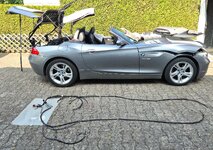
- All four hydraulic hoses should be replaced if one is defective. This requires completely disassembling the old hydraulic wiring harness, laying it next to the car, cutting out the old hoses, inserting the new ones, securing them with tape, attaching all cable ties, and then reinstalling the harness. This takes much longer than simply replacing the hydraulic wiring harness and is considerably riskier, as hardly anyone has experience with this type of work.
- This is the complete hydraulic wiring harness next to the Z4:
Last edited: