

 By the seaside...
Sorry Jonny, that's incorrect, the size of the discs is very important as larger rotors exert more torque on the wheels for any given clamping forceJonny essex said:...its the size of the calliper that dertermines the amount of stopping power as the size would be the overall pad coverage as well as piston power regardless of size of disc...
The overall piston area (rather than the number of pistons) in conjunction with the hydraulic pressure of your braking system dictate the clamping force exerted at each caliper and a 6 piston caliper may not actually provide any greater piston area than a 4 piston caliper (but it may spread the pressure more evenly) so, in the real world, exerts the same clamping force on the brake rotors.
It's important to realise that increasing the size of the pads will not increase clamping force (but will help with brake fade, important on a track, unlikely to be an issue on the road)
I've tried, but been unsuccessful so far, to find out the piston area of the D2 4-pot & 6-pot calipers although anecdotal evidence, based on them being fitted to cars without any changes to the master cylinder, suggests that they only have about the same piston area as the OEM calipers they are replacing - any extra braking torque is being generated by the additional rotor size, not from the calipers.
*If you want the maths behind it
Clamping Force is calculated as Maximum hydraulic pressure in psi x Total effective area of caliper pistons in square inches
NB if they're floating calipers multiply the Clamping Force value by 2
Resultant Braking Torque (ft lbs) is calculated as Clamping Force in lbs x Coefficient of friction between brake pads and rotors (this is a constant for a given type of pad) x (effective rotor radius in inches /12)
NB Effective rotor radius is the measurement from the centre of rotation to the centre of the brake pad
So you can see from this that, whatever clamping force your brakes develop this is multiplied up by the size of the rotors


 its the discs that are bench press weight, but i intend to out weigh that with a Fibre glass bonnet and lighter exhaust.

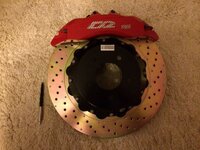

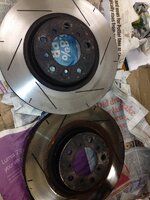


 )), the rear calipers, the brackets. You know all the stuff the mailman brought 8)