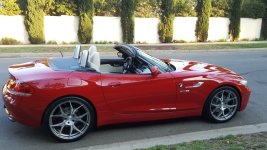
Staggered 19" front 20" rear with 255mm and 285mm Pilot Sport 4S

Valor1

Member
There are a number of reasons, performance and aesthetic, to run staggered wheels, that is, a smaller diameter front and larger diameter rear wheel. IMO the Z4 really needed a larger rear wheel to improve the aesthetics. The larger wheels also allow for an ideal tire fitment and a much larger tire patch in terms of both length and width. The wider tires really give the Z4 a more aggressive stance.

These 19" and 20" wheels are forged so these larger wheels and larger tires actually weigh less than the smaller OEM wheels and tires, improving acceleration and reducing unsprung weight which in turn improves handling and ride quality.

OEM 19” front wheels 27.778 lbs OEM Bridgestone Tire 24 pounds
19” rear wheels 29.247 lbs OEM Bridgestone Tire 27 pounds

Forged 19” front wheel 22.5 pounds Michelin Pilot Sport 4S 255 24 pounds
Forged 20” rear wheel 23.5 pounds Michelin Pilot Sport 4S 285 27 pounds

Total rotational mass savings is approximately 22 pounds.

Herb Adams, an engineer at Pontiac and race car engineer, wrote a well-respected book, Chassis Engineering, and the reduction of wheel rotational weight compared to static vehicle weight was estimated at a one to three ratio: For every one pound of wheel/tire rotation weight reduced it was the equivalent of reducing the vehicle’s static weight by three pounds. He proved his theories on the track where reduced rotating wheel/tire weights resulted in higher speeds and faster acceleration runs.

Applying that formula here my weight reduction of 22 pounds rotating mass is equivalent to reducing the Z4’s static weight by 66 pounds.

The larger tires also contribute to much improved handling and braking. As posted on another BMW forum by someone who fit lighter wheels and tires to his BMW besides better acceleration, "bumps were not transmitted as harshly, steering was more nimble, and steering response was more communicative."

Tire life should also be improved as there is less weight per cubic centimeter riding on the larger tires. Overall this set up gives the Z4 roughly 10 percent greater tire size than the Porsche Boxster Spider. My front tires are now as wide as the widest tires BMW fit to the rear of the Z4. Larger tire patch equals higher cornering capabilities and greater ability to brake harder without wheel lock up.

Looking forward to weighing the Z4 on my Longacre corner balancing scales ASAP.
 

Attachments

  • 20170814_185717.jpg
    20170814_185717.jpg
    195.6 KB · Views: 2,905
...The larger tires also contribute to much improved handling and braking. Tire life should also be improved as there is less weight per cubic centimeter riding on the larger tires...improving acceleration ...

Are you saying you can able to beat laws of physics ?
 
I would guess you've reduced your acceleration by raising the gearing of your car, those big wheels look to have a greater rolling radius than standard wheels. Tell us what profiles you're running?
Rob
 
Wow OP that is a nice colour combination. Is that melbourne red and a beige interior? Manual too? Must not be many of those around in 35i form
 
Valor1 said:
There are a number of reasons, performance and aesthetic, to run staggered wheels, that is, a smaller diameter front and larger diameter rear wheel. IMO the Z4 really needed a larger rear wheel to improve the aesthetics. The larger wheels also allow for an ideal tire fitment and a much larger tire patch in terms of both length and width. The wider tires really give the Z4 a more aggressive stance.

These 19" and 20" wheels are forged so these larger wheels and larger tires actually weigh less than the smaller OEM wheels and tires, improving acceleration and reducing unsprung weight which in turn improves handling and ride quality.

The larger tires also contribute to much improved handling and braking. Tire life should also be improved as there is less weight per cubic centimeter riding on the larger tires. Overall this set up gives the Z4 roughly 10 percent greater tire size than the Porsche Boxster Spider. (My front tires are now as wide as the widest tires BMW fit to the rear of the Z4.)

Looking forward to weighing the Z4 on my Longacre corner balancing scales ASAP.
One HUGE disadvantage you have stated "less weight per cubic centimetre riding on the larger tires" With more rubber on the road their is as you correctly state less pressure on the tyre'. As a result you have poorer grip especially in wet or damp conditions where the tyres dynamics rely on the weight of the vehicle to push it down through the water film and contact the road.
When tyres/wheels are selected by a manufacturer they are done by very skilled engineers, tyre specialists, and computers. They also use feedback from their race teams.
So, they probably know best, best left alone, safety before aesthetics.......

Oh, and make sure you tell your insurer as you have modified the cars handling......
 
mcbutler said:
Valor1 said:
There are a number of reasons, performance and aesthetic, to run staggered wheels, that is, a smaller diameter front and larger diameter rear wheel. IMO the Z4 really needed a larger rear wheel to improve the aesthetics. The larger wheels also allow for an ideal tire fitment and a much larger tire patch in terms of both length and width. The wider tires really give the Z4 a more aggressive stance.

These 19" and 20" wheels are forged so these larger wheels and larger tires actually weigh less than the smaller OEM wheels and tires, improving acceleration and reducing unsprung weight which in turn improves handling and ride quality.

The larger tires also contribute to much improved handling and braking. Tire life should also be improved as there is less weight per cubic centimeter riding on the larger tires. Overall this set up gives the Z4 roughly 10 percent greater tire size than the Porsche Boxster Spider. (My front tires are now as wide as the widest tires BMW fit to the rear of the Z4.)

Looking forward to weighing the Z4 on my Longacre corner balancing scales ASAP.
One HUGE disadvantage you have stated "less weight per cubic centimetre riding on the larger tires" With more rubber on the road their is as you correctly state less pressure on the tyre'. As a result you have poorer grip especially in wet or damp conditions where the tyres dynamics rely on the weight of the vehicle to push it down through the water film and contact the road.
When tyres/wheels are selected by a manufacturer they are done by very skilled engineers, tyre specialists, and computers. They also use feedback from their race teams.
So, they probably know best, best left alone, safety before aesthetics.......

Oh, and make sure you tell your insurer as you have modified the cars handling......

https://www.driving.co.uk/car-clinic/what-you-need-to-know-before-changing-the-size-of-the-wheels-and-tyres-on-your-car/
 
looks like its on baloony front tyres and rubber band rears- overall rolling radius should be the same thus not sure how the acceleration has improved.... be suprised if a 20inch rim weighs less than an OEM 18" one :S
 
mcbutler said:
One HUGE disadvantage you have stated "less weight per cubic centimetre riding on the larger tires" With more rubber on the road their is as you correctly state less pressure on the tyre'. As a result you have poorer grip especially in wet or damp conditions where the tyres dynamics rely on the weight of the vehicle to push it down through the water film and contact the road.
When tyres/wheels are selected by a manufacturer they are done by very skilled engineers, tyre specialists, and computers. They also use feedback from their race teams.
So, they probably know best, best left alone, safety before aesthetics.......

Oh, and make sure you tell your insurer as you have modified the cars handling......

I don't think any race team feeds back information regarding optimal tyre size for a road car, two completely different applications.

Cars often have multiple tyre setups depending on spec. The 3 series for example has optional staggered wheels which come with the M Sport kit. The efficient dynamics cars come with smaller sizes again to reduce fuel consumption.

The tyres are the Z4 aren't selected solely for performance, they also take fuel consumption and road noise into consideration. Putting wider tyres on the Z4 will improve traction but will also increase fuel use and road noise into the cabin.
 
R.E92 said:
mcbutler said:
One HUGE disadvantage you have stated "less weight per cubic centimetre riding on the larger tires" With more rubber on the road their is as you correctly state less pressure on the tyre'. As a result you have poorer grip especially in wet or damp conditions where the tyres dynamics rely on the weight of the vehicle to push it down through the water film and contact the road.
When tyres/wheels are selected by a manufacturer they are done by very skilled engineers, tyre specialists, and computers. They also use feedback from their race teams.
So, they probably know best, best left alone, safety before aesthetics.......

Oh, and make sure you tell your insurer as you have modified the cars handling......

I don't think any race team feeds back information regarding optimal tyre size for a road car, two completely different applications.

Cars often have multiple tyre setups depending on spec. The 3 series for example has optional staggered wheels which come with the M Sport kit. The efficient dynamics cars come with smaller sizes again to reduce fuel consumption.

The tyres are the Z4 aren't selected solely for performance, they also take fuel consumption and road noise into consideration. Putting wider tyres on the Z4 will improve traction but will also increase fuel use and road noise into the cabin.
I can guarantee you that race teams feedback into road car development, why do you think they race to win? It showcases the manufacturers technologies and abilities, M series cars are very race orientated.
Yes cars often have staggered setups AS DESIGNED AND TESTED BY PROFESSIONALS.
All tyres are selected SOLELY for performance, you seem to think that it is only grip that is relative to tyre performance, it includes noise - economy - comfort - grip - braking wet/dry - cornering - acceleration.
Have a read of this website giving the views of professionals in the matter https://www.driving.co.uk/car-clinic/what-you-need-to-know-before-changing-the-size-of-the-wheels-and-tyres-on-your-car/
 
mcbutler said:
I can guarantee you that race teams feedback into road car development, why do you think they race to win? It showcases the manufacturers technologies and abilities, M series cars are very race orientated.
Yes cars often have staggered setups AS DESIGNED AND TESTED BY PROFESSIONALS.
All tyres are selected SOLELY for performance, you seem to think that it is only grip that is relative to tyre performance, it includes noise - economy - comfort - grip - braking wet/dry - cornering - acceleration.
Have a read of this website giving the views of professionals in the matter https://www.driving.co.uk/car-clinic/what-you-need-to-know-before-changing-the-size-of-the-wheels-and-tyres-on-your-car/

If you actually read my post then you would see that I mentioned noise and fuel economy as factors, not just grip.

My point is that identical cars come with multiple different tyre widths and profiles. There isn't one perfect setup.
It usually goes along the lines of the higher you spec a car, the wider the tyres. I'm perfectly aware that there are sacrifices for having wider tyres but faster cars have wider tyres for a reason.

I think the poverty spec Z4s actually come without staggered wheel setups. They have the same chassis and the same "race experts" overseeing the specification.
 
Valor1 said:
There are a number of reasons, performance and aesthetic, to run staggered wheels, that is, a smaller diameter front and larger diameter rear wheel. IMO the Z4 really needed a larger rear wheel to improve the aesthetics. The larger wheels also allow for an ideal tire fitment and a much larger tire patch in terms of both length and width.
Valor1, have a read of THIS
 
R.E92 said:
mcbutler said:
One HUGE disadvantage you have stated "less weight per cubic centimetre riding on the larger tires" With more rubber on the road their is as you correctly state less pressure on the tyre'. As a result you have poorer grip especially in wet or damp conditions where the tyres dynamics rely on the weight of the vehicle to push it down through the water film and contact the road.
When tyres/wheels are selected by a manufacturer they are done by very skilled engineers, tyre specialists, and computers. They also use feedback from their race teams.
So, they probably know best, best left alone, safety before aesthetics.......

Oh, and make sure you tell your insurer as you have modified the cars handling......

I don't think any race team feeds back information regarding optimal tyre size for a road car, two completely different applications.

Cars often have multiple tyre setups depending on spec. The 3 series for example has optional staggered wheels which come with the M Sport kit. The efficient dynamics cars come with smaller sizes again to reduce fuel consumption.

The tyres are the Z4 aren't selected solely for performance, they also take fuel consumption and road noise into consideration. Putting wider tyres on the Z4 will improve traction but will also increase fuel use and road noise into the cabin.

Compared to the OEM Bridgestone Run Flat tires this set up, using the best all around tire on the market, the new Michelin Pilot Sport 4S (which replaces the Super Sport) this set up transforms the harsh riding 19" OEM set up into a much smoother and quiter ride. It is very similar to my SL600 in terms of ride comfort.

In addition, tire width is not the only factor in fuel economy.....as if fuel economy was the paramount concern for a sports car. Tire compounds are a significant factor in rolling resistance and these new Michelin tires are the latest tech on the market. I would gladly trade an mpg or two for this setup over the OEM set up.

As for how the Manufacturer equips their cars the fact is cost and marketing factor in. You can take the same BMW chassis and offer it as an economy car or an M tuned car and you'll note a dramatic difference in tires fit to the same basic vehicle architecture. The fact is COST is a huge player in any manufacturer's decision in how to equip a chassis for the market.
 
Smartbear said:
I would guess you've reduced your acceleration by raising the gearing of your car, those big wheels look to have a greater rolling radius than standard wheels. Tell us what profiles you're running?
Rob

Actually, no as my wheels and tires weigh significantly less than the OEM set up. Less power is required to rotate a lower mass, or put another way, it is easier to rotate a lower mass than a heavier mass. My wheels and tires reduce rotating weight by 22 pounds compared to stock wheels and tires and as such are easier to rotate. Also, with a properly tuned N54 motor, which makes 400 hp or more, the issue is further reduced as a concern.
 
sunnydays said:
Wow OP that is a nice colour combination. Is that melbourne red and a beige interior? Manual too? Must not be many of those around in 35i form

Thank you! No, it's actually crimson red and in this configuration zero were sold in Europe and only 28 globally, including automatic and manual gearbox cars. Probably only 3, give or take, ever produced in this color combination with the N54 motor and a manual gearbox. :driving:
 
[/quote]
One HUGE disadvantage you have stated "less weight per cubic centimetre riding on the larger tires" With more rubber on the road their is as you correctly state less pressure on the tyre'. As a result you have poorer grip especially in wet or damp conditions where the tyres dynamics rely on the weight of the vehicle to push it down through the water film and contact the road.
When tyres/wheels are selected by a manufacturer they are done by very skilled engineers, tyre specialists, and computers. They also use feedback from their race teams.
So, they probably know best, best left alone, safety before aesthetics.......

[/quote]

You are joking right? You think cars leave BMW optimized? Or do you think they are sold with cost considerations as a major factor? Lightweight forged wheels cost a lot more than cast wheels and premium tires cost more than other tires.

With the Z4 your comment is really ironic. Every review I've read about the Z4 with the 19" wheels and Run Flat Tires all commented on how harsh the car rode.

BMW was even sued because their 19" wheels were cracking!!! Why? Poor selection of tires! The fun flats in the size BMW elected to use causes an excessively harsh ride and a ride so harsh that it can lead to wheels cracking!

I learned this first hand. When I bought my Z4 I was shocked at how crappy the ride was. As anyone will atest to, replacing the OEM RFT with non-RFT quality tires transforms the Z4's ride. So you want to tell me how the Z4 came optimized from the factory??? Sorry, BMW really screwed this one up. Had they fit a proper set of wheels and tires the Z4 would have been reviewed more favorably.

Moreover, fitting larger wheels and tires is standard in the performance world because you can lower weight, improve dynamics (handling and braking, etc). Every higher performance version has bigger wheels and tires. BMW does it with their cars, Porsche, GM (Corvette, Camaro, etc) Ford (Mustang), etc.

If what you say is true there would be no need for the Tuner world (AMG, Alpina, RennTech, Ruf, Dinan, etc.)
 
Valor1 said:
R.E92 said:
mcbutler said:
One HUGE disadvantage you have stated "less weight per cubic centimetre riding on the larger tires" With more rubber on the road their is as you correctly state less pressure on the tyre'. As a result you have poorer grip especially in wet or damp conditions where the tyres dynamics rely on the weight of the vehicle to push it down through the water film and contact the road.
When tyres/wheels are selected by a manufacturer they are done by very skilled engineers, tyre specialists, and computers. They also use feedback from their race teams.
So, they probably know best, best left alone, safety before aesthetics.......

Oh, and make sure you tell your insurer as you have modified the cars handling......

I don't think any race team feeds back information regarding optimal tyre size for a road car, two completely different applications.

Cars often have multiple tyre setups depending on spec. The 3 series for example has optional staggered wheels which come with the M Sport kit. The efficient dynamics cars come with smaller sizes again to reduce fuel consumption.

The tyres are the Z4 aren't selected solely for performance, they also take fuel consumption and road noise into consideration. Putting wider tyres on the Z4 will improve traction but will also increase fuel use and road noise into the cabin.

Compared to the OEM Bridgestone Run Flat tires this set up, using the best all around tire on the market, the new Michelin Pilot Sport 4S (which replaces the Super Sport) this set up transforms the harsh riding 19" OEM set up into a much smoother and quiter ride. It is very similar to my SL600 in terms of ride comfort.

In addition, tire width is not the only factor in fuel economy.....as if fuel economy was the paramount concern for a sports car. Tire compounds are a significant factor in rolling resistance and these new Michelin tires are the latest tech on the market. I would gladly trade an mpg or two for this setup over the OEM set up.

As for how the Manufacturer equips their cars the fact is cost and marketing factor in. You can take the same BMW chassis and offer it as an economy car or an M tuned car and you'll note a dramatic difference in tires fit to the same basic vehicle architecture. The fact is COST is a huge player in any manufacturer's decision in how to equip a chassis for the market.

I'm not disagreeing with the tyre choice. I have the same and found my MPG increased, noise lowered and grip improved when moving from MPSS to MPS4S. They are a great tyre.

MPG is not really a concern for me either but it's a nice bonus.
 
Valor1 said:
Smartbear said:
I would guess you've reduced your acceleration by raising the gearing of your car, those big wheels look to have a greater rolling radius than standard wheels. Tell us what profiles you're running?
Rob

Actually, no as my wheels and tires weigh significantly less than the OEM set up. Less power is required to rotate a lower mass, or put another way, it is easier to rotate a lower mass than a heavier mass. My wheels and tires reduce rotating weight by 22 pounds compared to stock wheels and tires and as such are easier to rotate. Also, with a properly tuned N54 motor, which makes 400 hp or more, the issue is further reduced as a concern.

So what profile rear tyres are you using, as your reasoning only takes into account half of the relevant data?
Rob
 
Back
Top Bottom