Roof still malfunctioning after new motor install

kentuckyduck

New member
Greetings, all. I have an '06 Z4 3.0i that I bought used last year (only 53k miles!). The car was in pristine shape and had no mechanical issues.

Toward the end of the fall, the hydro pump began to make an extraordinary groaning noise during the final portion of the roof latching process. Within a few weeks, the motor began to struggle to raise, and then shortly later to even lower. As the weather was turning cold, I decided to put off the repair until spring. In the meantime, I did a lot of research and learned the propensity of the convertible top motor to fail due to corrosion if the drain well got clogged. Not knowing the history of the vehicle for the previous 13 years, I figured that was the case.

I ordered a new hydro pump, which was installed Monday. I've used the same mechanic for more than a decade. He was originally a Honda-certified mechanic, but left a Honda dealership and formed his own import repair shop. He's worked on many BMWs in the past so I felt comfortable using him.

To our surprise, the drain well was clean and the old motor looked brand new. Still, as we're talking about an '06 here, the motor still could've just worn out, right? The fluid level in the old motor was just slightly lower than that of the new motor so we figured we didn't have a fluid issue, either. He also said there was no evidence of a leak at the pump and the lines all looked perfect--no corrosion.

Upon replacement and reassembly, the new pump pushed the roof at the normal speed but intermittently groaned excessively. Uh oh....

Having read that a new hydro pump will self-bleed over the first few cycles, we held out hope that the noise would magically disappear.

Now here we are 3 days later. Road into work with the top down, celebrating 60 degree weather. When I went to close the roof, I got the loud groaning noise and the roof stopped halfway up. I had to (gently) pull the roof as I held the button to finish the closing cycle.

Any ideas what the heck is going on here???
 
Welcome to the Forum.

Firstly, does the roof move freely when you pull the red hoop ?
( This will prove the folding and that there is no resistance within the frame)

Secondly, Did your mechanic re- install the 3 copper washers between the banjo connections at the pump ?
(These are essential. There should be one either side of the two banjo connections and one in between)

Is the motor back in its original position, or did he relocate it into the boot ?
 
Thanks for the replies, RobbiZ4 & Number5.

Sadly, I didn't come across this forum before ordering the repair. Apparently moving the motor to the boot spread across the UK & Europe much faster than the States. Had I known about that procedure, I'd have had my mechanic move it for easy future access. However, the deed is now done.

Regarding the tips: Number5-the emergency release cable operates smoothly. In fact, so much so that I wasn't sure it was operating properly--I'd read other threads where people had to fight the cable to get the pressure to release. With mine, it took almost no effort to release the cable. And once done, the roof glides smoothly & without any hitches (I did have the hinges lubricated during the hydro pump swap).

RobbieZ4, there was no corrosion on either side. As previously stated, the old hydro pump came out looking virtually brand new. No corrosion at all and no evidence of water backing up in either well, and no signs of fluid leakage. There was still fluid in the reservoir of the old pump, though not quite up to the fill line. The mechanic said there was a bit more in the new pump than the old.

Under power, the top goes down smoothly and quickly. Going up, it hitches and groans intermittently, and stalls about halfway up. I then gently tug the next 6" or so and it then finishes the cycle as normal.
 
There is an easy test for this, but only if the motor was in the boot.
You can swap the two pairs of lines over at the pump, then swap the two electrical cables over as well.

This basically makes what was the 'Up' side become the down side and vice versa. If the roof then struggles down but flies up, you've moved the problem over, suggesting that you have a weakness on one side of the pump. This is not uncommon. You can them use the weaker side for 'down/open' which is mostly gravity assisted and use the stronger side of the pump for 'up/close'.

it sounds like your mechanic replaced both the motor and the pump ( the bit with the reservoir on ). Perhaps you can split the two and put the old pump onto the new motor and see if that improves things ?

Unfortunately, you're going to have to get the roof out again, in order to do anything so perhaps its a chance to relocate it then. This gives you the chance to fiddle with the motor with the roof in position and saves loads of time getting it all in/out repeatedly


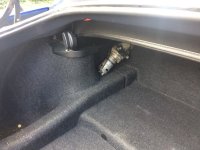
This is where it goes using all existing lines. (No need to extend them)
Motor relocated.JPG

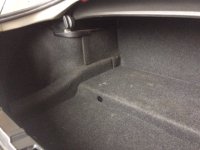
And then hides behind a carpet panel
IMG_6844.JPG
 
Do you get any error lights on the roof button at all? The other relatively common problem is that the wiring that runs down the left hand side of the roof to the hall sensors can fracture causing the roof to work intermittently, but it doesn’t really explain the groaning noise.

Have a good read of this thread and see if you think it sounds familiar...

https://z4-forum.com/forum/viewtopic.php?f=3&t=53729&hilit=Wiring
 
Thanks everyone for the replies. Your suggestions prompted some experimentation on my end. After a brief hiatus due to a hectic work schedule, I was able to fiddle with the roof yesterday. I discovered something; I just don't know what it means!

The roof had been down for a week. Attempting to raise it brought an immediate groaning noise out of the hydro pump and the roof was slow to move. It came to a halt less than a foot up. I was able to use one hand to help it along as I held the up button with the other. The pump seemed to be straining and continued with its extraordinary groaning noise, which sounded like a clutch slipping. One it got past the apex, I went to the boot and released the Bowden cable. It moved easily, with just a slight bit of resistance as it released pressure. From that point, I manually brought the roof to a fully closed position, which was achieved without any resistence. I then lowered the roof halfway back. Nice and smooth. Brought it back closed. Nice and smooth. Lowered it completely. Nice and smooth. Opened and closed a half-dozen times. No resistance beyond the weight of the roof. No unusual catching or hitching. Lo and behold, on the 7th try, after a foot-and-a-half it came to an abrupt halt. No grinding, no rubbing, no noise whatsoever. It was as if someone put a firm hand on the roof from the other direction. No noise, no grinding. Just stopped. I had my daughter hold the roof in place while I went back to the boot. The emergency release cable was still in the "out" position, so I reinserted it and pulled it back out. Lo and behold, there was slight resistance so pressure had clearly built up in the system as I was manually manipulating the roof. Once the pressure was released, it moved forward another foot then hit resistance again. Moved the cable back and forth another time and the release of pressure allowed the roof to completely close.

So I've clearly got a hydraulic pressure issue. I'm guessing I'm not getting the system fully pressurized, which is leading to the groaning/slow operation.But was is the source? I know the system is "self-bleeding" but at what point? There's no evidence of leaking fluid, and the reservoir of the old hydro pump still had fluid in the reservoir. The pump motor doesn't race, which is indicative of air in the system, right?

Others have suggested a faulty hinge. If that was the case, wouldn't the top twist as it raised, with one hinge operating properly and the other sticking?

Thoughts, anyone?
 
Sounds like you’ve got an intermittent release cable that does it’s job initially but then reverts to its normal position, that’s when you feel resistance returning when you manually move it.
As Alan mentioned, it sounds like you’ve got a worn pump.
Rob
 
if the roof goes up and down freely with the bypass pulled, then it can't be a physical obstruction stopping it fold/unfold.

Powering the roof up electronically, then releasing it back down manually will 'bleed' the system of any air.

It could be that you've not enough fluid to push it fully up, but difficult to tell without being able to see the levels. I would also want to be confident that the three copper washers are correctly placed (one before and after each banjo and one in between, on the pump bolt).
If these aren't there, then the banjos arent correctly spaced to allow the fluid to enter and exit the lines effectively.

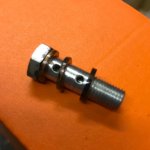
If you note the holes in the bolt, this is where the fluid transfers from pump to the lines. If they're not correctly spaced it can't.
Banjo Bolt.jpg

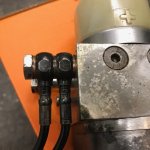
Below are the correct order to connect the lines with a washer in between each Banio. Faulire to do this may allow pressure to build up, but it can circulate. What goes out on one line (up line) comes back on the other (down line) hence the reservior stays fairly level. Many people beleive the reservoir is empty when roof is up and then fills when the roof is down, however it stays fairly level,
Banjo Lines.jpg
 
Smartbear said:
Sounds like you’ve got an intermittent release cable that does it’s job initially but then reverts to its normal position, that’s when you feel resistance returning when you manually move it.
As Alan mentioned, it sounds like you’ve got a worn pump.
Rob

Regarding the cable, I did the pull & 90 degree rotate and it stayed in the locked open position throughout the manual operations.

Also, the motor is brand new. And the “old” one came out looking brand new. No signs of corrosion on the lines either.
 
I think Number5 has a point about checking the banjo bolts washers for correct fitment. To do this, you can relocate the pump into the boot/trunk without removing the roof - there are several threads on how to do this, and if you're lucky and your mechanic didn't use a cable tie to reconnect the pump housing it should be a LOT easier to move it as cutting that cable tie has proven to be near mission-impossible for several members who have tried. Good luck, keep up posted.
 
I think more likely than anything is that the brass plunger (which the bowden cable operates) is just a bit sticky. Once you have pulled the red handle in the boot it rarely pops in and out freely like it should.
 
Agree pull the unit back into the boot, check those Banlo bolt washers are correct and above all lube the bypass valve plunger and tap it in and out so it moves freely under its spring pressure, WD40 and a small panel pin hammer should suffice to do this. If this makes no difference then maybe the pump is worn internally and would need replacement. Reposition the unit permanently in the boot using tie wraps to the bracket behind the side wall carpet. A small home made panel can be made to hide it covering it in carpet and secure it using velcro tape.
 
In my experience, the bypass plunger is either in or out. I can’t see that it’s going to alter mid cycle.
When I have seen it partially pulled, the roof may continue to close but at a slower rate and then as soon as you take your finger off the console button it will drop reasonably quickly rather than park in the halted position.

It sounds to me that you are building pressure to come out of the boot initially but it then stops suddenly at a certain point.

That’s either because it has built up maximum pressure and can’t go any further (because a return line is blocked) or the fluid is low and it’s not able to pump anymore out, again because none is coming back to the reservoir from the opposite line.

Hence my suggestion to double check these washers.
 
Back
Top Bottom