Re mapping

Andyhunn

Member
 North Yorkshire
I have heard lots of good things about re mapping, better bhp, better torque and improved mpg, well doday I had to make a work call to a place and next door was a garage that specialises in re mapping, so I took the Z4 along to see what they could do. My Z is bog standard 2.0i and as you know produces 184 bhp, I let them do their magic and OMFG, it's completely transformed the car, 260bhp now, pulls like a train and I'm getting another 6.5 mpg ( early days yet)
I took it out of the garage, went round a roundabout and onto a duel carageway and gently put my foot down! I was pinned into the seat, WOW.
I'm not a speed freak, I have big bikes if I want to go fast, but this was simply awesome, the power is instant and the torque certainly allows you the confidence that you've got the power there if needed. Any doubts about getting it done have gone, I'm still grinning now!
 
brillomaster said:
260bhp is a bit optimistic, 240 i could believe. mpg gains are even harder to come by realistically.

Not really, 20i can go a bit more than 260bhp as many on here can vouch for. 280 is not unusual :thumbsup:
Rob
 
brillomaster said:
260bhp is a bit optimistic, 240 i could believe. mpg gains are even harder to come by realistically.

I'm sure both Smartbear and Pbondar are seeing in the region of 280bhp from their mapped 20i's?
I also think Mr Bear mentioned at least as good fuel consumption, due to the increased torque, but 6.5mpg may be a little optimistic?
 
Smartbear said:
brillomaster said:
260bhp is a bit optimistic, 240 i could believe. mpg gains are even harder to come by realistically.

Not really, 20i can go a bit more than 260bhp as many on here can vouch for. 280 is not unusual :thumbsup:
Rob

Ah, a quicker keyboarder than me obviously :D
 
enuff_zed said:
brillomaster said:
260bhp is a bit optimistic, 240 i could believe. mpg gains are even harder to come by realistically.

I'm sure both Smartbear and Pbondar are seeing in the region of 280bhp from their mapped 20i's?
I also think Mr Bear mentioned at least as good fuel consumption, due to the increased torque, but 6.5mpg may be a little optimistic?

Yep, fuel economy is unchanged from previous. No issues with that as it’s still good :)
Rob
 
The economy I can only go on from what the car is telling me from me re setting it on the way there and back, like I said it's early days for that and time will tell.
 
Andyhunn said:
The economy I can only go on from what the car is telling me from me re setting it on the way there and back, like I said it's early days for that and time will tell.

Even a change in wind strength/direction will skew figures over a single journey. Remapped turbo diesels can give more economy, remapped petrol cars not really :thumbsup:
Rob
 
AFAIK most re maps keep the same fundamental ratios of fuel and air so if it makes more power then if you use that power you will burn more fuel..

However a lot of manufacturers focus is on fuel economy, the reason they are using turbo charged engines is in part due to the very flat and strong torque curves..

Allied to auto boxes with ever increasingly wide ratios it means that the car can achieve two sometimes divergent objectives..

By keeping the engine running at the peak of the torque curve, for complex reasons , we achieve the best bhp for amount of fuel burnt to achieve it..the optimum specific bhp/fuel burn figure

By running the engine at the lowest rpm possible the mechanical friction losses are minimised...

So a modern turbo with a ‘witches tit’ torque curve allied to an 8 speed box short shifting achieves best mpg..for a given road speed..

To square the OP view on economy the only other explanation is that usually instant fuel consumption figures are computed not measured and in the re-map something odd may have happened..you see a similar thing with the plug in bhp calculations on a smartphone..my phone shows I hit a peak of 185bhp despite the re-map...however if I load the rolls Royce version I show I’m doing 340 bhp..
 
As Pbondar alludes to, if you reset the mpg it will start working out the average from that point, so of course for the first few miles it will be up and down like a whore's drawers. As you do a lot more miles the average will even out a little and stop bouncing around.
I seem to recall on my fiesta it said it used the last rolling 600 miles to average over, unless you reset it. Not sure of the figures, but I'd guess BMW do something similar to that.
 
My 20i mapped is running 274bhp with rolling road proof. Cruising being careful it will return 42mpg on a decent run, typical every day mpg is 35, and playing with the power I get between 20-25 mpg.

I guess a lot also depends on fuel quality used, and how well the vehicle is maintained. 100bhp increase is not unheard of on the N20 engine.
 
Pbondar said:
AFAIK most re maps keep the same fundamental ratios of fuel and air so if it makes more power then if you use that power you will burn more fuel..

Most remaps will run leaner than the manufacturer tune under load. Peak power is between 12:1 and 13:1 and modern turbo charged petrol engines will be running at between 10.5:1 and 11.5:1 at higher load and rev scenarios.

How lean you can go in pursuit of power really depends on the quality of fuel being used and the temperatures in the combustion cylinder. Less fuel means higher cylinder temps which leads to pre ignition.

Here's the fuel table that BMW put in the N20 engine, taken from the stock N20 files I have: https://i.imgur.com/3Ss7USZ.jpg

The attachment seems to scale badly so I uploaded to imgur

The columns are engine RPM, the rows are engine load. 15 load is an engine at idle, 110 is probably the highest load a non tuned car will see.
 
R.E92 said:
Pbondar said:
AFAIK most re maps keep the same fundamental ratios of fuel and air so if it makes more power then if you use that power you will burn more fuel..

Most remaps will run leaner than the manufacturer tune under load. Peak power is between 12:1 and 13:1 and modern turbo charged petrol engines will be running at between 10.5:1 and 11.5:1 at higher load and rev scenarios.

How lean you can go in pursuit of power really depends on the quality of fuel being used and the temperatures in the combustion cylinder. Less fuel means higher cylinder temps which leads to pre ignition.

Here's the fuel table that BMW put in the N20 engine, taken from the stock N20 files I have: https://i.imgur.com/3Ss7USZ.jpg

The attachment seems to scale badly so I uploaded to imgur

The columns are engine RPM, the rows are engine load. 15 load is an engine at idle, 110 is probably the highest load a non tuned car will see.

Seems counter intutive to run leaner on a re-map under load..extra fuel improves cooling and power falls of slower as the mixture goes richer?

Lean mixtures are best for fuel economy and less HC annd CO?

Nice table though?
 
Pbondar said:
R.E92 said:
Pbondar said:
AFAIK most re maps keep the same fundamental ratios of fuel and air so if it makes more power then if you use that power you will burn more fuel..

Most remaps will run leaner than the manufacturer tune under load. Peak power is between 12:1 and 13:1 and modern turbo charged petrol engines will be running at between 10.5:1 and 11.5:1 at higher load and rev scenarios.

How lean you can go in pursuit of power really depends on the quality of fuel being used and the temperatures in the combustion cylinder. Less fuel means higher cylinder temps which leads to pre ignition.

Here's the fuel table that BMW put in the N20 engine, taken from the stock N20 files I have: https://i.imgur.com/3Ss7USZ.jpg

The attachment seems to scale badly so I uploaded to imgur

The columns are engine RPM, the rows are engine load. 15 load is an engine at idle, 110 is probably the highest load a non tuned car will see.

Seems counter intutive to run leaner on a re-map under load..extra fuel improves cooling and power falls of slower as the mixture goes richer?

Lean mixtures are best for fuel economy and less HC annd CO?

Nice table though?

Leaner mixtures produce more power until you go past the 14.7:1 stoichiometric ratio. More fuel than that will mean there is insufficient air for the complete combustion.

Lean mixtures will produce lower CO2 but higher NOx due to the increase combustion temperatures. Manufactures have to hit a sweet spot to satisfy both NOx and CO2 which is why factory maps produce less power.
 
I think your logic is inverted or I don’t comprehend what you are saying..
 

Attachments

  • 7E41FBE1-B459-4ECD-9BDD-2CB7F72A83BD.jpeg
    7E41FBE1-B459-4ECD-9BDD-2CB7F72A83BD.jpeg
    56.5 KB · Views: 907
R.E92 said:
Leaner mixtures produce more power until you go past the 14.7:1 stoichiometric ratio. More fuel than that will mean there is insufficient air for the complete combustion.

Will that actually reduce power? Or just mean you are sending some of the fuel through the system without extracting the power from it?
 
If I can ask a slightly tangential question, does the performance remap significantly affect the emissions to the point where it could cause an MOT fail?

This is assuming all other engine components are in good order.

I have been a bit scared with the insurance quotes up from £350 per year (unmodded with Hastings) to circa £1200 on the comparison sites
 
To take it from the top and its really useful if you have an old fashioned piston engined aircraft where you can:

Adjust the mixture control
Adjust the throttle position
Adjust the pitch on the prop analagous to changin gear
Monitor fuel flow
Monitor cylinder head temperature
Monitor exhaust gas temperature

This is only for petrol engines not diesels..

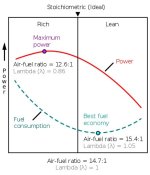
So there is a theoretical perfect ratio between petrol and air (of which only oxygen has any use to the process) which is 14.7:1 ie we need 14.7 kgs of air to burn 1kg of petrol.

In a perfect engine all the fuel would be burnt and converted into water and carbon dioxide and heat, part of which will be converted into power. (from O level chemistry)

In practice the ratio for maximum power lies to the rich side of this, ie less than 14.7 to 1. All the fuel is 'burnt' but because there is not enough oxygen to completely convert the petrol into water and CO2 we get some hydrocarbons broken down into simpler hydrocarbons, some carbon monoxide and the rest is CO2/water/heat as before.

The rate at which power falls of is slower on the rich side of the graph than on the lean side of the graph.

So for max power run slightly rich of the perfect ratio (theory), for best economy run on the lean side of the perfect ratio.

If you go to far either side then the engine either gets to rich to the point where unburnt fuel does exit the exhaust, the classical smell of following an old car with the choke on, or too lean and the engine misfires due to being too lean..

For modern car owners where its completely automated there's not much to see/feel/adjust..

In an old piston powered plan you can twiddle and watch directly your impact..

So cylinder head temperatures go up as a a result of leaner mixtures, wider throttle position, slower forward air speed, coarser prop aka lugging the engine.

Exhaust gas temperature is maximum at best economy setting and is lower at max power setting. Pilots operate the mixture control to get to peak temp then go 100F rich of peak for max power or for max fuel economy at that throttle position adjust mixture lean to peak EGT.

As an aircraft climbs there is less air/oxygen so the mixture lever is in a leaner position for the same either best power or best economy as the aircraft climbs.

Petrol has a strong cooling action as its vaporised (latent heat of evaporation, from O level physics) so runing a petrol engine rich of peak confers additional cooling right where its needed in and around the combustion space.

With a turbo the higher the EGT the higher will be the turbine inlet temperature on the exhaust side of the turbo, which in manually controlled turbos is a limiting condition ie they melt if pushed too hard..

Car engines also change throttle settings freqently and rapidly, so they also tend to run rich at the point of throttle chnage to avoid stumble' where changes in mixture ratio/ total volume can 'snuff out' a very lean running engine..again easily demonstrated in an aircraft where the engine is running perfectly, albeit very lean, rapidlly opening the throttle causes the engine to stall, very embarassing for a newbie at the end of the runway..

In the old days accelerator pumps on carburettors helped get round that issue.

Other complications set in primarily for pollution control reasons..

Super hot oxygen combines in the combustion space with nitrogen to form oxides of nitrogen which we are not fond off..the process is complex and there are different ratios of the different nitrogen oxidation compounds based on combustion temperature. Lean of peak tends to worsen these but we have 3 way cats for this now.

Hope that helps?
 
Pbondar said:
I think your logic is inverted or I don’t comprehend what you are saying..

Stoich is the ratio of air and fuel needed for complete combustion. Stoich and maximum power are one and the same in theory, in practice the cylinder temps will be too high if running at stoich during high loads and pre ignition will occur so people tend to use the term "peak power" as a rule of thumb for a given engine where the most power can be extracted safely.

Peak power is still a lot leaner than the afr at which the manufacturers set in high load scenarios.
 
Back
Top Bottom