 Cognac
Last year I had a problem with my alternator so I ordered a new Bosch one, like for like. It seemed to fix it but now I have the same issue. I only have 12 v at the battery and alternator.. I have another z4 which I can compare readings with and the one that is ok is at 14v when the car is running. Have I just been unlucky and had a new alternator go pop, or am I missing something. Is the voltage regulator built in to the alternator, or is it a separate piece somewhere else that I missed. I thought the regulator and diode pack where all built in. Unfortunately I cannot remember where I bought the alternator from. probably out of any sort of warranty anyway. Thanks in advance.

You are using an out of date browser. It may not display this or other websites correctly.
You should upgrade or use an alternative browser.
You should upgrade or use an alternative browser.
re Alternator Fault
- Thread starter w1ndsurfnut
- Start date


You could take a punt on fitting a replacement diode pack to the alternator if in fact that is the problem, check the make and part number and see what ebay turns up. Had mine die, replaced it like for like and was planning on sourcing a diode pack as the bearings seem fine on the old one.
Update. So I did some tests on the original alternator from the car. Measure across the 2 stator rings looking for around 2.7ohms resistance which I am getting. I did a diode check after looking at some YouTube vids. Measuring from the post to the casing of the alternator I get open circuit 1 way, and 510mv the other way which again matches what I have seen on the net and confirms diode pack is ok. So I am wondering if the alternator is getting the initial voltage that comes to it through the little connector cable. Not sure how to test this. I did read that sometimes this circuit goes through the actual bulb in the dash for the battery, and that if the bulb is faulty the alternator will not charge. But the thing is I see the battery light when I turn on the ignition, and it goes out when the car is started. Anyone got any ideas because I am running out of ideas. I do have another zed and I am thinking of just sticking the one I thought was faulty in that to test it. But its a lot of faff.
Anyone had the same problem. Ive got no charge voltage.
PS I have cross checked all tests on my working car and none working car. I even measured the voltage on the little connector that goes to the alternator, I think its the energiser cable to the alternator. Both cars measure just under 9v with the ignition on, car not running obviously. Working car has a solid 14v when the car is running.
Anyone had the same problem. Ive got no charge voltage.
PS I have cross checked all tests on my working car and none working car. I even measured the voltage on the little connector that goes to the alternator, I think its the energiser cable to the alternator. Both cars measure just under 9v with the ignition on, car not running obviously. Working car has a solid 14v when the car is running.
There is also a regulator as well as the diode pack so that could be duff. Our cars run canbus so not sure the alternator light works in quite the same way as the good old days. The fact you are getting 9V on the field winding suggests that is all ok, but if you are not getting anything above battery volts out of the main winding it's a little strange that the alternator light is not on anyway???
I would take it to a decent auto electrician to confirm but it sounds like another reconditioned alternator is on the cards to me.
I would take it to a decent auto electrician to confirm but it sounds like another reconditioned alternator is on the cards to me.
A friend of mine is pretty hot on motors. He suggested a test on the fat supply cable to the alternator. So I disconnected the battery. Took the air filter off and disconnected the fat cable to the B pillar on the alternator. Covered it with a bit of hose pipe so I did not risk touching the bodywork. Then I reconnected the battery. I have nothing on the fat cable with or without the ignition on. I should have 12 volts. There is a little box next to my battery where the big red supply cables pass through. I am wondering if there is a fuse of relay that is faulty/ blown. Cannot find any reference to alternator fuse on the forum. Anyone?
The alternator can output up to around 100A so will be at least that. Likely to be a large fusible link. I found a picture online which is supposedly from an E85 but I don’t recognise ever seeing those big fusible links on the left. Maybe they are under some kind of cover?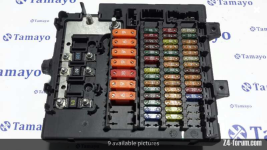
Thanks ph001. That photo is a bit of a find. I did not see that anywhere, and yes those big fuses must be under a cover because when you look behind the glove box you only see the normal type pull fuses. Thanks for this. Will check it out and update.ph001 said:The alternator can output up to around 100A so will be at least that. Likely to be a large fusible link. I found a picture online which is supposedly from an E85 but I don’t recognise ever seeing those big fusible links on the left. Maybe they are under some kind of cover?E5A382AB-EA2B-43AF-821A-886DCD112369.png
Also, did you measure the voltage coming out of the alternator on the b+ terminal with the fat lead disconnected? You should have >14v. This would be the confirmation that the alternator is indeed ok and it’s a fuse / wiring issue.
What is your exact model by the way?
What is your exact model by the way?
Yes a friend of mine suggested something similar. I have nothing on the fat cable when it is disconnected, I believe I should be seeing battery voltage coming back the other way, which I am not.ph001 said:Also, did you measure the voltage coming out of the alternator on the b+ terminal with the fat lead disconnected? You should have >14v. This would be the confirmation that the alternator is indeed ok and it’s a fuse / wiring issue.
What is your exact model by the way?
w1ndsurfnut said:Yes a friend of mine suggested something similar. I have nothing on the fat cable when it is disconnected, I believe I should be seeing battery voltage coming back the other way, which I am not.ph001 said:Also, did you measure the voltage coming out of the alternator on the b+ terminal with the fat lead disconnected? You should have >14v. This would be the confirmation that the alternator is indeed ok and it’s a fuse / wiring issue.
What is your exact model by the way?
I understand you have no voltage on the fat cable (and agree that you would expect to see battery voltage there), but it would certainly also be worth measuring the B+ terminal on the alternator itself with the engine running. You should see around 14V or so.
Ok I will check that as well and update later. Thanks for your help.
ph001 Ive just pm'd you. Cheers. Paul
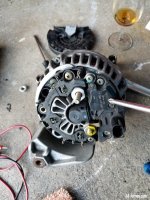
The thing that is confusing things is I have replaced the alternator with a new one. And I still have the problem. I have just done the test on the B pillar suggested by ph001. Start the car, the field cable is on, and I have no 14v on the b pillar. I am totally confused now. Fault finding does not seem to be getting me anywhere.
Was your alternator new or a rebuild? When they rebuild, they only replace broken and worn out parts. So. If rebuilt it may have the old voltage regulator.
If you search there are some diy's that show you how to apply a voltage to your alternator to get it to output a voltage. Or you can take it to a shop and have it checked.
If you search there are some diy's that show you how to apply a voltage to your alternator to get it to output a voltage. Or you can take it to a shop and have it checked.
What an absolute pillock I am. Just doing some tests. I found the hidden fuses as per phoo1 photo. Measured all the big 100A 2 x 60A fuse, not problem. Went to trace where the positive cable from the alternator goes. Pulled cable and it has come out in my hand. Guess what I did. When I changed the starter motor ages ago The cable that goes to the starter must have dropped away, and I did not re connect it. What a dick. It still has the tape on it from when I did it.
Just checking some old threads as I have the battery light on and am getting around 12v (and dropping) at the battery, with the engine running.javis20 said:]My guess is it's the voltage regulator on the back of the alternator. Easy fix. You can actually replace it without removing the alternator. Remove the air box and you have plenty of room.
Is it worth try to renew the voltage reg or just go for a new alternator,
Really depends on the age of the alternator, if its original and your mileage is high probably best bite the bullet and fit a recon alternator that has passed the manufacturers test following rebuild. They replace any worn items and that would include the bearings if they had been found to be suspect. Usual faults on alternators are the regulator/diode pack failing you can replace these at lower cost than a full recon unit. had the same choice when mine failed, decided to go the recon route.