pilchardthecat's MAF screen mod

If the dip in power is caused by a restriction in the air-intake I'm presently puzzled to know why this is then followed by a rebound at 7600rpm? The rebound is confirmed by the datlog of airflow through the MAF. After all my modding, in 3rd gear I now see a maximum airflow of over 34lbs/min in comparison to 31.2lbs/min when my car was OEM.

Anyway, I've just bought some honeycomb mesh off ebay for £2.65 and I've also ordered some of that 4.1 honeycomb from saxonpc at 22.53USD (£14.77) so I'll make a couple of MAF screens and I'll datalog them both. :thumbsup:
 
So, we need someone to create a full CF airbox, with a top-switchable Eureka mod (which is what I'm planning to do with it), and a honeycomb MAF screen!

BTW, my data logging of the 'before' failed due to the app crashing on the iphone when I tried to save the log in DashCommand. No trace of the 4 hours of logging I'd just done, but the good news is it looks like I'd used the wrong setting anyway and it would only have recorded my speed & fuel consumption.

Will try to capture at least an hour's worth of 'before' figures on the way home this/next Thursday and on Monday, to compare with similar runs over the next 2 weeks.
 
pilchardthecat said:
The rebound could be due to resonance being in-phase. Are the plenums significantly different between the e46 M3 and the Z?

No difference at all. Part number: 11 61 7 835 819 shows same for Z3M, E46 M3 and Z4M. That's why I'm wondering if the resonance of the air-intakes (pre-plenum) make a difference, because there's a very significant difference between all the three variants using the same plenum. The Z3M is restricted to max revs of 7600rpm, so any drop off above 7200rpm doesn't have any rebound, so no comparison possible here.
 
Anything the wrong side of the MAF screen is going to have a tiny impact on resonance - there's just too much between there and the valves.

However if there were packaging issues with bonnet space, it could be the length of the pipe between the plenum and the first bend, or the first bend and the MAF screen (are these different?). If you really wanted to test this, you could fabricate a short section (say 2 inches) of the oval pipe that connects the intake to the plenum, and make it a bit longer. This would change the internal dimensions and alter the alignment of any pressure waves with the valve timings (although if the wavelength was exactly the same as your extension length it wouldnt do anything, so probably best to try a one-inch long section too)
 
My dyno (posted on another thread last week) didn't show a dip at 7200 but it had levelled off noticeably. Unfortunately I don't know whether it would've then stepped up again at 7600 because they chap doing it wouldn't take it above 7400.
 
I've now received the honeycomb screen and fitted it into a spare air-filter box lid so I'll get around to data-logging this mod soon. :thumbsup:
 
Rec mine and fitted it . been out for my usual run. 60mls mixed driving seems to be a bit flat on low revs 2000 ish but above 3000. Seems better ? Fuel consumption marginally better.or at least no worse.+ car is decatted.
Would taking the stuffing out of the back box do anything apart from more noise:grin: 3.0 se.
Moz


Sent from my GT-I9300 using Tapatalk 2
 
I did some datalogging of the Honeycomb MAF screen mod versus the OEM MAF screen in my Z4MC this morning.

The best way to assess any changes which might occur from modding the air-intake system is by datalogging the parameter of "Airflow through the MAF", because the more efficient the air-intake, the greater the airflow through the MAF to which the appropriate amount of fuel can be added by the ECU. When my Z4MC was completely OEM when I first bought it, the maximum airflow through the MAF in 3rd gear at an ambient temperature of 5degs C was 31.2lbs/min.

After doing several air intake mods and gutting the silencers I've managed to get the maximum airflow through the MAF in 3rd gear at an ambient temperature of 2degs C to 34.5lbs/min this represents an increase in airflow of 10.57%.

So, I did a couple of accelerations with my Z4MC in opposite directions on the same test track with all my existing mods and immediately afterwards I parked up and then removed the OEM MAF screen from my OEM air-filter box and swapped it for the Honeycomb MAF screen. It took about 5 minutes to swap the screens and then I got back in the car and did the same test again. The ambient temperature was 21 degsC and the humidity was 73%. It was relatively windless.

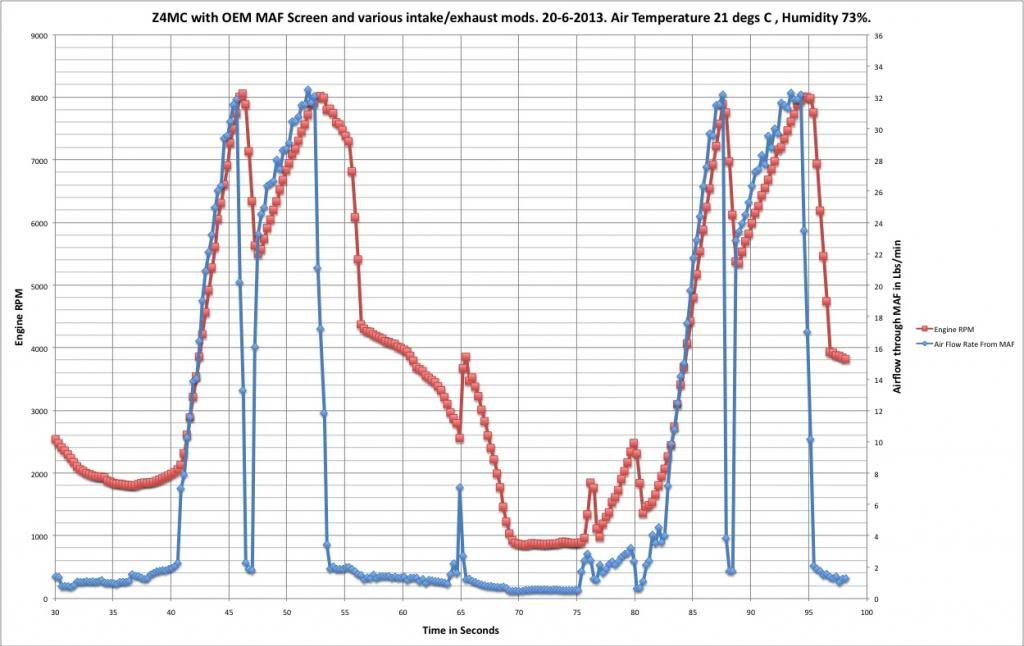
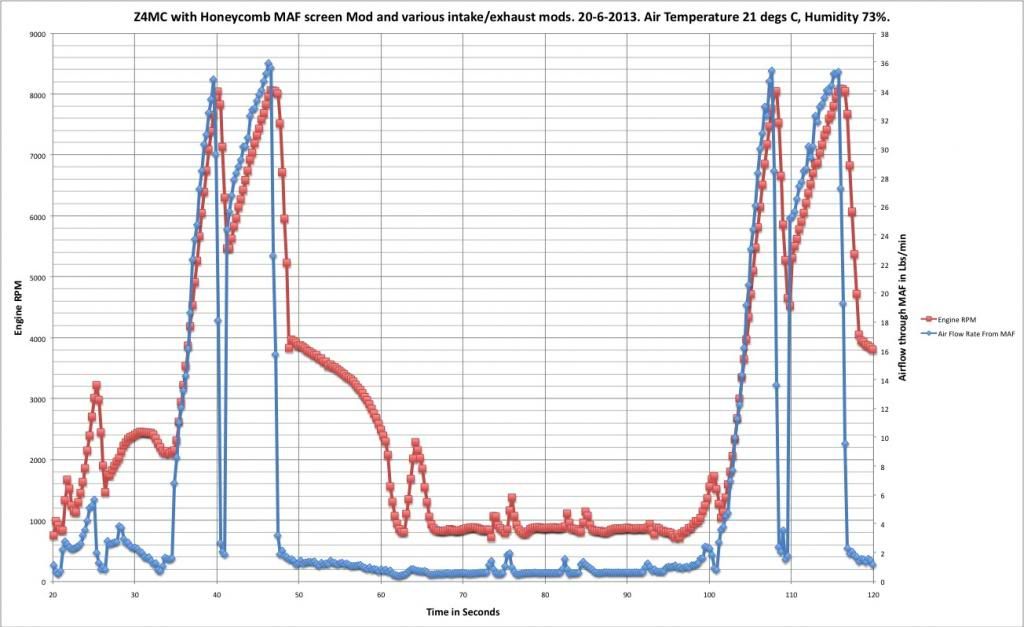
Here are the graphs of the OEM v Honeycomb runs.

WithOEMMAFScreen20-6-2013_zps9d12388a.jpg


HoneycombMAFScreen_zpsd4fe719c.jpg


The maximum Airflow through the MAF when I was running the OEM MAF screen was 32.49 lbs/min (this is lower than my previous figure of 34.5lbs/min because the temperature was 18 degs C higher today, which reduces the air density). The maximum Airflow through the MAF when I was running the Honeycomb MAF screen was 35.93lbs/min: this represents an increase of 10.58% above what my modified intake/exhaust set-up was producing under the same conditions. :D 8) This mod definitely works! :thumbsup:

From researching the honeycomb screens I see that this mod has been round for over 10 years for the Corvette see: http://www.southerncarparts.com/Inst/MAFscreen.pdf. Big thanks to pilchardthecat for bringing it to our attention. :thumbsup: :thumbsup: :thumbsup:

I shall analyse the data some more and produce some more information from it.
 
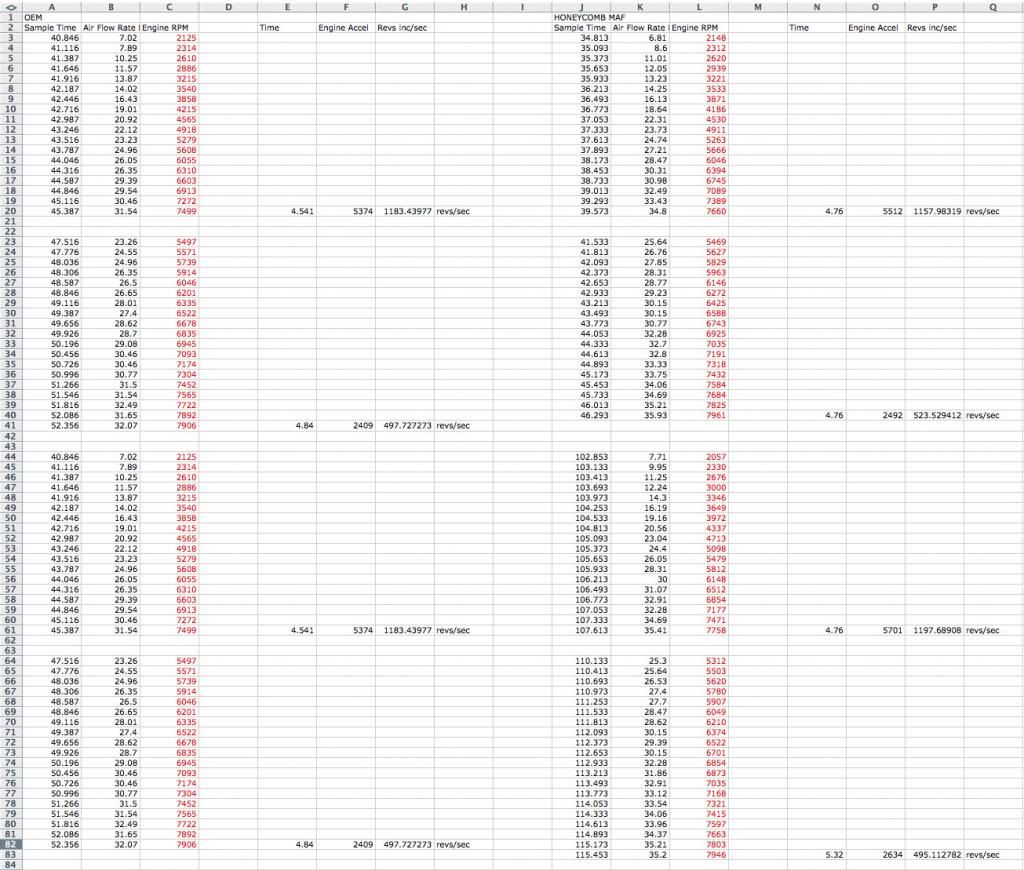
Below is the raw data from the datalogging.

The 4 data samples on the left are when the car was OEM, and the 4 samples on the right are when the car had the Honeycomb MAF screen. The top two samples both OEM and Honeycomb, were when the car was travelling South on the same track and the bottom two samples were when the car was travelling North on the same track; therefore the data has been presented so that it is comparable, when viewing horizontally.

I've used the "time stamps" for the datalogs and the engine rpm to calculate "engine acceleration". For example, using the top left sample; it takes from 40.846secs to 45.387 secs for the engine to accelerate from 2125rpm to 7499rpm (= total 5374 rpm increase), and this represents an engine acceleration rate of 1183.43977 revs/sec during that sampling period.

From comparing the engine acceleration of the OEM MAF screen against the Honeycomb MAF screen, there doesn't seem to be much difference in engine performance between OEM and Honeycomb MAF screens despite there being a very significant difference in airflow through the MAF with the Honeycomb MAF screen. Bearing in mind that I did the test runs immediately after swapping the MAF screens, without resetting the ECU or allowing any time for the ECU to make its own adaptations to a greater airflow, it's possible that this may produce the increase in performance that an increase in airflow potentially provides. I will datalog the car again after doing some more miles to see if there's any adaptation improvement. I suspect that the fuelling was a little "conservative" with the increased airflow through the honeycomb MAF screen. We shall see.


Exceldatalog_zps6104e0e3.jpg
 
I have no idea what any performance benefit might be, although i suppose in principle the aught to be one.... but either way it's nice to see the flow improvement confirmed
 
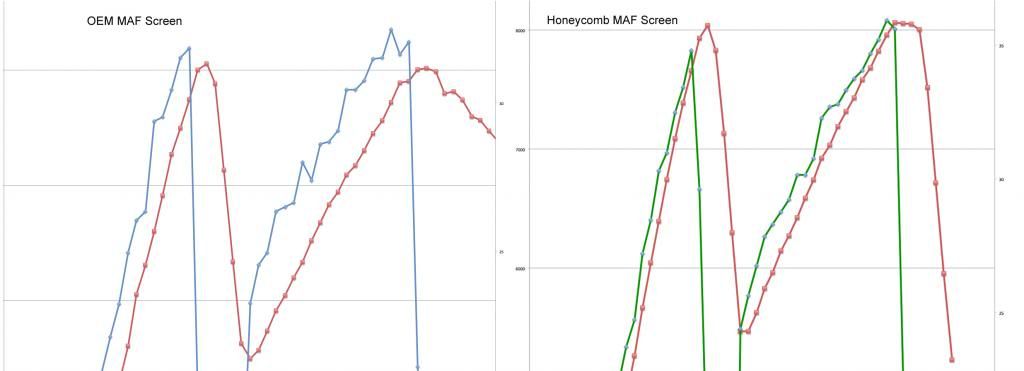
I've done an enlarged graphical representation showing the comparison of airflow (blue line OEM, green line Honeycomb) and Engine rpm (red lines) when with OEM MAF screen and with Honeycomb MAF screen, as below. I think that this shows beyond doubt that the Honeycomb MAF screen provides a much better airflow (and more of it). It also makes the engine acceleration smoother too, right up to the redline. :thumbsup:

I just need to do some more datalogging to see how this might provide any tangible performance gain with my car (and all its intake/exhaust mods).


OEMairflowcloseup_zps5595fcac.jpg
 
exdos said:
I've done an enlarged graphical representation showing the comparison of airflow (blue line OEM, green line Honeycomb) and Engine rpm (red lines) when with OEM MAF screen and with Honeycomb MAF screen, as below. I think that this shows beyond doubt that the Honeycomb MAF screen provides a much better airflow (and more of it). It also makes the engine acceleration smoother too, right up to the redline. :thumbsup:

I just need to do some more datalogging to see how this might provide any tangible performance gain with my car (and all its intake/exhaust mods).


OEMairflowcloseup_zps5595fcac.jpg

Thanks - i really appreciate those graphs :) it's very much representative of my smoke tests and theory - much more solid laminar flow, less turbulence = better MAF signal.
 
You two guys are amazin(exedos,pilchard t.c. )keep up the good work .Installed the honeycombe at first it seemed flat/hesitant lowdown.but had a 300ml cruz on wed .and now seems to have settled down and seems to better at higher revs 4000+.Pleased to say fuel consumption hasnt suffered.
I assume the maf learns and adjusts to changes .
Moz

Sent from my GT-I9300 using Tapatalk 2
 
also , I would like to say thanks both to pilchardthecat and exdos ... I will look into both mods when I get time ... Big Thanks for sharing your knowledge.

exdos ... the engine rev graph with the honeycomb is much steeper on the time axis ... i guess the engine will rev much faster = better acceleration ... was this data logging done in real world conditions??? (of course on a closed road :wink: )
 
tombar said:
exdos ... the engine rev graph with the honeycomb is much steeper on the time axis ... i guess the engine will rev much faster = better acceleration ... was this data logging done in real world conditions?
Don't read anything into the steepness of the graphs because the 2 graphs are slightly different scales because I didn't stretch the graph images identically, I simply wanted to demonstrate the relatively smoother data points from the ECU with the honeycomb MAF screen due to the laminar flow characteristics. All my datalogging is done in real world conditions: I am no fan of static dynos.
 
Back
Top Bottom