No one wants a CF Airbox?

fighting_fish said:
Franzino said:
Same here; 4.000 dollars for a slight power gain en some CSL induction noise does not do it for me. Too much money for me based on what it would provide. Imagine what other nice modifications you can buy with 4.000 dollars.

It's 2/3rds of the power to ESS stage 1, for 2/3rds the price. Price per horsepower it's definitely worth the money. The CSL induction noise is just a free bonus. Keeping the car N/A is another bonus. If you know anyone with a supercharger, you know it's a LONG process of tweaking, buying parts, moving hoses, etc. etc. it's a huge labor of love. Not saying it's not worth it, but it has a lot of hidden costs.

And no, there is no other power mod that comes close to this. Seriously name one. Induction does nothing for our cars, full exhaust from the cats back does 10hp at the most.
Personally I would never fit a supercharger or turbo on a car that is designed as a NA car. I love NA cars and if I want a car with a supercharger, then I will buy one that's is designed this way and not make one myself. But that's just me 8)
Yes everything you say is true; it's 2/3rds of the power of ESS stage 1, for 2/3rds the price! But IMO; the gains are not worth the money. If I had unlimited funds, then I would probably do it also...but for me there is more into a car then only the power, so I would like to spend 4.000 dollars on other thing then more horsepower. That is my personal opinion and can be different for other people. I have fitted AP racing brakes on my Z4M. Some people may also find it's not worth the money... On the street this is true; but I do around 10-12 trackdays a year, so the investment makes more sense and I enjoy this mod a lot...

 
original guvnor said:
I look at the CSL power and torque outputs - IIRC 355bhp and 272 lb/ft torque with a carbon airbox, new cams and Alpha N tune? And I think to myself if M Division only extracted these numbers then how is someone else doing so much better with essentially the same set-up? I'm not saying I don't believe the gains, just that I need more explanation. Are they capitalising on the same sort of effect that Exdos has been experimenting with?


exdos said:
I have refrained from making any comments about this until now, but you've just hit the nail on the head.

I don't know the reason either, but people are getting better gains than this real world, I imagine that like everything Evolve is a very reputable company and will always report very conservative numbers. See here and here.

Also look at the dyno plots, peak torque happens much earlier, right around the middle of the power band. So even though the numbers are smaller than a stage 1 supercharger, they don't happen right at 8k so it's much more usable power. The difference in the above two dynos is related that the higher one (xspade) had custom alpha-N tuning, while flipm3 got the out of the box alpha-n tune.

Franzino said:
Personally I would never fit a supercharger or turbo on a car that is designed as a NA car. I love NA cars and if I want a car with a supercharger, then I will buy one that's is designed this way and not make one myself. But that's just me 8)
Yes everything you say is true; it's 2/3rds of the power of ESS stage 1, for 2/3rds the price! But IMO; the gains are not worth the money. If I had unlimited funds, then I would probably do it also...but for me there is more into a car then only the power, so I would like to spend 4.000 dollars on other thing then more horsepower. That is my personal opinion and can be different for other people. I have fitted AP racing brakes on my Z4M. Some people may also find it's not worth the money... On the street this is true; but I do around 10-12 trackdays a year, so the investment makes more sense and I enjoy this mod a lot...

Again it's not worth the money for *you*. Which is something very relative to each person, where they are in their modding stages and where their priorities lie. However I completely agree with you, I want to stay NA, I like NA power. I also agree with you that there's better things to spend money on than power. I did suspension/tires/etc. first. Now I'm looking for more power.

What I'm saying is it's definitely worth the money. When looked at what it does for performance, as well as for what it is as an item in itself. Price per performance it's almost the same as supercharging, and supercharging is the best bang for the buck by far. No other power mod comes even close to this.
 
fighting_fish said:
I don't know the reason either, but people are getting better gains than this real world, I imagine that like everything Evolve is a very reputable company and will always report very conservative numbers. See here and here.

Also look at the dyno plots, peak torque happens much earlier, right around the middle of the power band. So even though the numbers are smaller than a stage 1 supercharger, they don't happen right at 8k so it's much more usable power. The difference in the above two dynos is related that the higher one (xspade) had custom alpha-N tuning, while flipm3 got the out of the box alpha-n tune.

Fighting Fish,

I've looked at the link you've given to FlipM3's E46 M3 and done some calculations based on the figures given in those dyno sheets, and a great part of the gain comes from the fitting of the stainless headers. Here in the UK, our E46 M3s and Z4Ms have euro-style exhaust manifolds which are inherently less restrictive than the US parts. Consequently, I think most owners in the UK would rely on Evolve's own published dyno plot (as shown in my previous post) which shows that the gain is around 30hp at the flywheel. Therefore for a UK owner, this gain will cost $4000 and that is not directly comparable with the cost of increased HP achieved by supercharging on a $$$ cost per HP gain basis as you're suggesting.
 
exdos said:
I've looked at the link you've given to FlipM3's E46 M3 and done some calculations based on the figures given in those dyno sheets, and a great part of the gain comes from the fitting of the stainless headers. Here in the UK, our E46 M3s and Z4Ms have euro-style exhaust manifolds which are inherently less restrictive than the US parts. Consequently, I think most owners in the UK would rely on Evolve's own published dyno plot (as shown in my previous post) which shows that the gain is around 30hp at the flywheel. Therefore for a UK owner, this gain will cost $4000 and that is not directly comparable with the cost of increased HP achieved by supercharging on a $$$ cost per HP gain basis as you're suggesting.

I'm aware of the difference in headers. As you mention Flip has Supersprint stepped headers, which do dyno slightly higher especially with the less restrictive US cats.

However the other plot (the plot showing bigger gains with the custom dyno alpha-n tuning) the owner bought Euro headers AND cats. So his setup would be identical to a setup in the UK.

So no, it does show that $ per power it's very close to supercharging. Especially if you take into account that the cost to install a supercharger is significantly higher, and you will inevitably have to buy clamps/brackets/extra parts/etc. to do it perfectly. Ask beedub if you don't believe me that it takes a lot of tweaking and extra parts to do right, just his beautiful catch can is an extra $250 or so.

And seeing as there is no other power mod that remotely compares, I don't get why people say it's not worth it. Really for power there's only this and supercharging, and this option gives you one more rung in the ladder:

Airbox (4k) > supercharger stage 1 (7k) > supercharger stage 2 (10k+).

Looking at it another way, bang for the buck:

Supercharging > Airbox >> Differential Gears >>>>> everything else (intake, tune, pulleys, etc. etc.)

All of it while staying NA, not having to deal with extra points of failure, and having that beautiful induction noise.
 
fighting_fish said:
However the other plot (the plot showing bigger gains with the custom dyno alpha-n tuning) the owner bought Euro headers AND cats. So his setup would be identical to a setup in the UK.

So the question that must be asked is: how does the owner "sticky" manage to achieve 46.8hp "at the wheel" gain on a Dynojet Research dynamometer (as per your link to his thread on the Bimmerboost forum) with an identical E46 M3, that Evolve has used, yet Evolve themselves can only achieve a gain of 30hp "at the flywheel" on their DynoDynamics dynamometer? A figure of 46.8hp "at the wheel" equates to a gain of 55hp "at the flywheel", which is almost double that which Evolve records. Why are these 2 figures so different to each other when Evolve supplies the CF airbox and does the tune for both cars?
 
exdos said:
So the question that must be asked is: how does the owner "sticky" manage to achieve 46.8hp "at the wheel" gain on a Dynojet Research dynamometer (as per your link to his thread on the Bimmerboost forum) with an identical E46 M3, that Evolve has used, yet Evolve themselves can only achieve a gain of 30hp "at the flywheel" on their DynoDynamics dynamometer? A figure of 46.8hp "at the wheel" equates to a gain of 55hp "at the flywheel", which is almost double that which Evolve records. Why are these 2 figures so different to each other when Evolve supplies the CF airbox and does the tune for both cars?

Good question, but if you search the e46 forums those results are not atypical for the many evolve airbox installations.

Also you guys keep focusing on HP and that's the wrong number to look at. Let me explain why:

The formula for horsepower is

49b9b534acdc06c352c3d6bb30fd12da.png

T is torque
f is rpm

Therefore, the higher the rpm, the higher the HP.

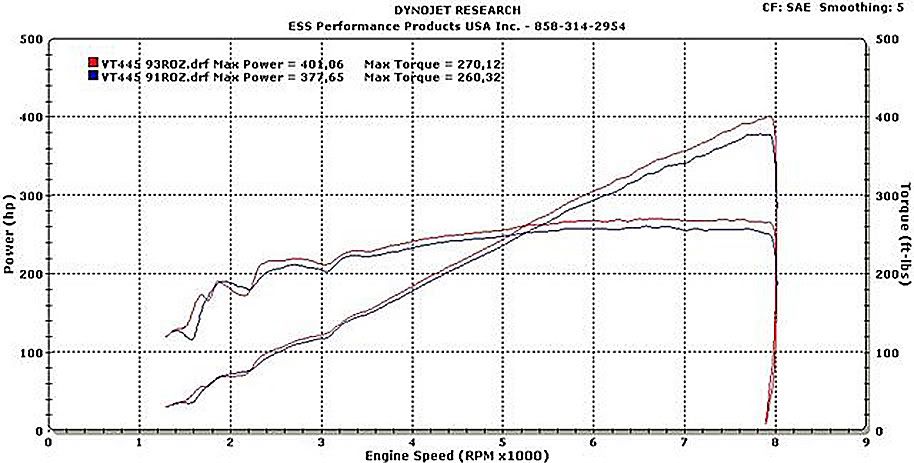
When you look at a dyno like this one:

vt1-445-1.jpg


Notice how the torque goes up all the way to redline. Therefore the max horsepower happens RIGHT at 8k rpm (8k * torque). Who spends more than a few seconds at 8k rpm between shifts?

A better way to look at it, is to look at the horsepower and torque for a small section, like 5-7 rpm. Which is a realistic window for "performance driving", and if you're talking more about street power, I'd say the window should be more like 3-7.

If you only look at that window, and focus your attention on the torque (which is really what you feel, not the horsepower) you'll see how the kits compare a lot more favorably than looking just at that final number which is not usable or realistic.

Let's take 5k rpm and use the official ESS dyno (posted above) versus the official evolve dyno (which you posted). At this engine speed, the evolve dyno is showing roughly 230 horsepower and 250 torque (I'm using numbers from the graph x 0.85 for wheel horsepower). The ess dyno is showing roughly 250 torque and 270 hp, which is roughly 8% more.

Let's take 7k rpm ESS here has about 270 torque and 360 hp, while the airbox has 212 torque and 290 horsepower. Now you begin to see how the supercharger starts pulling away. And it continues to pull strong all the way to 8k. Now we're at a difference of roughly 20-25%.

Is the difference that huge? not really. It only looks like a big difference when you take the HIGHEST numbers for both, which is how people compare these kits. And comparing the highest numbers is completely meaningless. In a realistic driving scenario the airbox trails the supercharger by 8 to 20%.

And this is using the evolve official numbers, which are very conservative as I have seen many dynos showing higher numbers, including the two I linked. And we also know that in a real world scenario, the extra air from driving at speed will give the airbox even better numbers (the supercharger suffers less of this problem being force fed air).

In a more realistic scenario, with actual user dynos, at speed, the difference should be more in the 0-5% to 10-15% range. Which means that until 5k rpm (and cursing around town) your airbox will feel almost identical to the supercharger.
 
fighting_fish said:
Good question, but if you search the e46 forums those results are not atypical for the many evolve airbox installations.

I know it's a very good question, that's why I asked it. 8) But you haven't answered it! :poke:


fighting_fish said:
Also you guys keep focusing on HP and that's the wrong number to look at. Let me explain why:

The formula for horsepower is

49b9b534acdc06c352c3d6bb30fd12da.png

T is torque
f is rpm

Therefore, the higher the rpm, the higher the HP.

When you look at a dyno like this one:

vt1-445-1.jpg


Notice how the torque goes up all the way to redline. Therefore the max horsepower happens RIGHT at 8k rpm (8k * torque). Who spends more than a few seconds at 8k rpm between shifts?

A better way to look at it, is to look at the horsepower and torque for a small section, like 5-7 rpm. Which is a realistic window for "performance driving", and if you're talking more about street power, I'd say the window should be more like 3-7.

If you only look at that window, and focus your attention on the torque (which is really what you feel, not the horsepower) you'll see how the kits compare a lot more favorably than looking just at that final number which is not usable or realistic.

Let's take 5k rpm and use the official ESS dyno (posted above) versus the official evolve dyno (which you posted). At this engine speed, the evolve dyno is showing roughly 230 horsepower and 250 torque (I'm using numbers from the graph x 0.85 for wheel horsepower). The ess dyno is showing roughly 250 torque and 270 hp, which is roughly 8% more.

Let's take 7k rpm ESS here has about 270 torque and 360 hp, while the airbox has 212 torque and 290 horsepower. Now you begin to see how the supercharger starts pulling away. And it continues to pull strong all the way to 8k. Now we're at a difference of roughly 20-25%.

Is the difference that huge? not really. It only looks like a big difference when you take the HIGHEST numbers for both, which is how people compare these kits. And comparing the highest numbers is completely meaningless. In a realistic driving scenario the airbox trails the supercharger by 8 to 20%.

And this is using the evolve official numbers, which are very conservative as I have seen many dynos showing higher numbers, including the two I linked. And we also know that in a real world scenario, the extra air from driving at speed will give the airbox even better numbers (the supercharger suffers less of this problem being force fed air).

In a more realistic scenario, with actual user dynos, at speed, the difference should be more in the 0-5% to 10-15% range. Which means that until 5k rpm (and cursing around town) your airbox will feel almost identical to the supercharger.

Have you read the thread here: http://www.z4-forum.com/forum/viewtopic.php?f=9&t=47161 ?
In that thread, I've written at length on this subject and you are correct that the increase in torque is what we should be aiming for and that horsepower is merely a "bi-product" of torque as a measure of "work done". You have just nicely argued my point in that thread for me. :thumbsup: However, in that thread, you will read several times others suggesting that they will only accept the results of my developments when I produce the graphs which are produced on static dynos, and not those recorded directly from the ECU by my datalogger, yet you have clearly shown that static dynos can and do produce inexplicable and differing results, which therefore must be consider somewhat unreliable for measuring any gain shown as a consequence of harnessing of ram-effect. I've not yet had the opportunity to datalog a M3 CSL or E46 M3 with a CF airbox, but I would very much like to do so to see precisely how effective a CF airbox is in real world driving conditions.
 
exdos said:
I know it's a very good question, that's why I asked it. 8) But you haven't answered it! :poke:

Well there's probably many reasons. For one they've continued to tweak and better their alpha-n tune. Another possible reason is some of those people are running re-located IATs. In the stock setup the MAF and IAT are one unit, so your readings of IAT are not always correct and can read hotter; re-locating your IATs can give you more accurate (and lower) temperatures allowing you to safely extract more power. I also think evolve is going to give conservative numbers to safeguard their reputation.

exdos said:
Have you read the thread here: http://www.z4-forum.com/forum/viewtopic.php?f=9&t=47161 ?
In that thread, I've written at length on this subject and you are correct that the increase in torque is what we should be aiming for and that horsepower is merely a "bi-product" of torque as a measure of "work done". You have just nicely argued my point in that thread for me. :thumbsup: However, in that thread, you will read several times others suggesting that they will only accept the results of my developments when I produce the graphs which are produced on static dynos, and not those recorded directly from the ECU by my datalogger, yet you have clearly shown that static dynos can and do produce inexplicable and differing results, which therefore must be consider somewhat unreliable for measuring any gain shown as a consequence of harnessing of ram-effect. I've not yet had the opportunity to datalog a M3 CSL or E46 M3 with a CF airbox, but I would very much like to do so to see precisely how effective a CF airbox is in real world driving conditions.

The thing is, even with variations in the dynos, it is a baseline and a fairly repeatable number within a few percent. The method of using the MAF and air-pressure to extrapolate power can work, but it also could be completely wrong. Just adding more air won't add more power unless fuel and a lot of other factors and calculations that the DME does are correct. Adding air could even hinder performance.

The only way to verify the numbers you've posted is to dyno your car stock, compare that to your data logs, then dyno the car with the intake, and compare that to the data log. Then we can see what the relationship is between power / air. It may in fact be 1:1 and you've come up with something amazing, or it could sharply drop off, or even lose power because the DME is not doing the right thing.

The issue with using datalogging on a CF Airbox is that they delete the MAF precisely because with that much air coming in through the new airbox, it is no longer able to monitor the air intake consistently as it overwhelms the sensor. So they ignore it and use alpha-n tuning.
 
fighting_fish said:
Well there's probably many reasons. For one they've continued to tweak and better their alpha-n tune. Another possible reason is some of those people are running re-located IATs. In the stock setup the MAF and IAT are one unit, so your readings of IAT are not always correct and can read hotter; re-locating your IATs can give you more accurate (and lower) temperatures allowing you to safely extract more power. I also think evolve is going to give conservative numbers to safeguard their reputation.
Surely, Evolve, as honest people, would want to give accurate figures which best represent their product, rather than conservative figures as you suggest, especially if others are finding that the gains are much greater than Evolve claim?

With regard to relocating the IAT: surely the temperature to record for fuelling is inside the intake system, which accurately represents the actual temperature of the air which is to be mixed with the fuel? Or should we all just fit one of these off ebay: http://www.ebay.co.uk/itm/15BHP-Pow...arts_Vehicles_CarParts_SM&hash=item2ebf7e449e which cost less than £10?


fighting_fish said:
The thing is, even with variations in the dynos, it is a baseline and a fairly repeatable number within a few percent.

That's precisely my point! There is a considerable difference in dyno results between that from Evolve and that from "Sticky" with what you say is an identical E46 M3. Therefore, it would appear that the results are not repeatable within a few percent as you suggest. Evolve show an increase of 30hp whereas Sticky shows a 55hp increase: that's an 83% difference with an identical car!

fighting_fish said:
The method of using the MAF and air-pressure to extrapolate power can work, but it also could be completely wrong. Just adding more air won't add more power unless fuel and a lot of other factors and calculations that the DME does are correct. Adding air could even hinder performance.
That is correct, but if datalogging of the DME shows that the AFRs are adjusted commensurate with the measurable increased airflow, which it does, and that the time taken for the engine rpms to go from, say, 5,000rpm -> 8,000rpm is reduced (i.e. faster), which it does, then it follows that adding more air into the cylinders increases volumetric efficiency which increases torque output. Adding more air with carburettors can be a disaster but with EFI and a DME this should not be a problem, and certainly isn't with the Z4MC.

fighting_fish said:
The only way to verify the numbers you've posted is to dyno your car stock, compare that to your data logs, then dyno the car with the intake, and compare that to the data log. Then we can see what the relationship is between power / air. It may in fact be 1:1 and you've come up with something amazing, or it could sharply drop off, or even lose power because the DME is not doing the right thing.

I've already had my Z3MC on Evolve's dyno, which acts as a yardstick, and using my datalogger with the same car in the same condition produced remarkably close figures. Therefore, it should be considered that my datalogger has already been "calibrated" against Evolve's static dyno. As such, there is no need to keep taking different cars on to static dynos. In any event, as you know, the ram effect cannot be replicated on a static dyno. You linked to Sticky's posting, in which he wrote: "Dynoing this setup proved to be quite the challenge with the limitations in equipment we had to work with. What my friends and I found out was that we simply do not have enough air blowing through the front of my car to reciprocate what is happening on the streets at normal road speeds."

Yes, I have come up with something which produces very significant and measurable gains in real world conditions. I've been able to record a host of different data from the DME in real world driving conditions, and whichever way I look at the data, it always shows very significant gains.

fighting_fish said:
The issue with using datalogging on a CF Airbox is that they delete the MAF precisely because with that much air coming in through the new airbox, it is no longer able to monitor the air intake consistently as it overwhelms the sensor. So they ignore it and use alpha-n tuning.
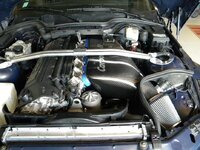
An airbox works by increasing the plenum volume, so that there is less pressure drop on the intake stroke at WOT and I'm sure that if the CF airbox utilised a MAF and IAT sensor (i.e. OEM MAF) at the mouth of the airbox like the one in the photos below, that the MAF could be reliably used without the need for any remapping or Alpha-n tuning. The ultimate restriction in the intake system is the inlet valves on each cylinder and not the opening into the intake system, provided that it is larger than the throttle plates.

grille2.jpg

z3m5.jpg
 
exdos said:
Surely, Evolve, as honest people, would want to give accurate figures which best represent their product, rather than conservative figures as you suggest, especially if others are finding that the gains are much greater than Evolve claim?

Your entire premise is wrong. We talked about the difference in headers and here you are using the absolute gain (from US headers) as the difference instead of the top numbers.

The top number for what evolve posted is 355hp flywheel. The top number for flip (using supersprint headers) is 365 flywheel. A whopping difference of 10hp which is less than 3%. As for the other dyno, he gets higher numbers still, but he got a CUSTOM dyno tuned alpha-n tune so his numbers are higher.

exdos said:
With regard to relocating the IAT: surely the temperature to record for fuelling is inside the intake system, which accurately represents the actual temperature of the air which is to be mixed with the fuel? Or should we all just fit one of these off ebay: http://www.ebay.co.uk/itm/15BHP-Pow...arts_Vehicles_CarParts_SM&hash=item2ebf7e449e which cost less than £10?

No it's not, the IAT is in the intake manifold. I'm fairly certain that in our cars the MAF performs this function. The MAF is also known to heat soak somewhat because of the design of the sensor itself and location.

exdos said:
That is correct, but if datalogging of the DME shows that the AFRs are adjusted commensurate with the measurable increased airflow

Of course the AFRs are increased, the DME is using the MAF numbers, which are increased. Doesn't mean more power.

exdos said:
and that the time taken for the engine rpms to go from, say, 5,000rpm -> 8,000rpm is reduced (i.e. faster), which it does

This is the only real piece of information that could demonstrably show an increase in power (see below for specific conditions in which this would be valid). The rest of your assessment makes too many assumptions to be considered correct at face value.

exdos said:
I've already had my Z3MC on Evolve's dyno, which acts as a yardstick, and using my datalogger with the same car in the same condition produced remarkably close figures. Therefore, it should be considered that my datalogger has already been "calibrated" against Evolve's static dyno. As such, there is no need to keep taking different cars on to static dynos.

The Z3MC is calibrated, doesn't say anything about the Z4MC. As I said the only accurate number is to dyno before and after, then data log before and after and make sure there is a similar change. Even without the full RAM effect happening, most dynos have at least 60mph fans, which should give you most of the gains.

exdos said:
Yes, I have come up with something which produces very significant and measurable gains in real world conditions. I've been able to record a host of different data from the DME in real world driving conditions, and whichever way I look at the data, it always shows very significant gains.

The only data that would indicate a gain is the 5k -> 8k time. The thing is that this is such a short amount of time, that for the data to be accurate the measurement would have to be extremely accurate.

To get valid 5->8k numbers you'd have to:

1. Do it in the same gear (obviously) and preferably a higher gear for longer time.

2. Have 100% traction. In a higher gear this is a given.

3. Bounce off the limiter, really it probably is more like a 5 -> 7.8k rpm.

4. Same day.

5. Same surface, exact same stretch of road. Even a change in 1% in the grade can produce big changes in such a short timeframe.

6. At least 10 runs, both before and after. Perform a truncated average to throw away the highest and lowest runs.

exdos said:
An airbox works by increasing the plenum volume, so that there is less pressure drop on the intake stroke at WOT and I'm sure that if the CF airbox utilised a MAF and IAT sensor (i.e. OEM MAF) at the mouth of the airbox like the one in the photos below, that the MAF could be reliably used without the need for any remapping or Alpha-n tuning. The ultimate restriction in the intake system is the inlet valves on each cylinder and not the opening into the intake system, provided that it is larger than the throttle plates.

The MAF does not accurately track much more than the volume of air that it is designed to track. It is a filament that gets cooled by the incoming air, and the dme uses the amount of cooling to estimate air passage. It only works for a relatively narrow range, above or below that range and the numbers are not accurate. This and other reasons necessitate alpha-n tuning.

Even if you changed the sensor, there is a possibility the DME would recognize the new numbers as impossible and throw a plausibility error. The DME has tons of places where if the values don't match up to a predefined range, it throws an error so you can replace the (presumably faulty) sensor.
 
fighting_fish said:
Your entire premise is wrong. We talked about the difference in headers and here you are using the absolute gain (from US headers) as the difference instead of the top numbers.

I previously quoted one of your sources saying: "Dynoing this setup proved to be quite the challenge with the limitations in equipment we had to work with." Why did he find it any more a challenge to dyno the car with a CF airbox than it was in OEM? The OEM intake is designed to harness the ram-effect, but clearly the owner didn't bother to go to the same trouble to attempt to provide more air when his car was OEM. As such his dyno results would appear to be artificially enhanced, whereas Evolve follow the same protocol for dynoing every car on their rollers, in any condition, to produced standardised results.


fighting_fish said:
No it's not, the IAT is in the intake manifold. I'm fairly certain that in our cars the MAF performs this function. The MAF is also known to heat soak somewhat because of the design of the sensor itself and location.

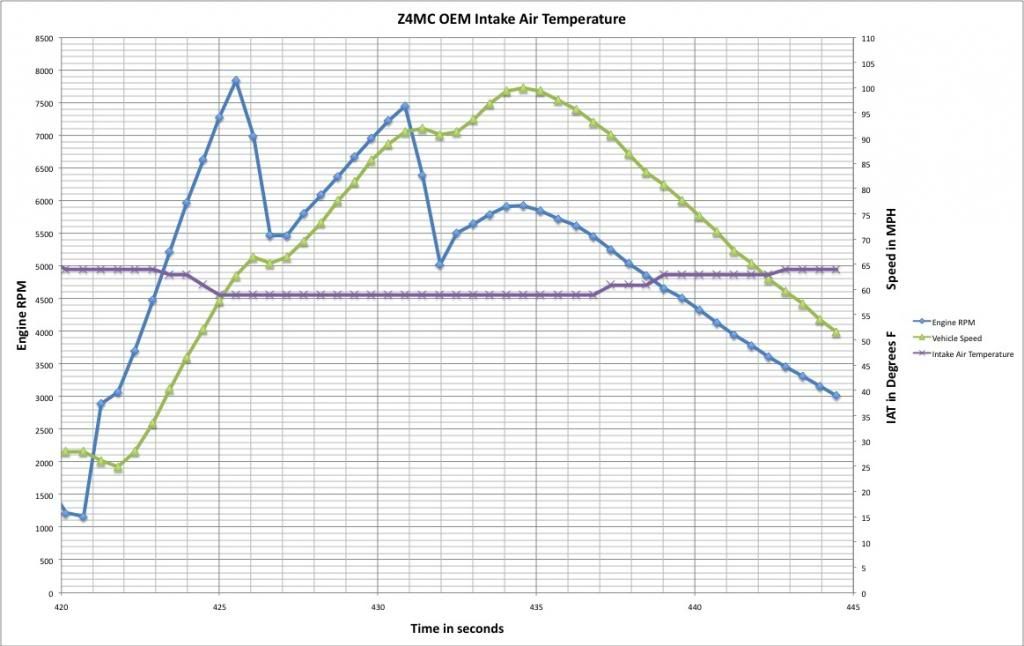
You are right that the OEM MAF in the Z4M is also an IAT sensor. Datalogging shows the temperature inside the air intake system as recorded by the IAT sensor, varies, and the temperature recorded is a function of airflow through the MAF, vehicle speed and ambient temperature. The faster the car travels at WOT, the lower the temperature the IAT sensor records. Ordinarily, the lowest temperature recorded by the IAT sensor is 7 degrees F above ambient, and when the car either slows down, or the airflow through the MAF is reduced, the temperature rises. I do not consider that the rise in temperature is caused by conductivity of heat in the engine bay, instead, I believe the rise in temperature is caused by heat convection and radiation from the hot cylinders through the inlet valves into the plenum. No matter, the actual temperature inside the air-intake system, is not the same as ambient temperature, therefore, for proper fuelling, the actual temperature inside the air-intake system as recorded by the IAT in the same position as the MAF is the correct place to measure IAT.

Here's a snapshot plot of IAT recorded from my Z4MC in OEM format, which shows precisely how IAT changes as I've described above.


Z4MCIAT_zps2728b01a.jpg


fighting_fish said:
This is the only real piece of information that could demonstrably show an increase in power (see below for specific conditions in which this would be valid). The rest of your assessment makes too many assumptions to be considered correct at face value.
I have a LOT of datalogs from my Z3MC and Z4MC, and reduced time for engine acceleration through a specific range of engine revs definitely occurs when DME shows that the MAF consumes more air at any given engine rpm.


fighting_fish said:
The Z3MC is calibrated, doesn't say anything about the Z4MC.

It's the datalogger that is calibrated, not the specific car!

fighting_fish said:
Even without the full RAM effect happening, most dynos have at least 60mph fans, which should give you most of the gains.
You clearly do not understand how ram pressure operates in an intake designed to harness the increased pressure! The Volumetric Efficiency of the Z4M at WOT varies with speed: in 1st gear it's about 70%VE in 2nd gear its about 90%VE and in 3rd gear and above it's over 100%. The Z4MC cannot go above 60mph in 2nd gear! Therefore, if the car is on a dyno in 3rd gear reaching a speed equivalent to almost 100mph, there will be relative air starvation, as described by your chums in your link!

fighting_fish said:
The only data that would indicate a gain is the 5k -> 8k time. The thing is that this is such a short amount of time, that for the data to be accurate the measurement would have to be extremely accurate.

I have a wealth of such data.

fighting_fish said:
The MAF does not accurately track much more than the volume of air that it is designed to track. It is a filament that gets cooled by the incoming air, and the dme uses the amount of cooling to estimate air passage. It only works for a relatively narrow range, above or below that range and the numbers are not accurate. This and other reasons necessitate alpha-n tuning.
The Z4M uses the same MAF as used on several other different BMW models see: http://bmwfans.info/parts/catalog/13627839014/ and it must be a very reliable, tried and tested part. It is more than capable of accurately monitoring the mass of air entering the engine under ram effect. Do you know the maximum Mass flow of air (Lbs/min or gms/sec) in the Z4M in OEM format? How much greater mass of air do you think a CF airbox will flow?
 
exdos said:
I previously quoted one of your sources saying: "Dynoing this setup proved to be quite the challenge with the limitations in equipment we had to work with." Why did he find it any more a challenge to dyno the car with a CF airbox than it was in OEM? The OEM intake is designed to harness the ram-effect, but clearly the owner didn't bother to go to the same trouble to attempt to provide more air when his car was OEM. As such his dyno results would appear to be artificially enhanced, whereas Evolve follow the same protocol for dynoing every car on their rollers, in any condition, to produced standardised results.

Just because it was challenging doesn't mean the data isn't valid. He still got numbers within 3% of evolve. The point is the dyno is more than accurate enough. Your discounting of dyno entirely is what I disagree with, it's provably more accurate than the method you're using.


exdos said:
You are right that the OEM MAF in the Z4M is also an IAT sensor. Datalogging shows the temperature inside the air intake system as recorded by the IAT sensor, varies, and the temperature recorded is a function of airflow through the MAF, vehicle speed and ambient temperature. The faster the car travels at WOT, the lower the temperature the IAT sensor records. Ordinarily, the lowest temperature recorded by the IAT sensor is 7 degrees F above ambient, and when the car either slows down, or the airflow through the MAF is reduced, the temperature rises. I do not consider that the rise in temperature is caused by conductivity of heat in the engine bay, instead, I believe the rise in temperature is caused by heat convection and radiation from the hot cylinders through the inlet valves into the plenum. No matter, the actual temperature inside the air-intake system, is not the same as ambient temperature, therefore, for proper fuelling, the actual temperature inside the air-intake system as recorded by the IAT in the same position as the MAF is the correct place to measure IAT.

So first you say that the IAT is calculated based on speed, mass air flow and ambient temperature. Then you note that it goes up when the vehicle slows down. I don't know how you can conclude that the rise in temperature is caused by anything other than the fact that the speed (and possibly ambient temperature, depending on where the sensor is) is giving different numbers. Any other conclusion is a stretch.

exdos said:
I have a LOT of datalogs from my Z3MC and Z4MC, and reduced time for engine acceleration through a specific range of engine revs definitely occurs when DME shows that the MAF consumes more air at any given engine rpm.

Without repeatability those numbers don't mean anything.

Let's look at your 5k -> 8k rpm times. Now I know you don't have a runway, so you're probably not doing it in 4th. If you're doing this testing in 3rd you have about 7 seconds. If your'e doing this testing in 2nd you have about 3 seconds.

Let's say it's in 2nd as I don't know if you can do it in 3rd as you'd end up going 110mph. If you're doing it 2nd and the road has a 1% grade difference, this can cause a 0.1 to 0.2s variation in your time. So now you'd be showing a 5-10% gain in power. Small errors really add up when your testing time is so small.

The only way that data is valid is if you follow all the conditions I specified before, on a flat runway, with many runs.

exdos said:
It's the datalogger that is calibrated, not the specific car!

It's calibrated for THOSE set of numbers, it says nothing if you change the conditions. You would have to do another dyno to verify that the values your sensors are picking up are correct.

exdos said:
You clearly do not understand how ram pressure operates in an intake designed to harness the increased pressure! The Volumetric Efficiency of the Z4M at WOT varies with speed: in 1st gear it's about 70%VE in 2nd gear its about 90%VE and in 3rd gear and above it's over 100%. The Z4MC cannot go above 60mph in 2nd gear! Therefore, if the car is on a dyno in 3rd gear reaching a speed equivalent to almost 100mph, there will be relative air starvation, as described by your chums in your link!

Agreed. But using your own numbers we're going from 90%VE to a little over 100%, so the dyno could read a little lower at the top. It would still give us a great baseline. Especially since you would get artificially high numbers below 60mph, and artificially low numbers above 60mph.

Either you do the dyno before and after, or you do the repeated runs on a runway. Any other data is meaningless until you've verified scientifically that your sensors are not leading you astray. You're basing your entire premise on sensors that you have not verified are giving you accurate data, and then using a ton of math to extrapolate from some very simple sensors. They may be right, but they could also be completely wrong, and since you refuse the verify, we can't know.

exdos said:
I have a wealth of such data.

Was it done on the same, day, same surface, blah blah blah that I specified? do you have at least 10 runs with all the same conditions? Otherwise you need to gather that data again. Driving around differently, on different days, with different setups is not data, it's anecdote. Add to that some selection bias.

exdos said:
The Z4M uses the same MAF as used on several other different BMW models see: http://bmwfans.info/parts/catalog/13627839014/ and it must be a very reliable, tried and tested part. It is more than capable of accurately monitoring the mass of air entering the engine under ram effect. Do you know the maximum Mass flow of air (Lbs/min or gms/sec) in the Z4M in OEM format? How much greater mass of air do you think a CF airbox will flow?

That MAF is only used in the S85 and S54. It only works for a narrow range as all it's doing is monitoring the current necessary to keep the filament at the same temperature (in other words it responds to air density as well as flow). One of the drawbacks of this design is that it can give you bad data depending on the direction of the air flow as well as pulsation. So if your intake is producing turbulence, you could be artificially lowering this number.
 
fighting_fish said:
Just because it was challenging doesn't mean the data isn't valid. He still got numbers within 3% of evolve. The point is the dyno is more than accurate enough. Your discounting of dyno entirely is what I disagree with, it's provably more accurate than the method you're using.
I am not discounting the use of a static dyno as a method of assessing performance. I am merely pointing out that your chums appear to have gone to greater effort to force air into the intake of the car when it has the CF airbox fitted than they did when the car was in OEM state and consequently they have distorted the data collected. This isn’t a scientific method, more a rigged experiment.
I am not claiming accuracy on an absolute scale for the dyno results of my datalogging, but the method provides consistency and thus comparability of all results collected in this way. However, the results produced are very comparable to those of static dynos which I have used, so the results I get are comparable to those obtained on those static dynos.

As for the data recorded directly from the DME: this will be 100% accurate since it is exactly the same data that the DME uses to function.


fighting_fish said:
So first you say that the IAT is calculated based on speed, mass air flow and ambient temperature. Then you note that it goes up when the vehicle slows down. I don't know how you can conclude that the rise in temperature is caused by anything other than the fact that the speed (and possibly ambient temperature, depending on where the sensor is) is giving different numbers. Any other conclusion is a stretch.
I don’t say that IAT is calculated in the way you’ve just described. I’ve said IAT is recorded by the IAT sensor housed in the MAF. The plot that I produced for you is just a snapshot in a small timeframe which visually shows exactly what I described.

fighting_fish said:
Let's look at your 5k -> 8k rpm times.
………………
The only way that data is valid is if you follow all the conditions I specified before, on a flat runway, with many runs.

I would be happy to let you see comparison engine acceleration times of my Z4MC in OEM and modded format. However, since you say that the only way the data would be valid is if I followed all your specified conditions to the letter, then after seeing it, you will turn round and tell me that one example of data OEM versus one example of data modded for comparison is not valid, so there’s no point in my producing such information for you to rubbish.

Your chums clearly didn’t follow the same protocol you require in producing their dyno results for the CF airbox.

fighting_fish said:
It's calibrated for THOSE set of numbers, it says nothing if you change the conditions. You would have to do another dyno to verify that the values your sensors are picking up are correct.
You clearly don’t know how the DashDyno datalogger computes its dyno results. The results are “standardized” by utilizing environmental and other factors in the calculations, therefore results are always comparable.

fighting_fish said:
Agreed. But using your own numbers we're going from 90%VE to a little over 100%, so the dyno could read a little lower at the top. It would still give us a great baseline. Especially since you would get artificially high numbers below 60mph, and artificially low numbers above 60mph.
You seem to be arguing on shifting ground! Earlier you are demanding strict conditions to make the data you will accept as valid, and now you are suggesting that we’d get “a great baseline” by using “artificially high numbers below 60mph, and artificially low numbers above 60mph”. That’s not a scientific approach and certainly not the way that I work!


fighting_fish said:
Either you do the dyno before and after, or you do the repeated runs on a runway. Any other data is meaningless until you've verified scientifically that your sensors are not leading you astray. You're basing your entire premise on sensors that you have not verified are giving you accurate data, and then using a ton of math to extrapolate from some very simple sensors. They may be right, but they could also be completely wrong, and since you refuse the verify, we can't know.
You are being ridiculous now! Have you ever used a datalogger through the OBDII socket? My datalogger records information which the OEM DME will yield, which is provided entirely by the same OEM sensors that the DME uses in making the car function. If the same sensors are leading me astray, then they are also leading the DME astray!

fighting_fish said:
That MAF is only used in the S85 and S54. It only works for a narrow range as all it's doing is monitoring the current necessary to keep the filament at the same temperature (in other words it responds to air density as well as flow). One of the drawbacks of this design is that it can give you bad data depending on the direction of the air flow as well as pulsation. So if your intake is producing turbulence, you could be artificially lowering this number.
A very large number of vehicles uses this MAF and so it must function well, despite what you say. In an OEM intake, the direction of flow will invariably be from the filter towards the throttle bodies. The post-filter arrangement in the Z4MC is such that there is a tube with the screens within it followed by the MAF. I assume that BMW engineers have specifically designed this layout to ensure the optimum performance of the MAF/IAT sensor to ensure that the DME has extremely reliable data from which it can use for optimal fuelling. My intake will be producing the same airflow pattern through the MAF as it does OEM.
 
exdos said:
I am not discounting the use of a static dyno as a method of assessing performance. I am merely pointing out that your chums appear to have gone to greater effort to force air into the intake of the car when it has the CF airbox fitted than they did when the car was in OEM state and consequently they have distorted the data collected. This isn’t a scientific method, more a rigged experiment.

Huh? did you even read the rest of the statement which you quoted: "I made attempts at building different forms of ducting, but ultimately, I ended up coming full circle to what Evolve Automotive recommended."

exdos said:
I am not claiming accuracy on an absolute scale for the dyno results of my datalogging, but the method provides consistency and thus comparability of all results collected in this way. However, the results produced are very comparable to those of static dynos which I have used, so the results I get are comparable to those obtained on those static dynos.

You are is the problem. You're extrapolating data, then not verifying that the extrapolated data is correct.

exdos said:
As for the data recorded directly from the DME: this will be 100% accurate since it is exactly the same data that the DME uses to function.

That is a huge assumption to make. Just because the DME uses it, doesn't mean it's right.

I can easily fool the DME. I could make a device that opens and closes a gate very rapidly in front of the stock airbox. The DME would think it's getting more air, even though it's getting less. The reason is the MAFs hot wire will be cooled more by the buffeting winds than it would by a continuos air stream, so it will report to the DME that greater airflow is going through the intake.

If you looked at the air to fuel ratio, it would be much increased. But the reality of the world is that there would be less air and less performance.

You could also fool the DME by redirecting the air so it points directly at the MAF wire. Lots of things you could do, that would give you wrong numbers. And using these wrong numbers you would extrapolate power gains, when in reality you're losing power.

So no, you can't rely on the sensors. You can only rely on the sensors if you've validated them on both ends. Base and changed.

exdos said:
I would be happy to let you see comparison engine acceleration times of my Z4MC in OEM and modded format. However, since you say that the only way the data would be valid is if I followed all your specified conditions to the letter, then after seeing it, you will turn round and tell me that one example of data OEM versus one example of data modded for comparison is not valid, so there’s no point in my producing such information for you to rubbish.

And you'd be right, it would be pointless. I already explained how a 1% change in the slope of the road could give you a 10% variation. Differences in temperature, time of day, how hot the tires are, etc. could easily cause much larger variations beacuse your test time is so short. I explained this at length in my last message. If you still don't get why the data isn't valid unless you take pains to make your data as accurate as possible for such a short test time, I don't know what will convince you.

exdos said:
You clearly don’t know how the DashDyno datalogger computes its dyno results. The results are “standardized” by utilizing environmental and other factors in the calculations, therefore results are always comparable.

That's not standardized. That's grabbing some numbers: weight of the vehicle, air flow readings, etc. etc. and using some complicated math extrapolating what it thinks power should be. It is only standardized once you've validated the data on both ends: stock and modified. I understand you validated stock and it gave you correct numbers, that's great. Now you need to validate the high numbers you're seeing.

exdos said:
You seem to be arguing on shifting ground! Earlier you are demanding strict conditions to make the data you will accept as valid, and now you are suggesting that we’d get “a great baseline” by using “artificially high numbers below 60mph, and artificially low numbers above 60mph”. That’s not a scientific approach and certainly not the way that I work!

The part of this whole thing you're missing is the margin of error. Your measurements have an unknown and possibly large margin of error. A dyno would have a much smaller margin of error. If you don't want to dyno fine, then do the test I suggested for 5 -> 8k rpm. If you don't want to do that, then design your own test that you're willing to do. I'm more than happy to help you fine tune it to make it accurate enough.

You're only using one point of data: the dash dyno. We don't know if this is accurate until you validate it with some other method. Once you validated the dash dyno then yes, you can continue to use it. You would need to validate both the baseline and your claim.

I don't understand how you don't get that because your numbers are so extraordinary they need to be validated. Any time the numbers are out of the ordinary you need to take a very hard look at them, you're not doing that.

exdos said:
You are being ridiculous now! Have you ever used a datalogger through the OBDII socket? My datalogger records information which the OEM DME will yield, which is provided entirely by the same OEM sensors that the DME uses in making the car function. If the same sensors are leading me astray, then they are also leading the DME astray!

Yes and this happens quite often.

exdos said:
A very large number of vehicles uses this MAF and so it must function well, despite what you say. In an OEM intake, the direction of flow will invariably be from the filter towards the throttle bodies. The post-filter arrangement in the Z4MC is such that there is a tube with the screens within it followed by the MAF. I assume that BMW engineers have specifically designed this layout to ensure the optimum performance of the MAF/IAT sensor to ensure that the DME has extremely reliable data from which it can use for optimal fuelling. My intake will be producing the same airflow pattern through the MAF as it does OEM.

Only 2 engines use that MAF regardless of the number of cars. The MAF was carefully placed in each of the two engines and tested in order to give valid numbers for the specific range of air that the car would see in the real world. Any value outside of these parameters and the sensor is no longer necessarily valid (it might be, but you can't assume it is).

And what you say may be true, all I'm saying is that it needs to be validated. Using only one set of numbers: dash dyno/dme is not validation.
 
In any case, can we get this back on track? This thread is about the Evolve CF Airbox.

If you are interested, let Evolve know so they can build us one.

If it's not for you, that's fine, but I demonstrated in the 2nd page of this thread, with lots of numbers and graphs, why $ to performance it stacks up with the best power mod which is supercharging. No other mod comes remotely close.
 
fighting_fish said:
exdos said:
As for the data recorded directly from the DME: this will be 100% accurate since it is exactly the same data that the DME uses to function.

That is a huge assumption to make. Just because the DME uses it, doesn't mean it's right.

I can easily fool the DME. I could make a device that opens and closes a gate very rapidly in front of the stock airbox. The DME would think it's getting more air, even though it's getting less. The reason is the MAFs hot wire will be cooled more by the buffeting winds than it would by a continuos air stream, so it will report to the DME that greater airflow is going through the intake.

If you looked at the air to fuel ratio, it would be much increased. But the reality of the world is that there would be less air and less performance.

You could also fool the DME by redirecting the air so it points directly at the MAF wire. Lots of things you could do, that would give you wrong numbers. And using these wrong numbers you would extrapolate power gains, when in reality you're losing power.

So no, you can't rely on the sensors. You can only rely on the sensors if you've validated them on both ends. Base and changed.

You are really scraping the bottom of the barrel with your argument! It doesn’t matter at all if the sensors are accurate on an ABSOLUTE SCALE. All that matters is that the SAME sensors are used throughout, so that any differences in readings produced by modifications to the air-intake are measured in exactly the SAME way on the SAME SCALE. Therefore the recordings will always be 100% accurate on the same scale: a gain will be a gain and a loss will be a loss. In any event, my Z4MC uses exactly the same OEM sensors as any other Z4M, therefore it will be on the same scale as all other Z4M's, so all comparisons are valid, and I'm surprised that you don't already realise that!

fighting_fish said:
And you'd be right, it would be pointless
So why did you ask?
fighting_fish said:
If you still don't get why the data isn't valid unless you take pains to make your data as accurate as possible for such a short test time, I don't know what will convince you.
You have no real clue of my methodology but you are at pains to attempt to rubbish it.

fighting_fish said:
The part of this whole thing you're missing is the margin of error. Your measurements have an unknown and possibly large margin of error. A dyno would have a much smaller margin of error. If you don't want to dyno fine, then do the test I suggested for 5 -> 8k rpm. If you don't want to do that, then design your own test that you're willing to do. I'm more than happy to help you fine tune it to make it accurate enough.
I have no problem whatsoever in accepting that there will be a margin of error in any methodology, including my own, and I’ve never claimed otherwise. In order to keep this to an absolute minimum I always follow the same protocol. You are going to great length to tell me how inaccurate my methodology and data is yet you know bugger all about it!

fighting_fish said:
I don't understand how you don't get that because your numbers are so extraordinary they need to be validated. Any time the numbers are out of the ordinary you need to take a very hard look at them, you're not doing that.
The reason why you find my numbers extraordinary is because you don’t know what I have done to achieve them. It would be so easy for me to show photos and describe exactly what I have done and you’d probably then understand exactly how such gains have been achieved. I’m also sure that you’d then wonder why nobody else has come up with this idea before, because now that I’ve done what I’ve done, it seems so bloody obvious! Believe me, I’ve done an immense amount of research, experimentation and testing to arrive at where I’m at and I’ve pieced together all the bits of the jigsaw of knowledge which has already been in the public domain for some time. Should I decide to make my invention commercially available it is my intention to get an automotive engineering faculty to independently assess the product and its results would be the basis of any claims about the gains offered by the product. That should be good enough for anyone, including you. :thumbsup:
 
fighting_fish said:
In any case, can we get this back on track? This thread is about the Evolve CF Airbox.

Yes, let's get this back on track: It is you who has chosen to digress.

fighting_fish said:
The issue with using datalogging on a CF Airbox is that they delete the MAF precisely because with that much air coming in through the new airbox, it is no longer able to monitor the air intake consistently as it overwhelms the sensor. So they ignore it and use alpha-n tuning.
exdos said:
Do you know the maximum Mass flow of air (Lbs/min or gms/sec) in the Z4M in OEM format? How much greater mass of air do you think a CF airbox will flow?

In order for us to properly assess the efficacy of a CF airbox, can you please answer my question above so that we can see how much more air passes through the CF airbox, which you claim "overwhelms the sensor"?
 
exdos said:
You are really scraping the bottom of the barrel with your argument! It doesn’t matter at all if the sensors are accurate on an ABSOLUTE SCALE. All that matters is that the SAME sensors are used throughout

It has nothing to do with absolute versus relative. I don't know why you refuse to understand that increases in sensors, do not necessarily correlate to increases in power. You need to validate your sensors are sending you correct data and you need to validate that the new inputs are in fact producing more power. You keep assuming both these things to be true without any validation.

exdos said:
The reason why you find my numbers extraordinary is because you don’t know what I have done to achieve them. It would be so easy for me to show photos and describe exactly what I have done and you’d probably then understand exactly how such gains have been achieved. I’m also sure that you’d then wonder why nobody else has come up with this idea before, because now that I’ve done what I’ve done, it seems so bloody obvious! Believe me, I’ve done an immense amount of research, experimentation and testing to arrive at where I’m at and I’ve pieced together all the bits of the jigsaw of knowledge which has already been in the public domain for some time. Should I decide to make my invention commercially available it is my intention to get an automotive engineering faculty to independently assess the product and its results would be the basis of any claims about the gains offered by the product. That should be good enough for anyone, including you. :thumbsup:

That's all a bunch of handwaving. Your numbers are extraordinary, because they are extraordinary. They start to get close to the numbers of CSL, when all you've done is an intake and a questionable exhaust mod.

Regardless this thread isn't about your intake, so can we please drop it. You refuse to see reason, or try to validate your numbers against any other benchmark than your dyno dash. And even if you did, you're not selling the thing so let's please move on.

exdos said:
In order for us to properly assess the efficacy of a CF airbox, can you please answer my question above so that we can see how much more air passes through the CF airbox, which you claim "overwhelms the sensor"?

I don't know and it doesn't matter. The proof is in the dyno, we can talk about the air and how it achieves these results, but that's not the point of this thread.

If you want to find out how much air passes through it and why it works so well, feel free to figure it out. You'd have to install some new sensors onto a CF airbox to figure it out though. Why? The MAF is only giving a valid reading for the diameter of tube that it's installed in. If you change the diameter of the tube, then it no longer gives a valid reading. Putting a restricting tube defeats the entire purpose of the airbox. Putting a MAF in there would involve designing a new MAF for the new width of the intake. If you used an aftermarket maf, it would have to give numbers within the same voltage for the same air, which is probably not something off the shelf. And even if you did, the DME might throw a fault.

As for the range, it's something like 0.5 - 4v normal range, anything above 4.9 is considered a fault. Don't quote me on these numbers though I didn't really verify them.

IMG_6107.JPG
 
Back
Top Bottom
