Further info -
The BMW Z4: Debut for new four-cylinder engines with BMW TwinPower Turbo technology and exclusive Design Pure Balance equipment package.
With its classic styling, powerful engines and excellent driving dynamics, the BMW Z4 has already established its segment leadership at the premium end of the roadster market. Now this sporty two-seater boasts a new highlight. From autumn 2011, two model versions will be equipped with state-of-the-art four-cylinder petrol engines featuring BMW TwinPower Turbo technology. The new 2.0-litre engines are fitted in the BMW Z4 sDrive20i and in the BMW Z4 sDrive28i, which now replace the naturally aspirated six-cylinder BMW Z4 sDrive23i and BMW Z4 sDrive30i models. Combining improved efficiency and performance with a simultaneous reduction in fuel consumption and emissions, the new 135 kW/184 hp and 180 kW/245 hp engines are also lighter in weight thanks to an all-aluminium crankcase. This reduces the load on the front axle, for improved agility and handling.
The BMW Z4 is equipped as standard with a six-speed manual transmission, but optionally the new engines can be combined with an eight-speed automatic transmission. All models in the BMW Z4 range will in future feature Servotronic speed-sensitive power steering as standard.
The BMW Z4 sDrive 35i will also get 18-inch multispoke alloy wheels. The popular roadster range will also be available with the new Design Pure Balance equipment package for extra styling enhancement. Exclusively in combination with this package, Mineral White metallic paintwork is available.
BMW Z4 sDrive28i and BMW Z4 sDrive20i with BMW TwinPower Turbo technology. The new four-cylinder petrol engines are key components in the BMW EfficientDynamics strategy, which aims to combine increased driving enjoyment with reduced fuel consumption and emissions. Both versions are based on the same reduced-friction 1997 cc core engine, their different output ratings being due mainly to different injection and turbocharging technology. Key features of the world-exclusive BMW TwinPower Turbo technology include High Precision Injection direct injection, twin-scroll turbocharging, Double-Vanos variable camshaft timing and VALVETRONIC variable valve timing. These features give the new four-cylinder engine the sort of power which in a naturally aspirated engine would require more cylinders and larger displacement. At the same time, with their all-aluminium crankcase, these engines are lighter and more compact than a six-cylinder engine of equivalent power. This has obvious benefits for driving dynamics: the reduced load on the front axle results in greater agility and further improved steering and cornering characteristics.
More dynamic performance, reduced fuel consumption.
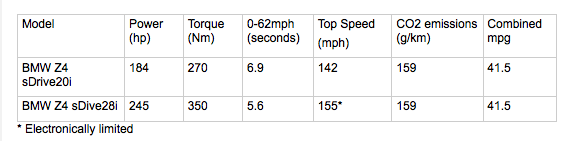
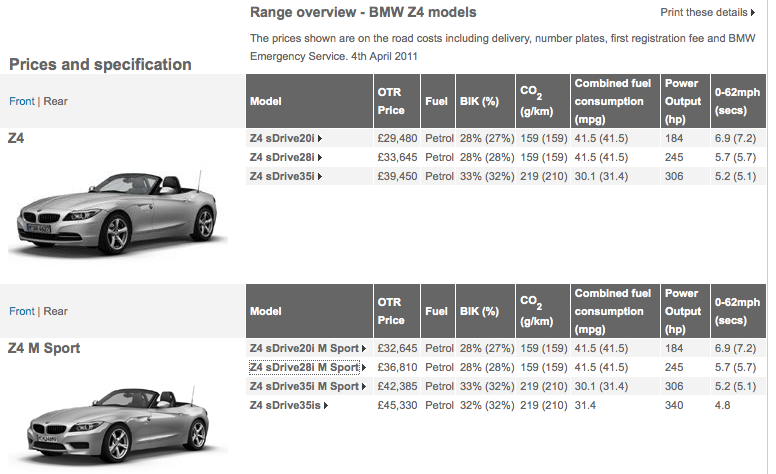
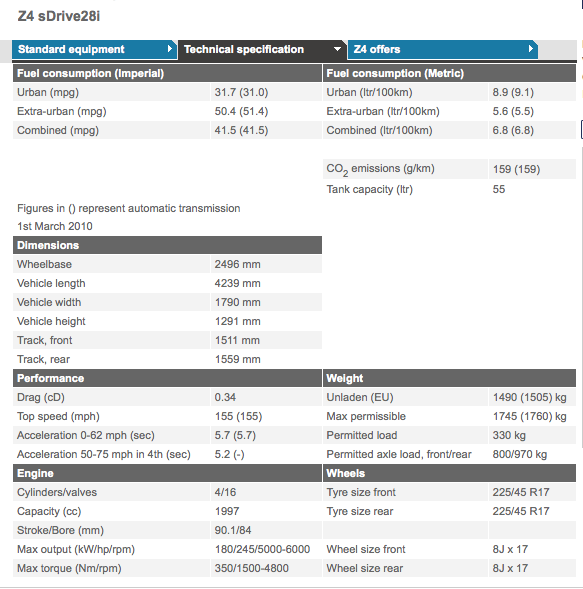
In the version fitted in the new BMW Z4 sDrive28i, the 1997 cc four-cylinder engine develops maximum power of 180 kW/245 hp at 5,000 rpm, which is almost a match for the 190 kW/258 hp six-cylinder unit it replaces. And on torque it actually goes one better. With peak torque of 350 Newton metres (258 lb-ft) (+40 Nm / 29 lb-ft), which is available from 1,250 rpm, the new engine is noticeably more responsive. The lively power delivery from just above idle continues all the way into the higher engine load range. The resulting 0 to 100 km/h (62 mph) acceleration time for the BMW Z4 sDrive28i is just 5.6 seconds, which is 0.1 seconds faster than for the predecessor BMW Z4 sDrive30i (0.4 seconds faster for automatic versions). The new four-cylinder unit also offers better in-gear acceleration. Top speed remains unchanged at 250 km/h (155 mph).
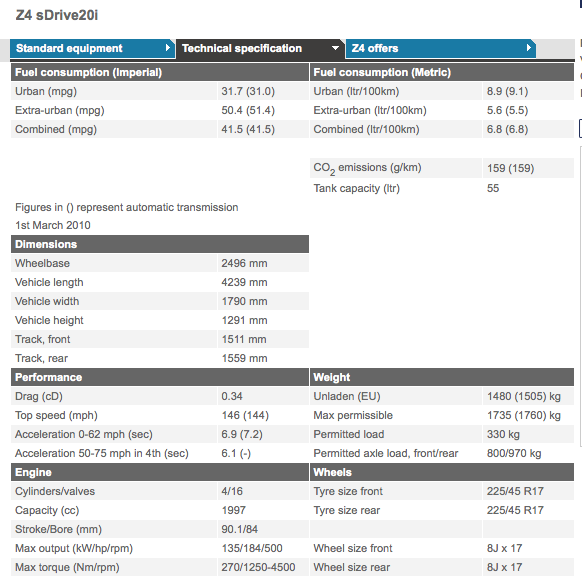
Despite the performance upgrade, the roadster also boasts substantially improved fuel consumption. Average fuel consumption for the BMW Z4 sDrive28i in the EU test cycle has improved by an impressive 1.7 litres – or 20 per cent – to 6.8 litres/100 km (41.4 mpg imp). And there is a corresponding reduction in CO2 emissions, which now stand at 159 grams per kilometre.
The four-cylinder engine fitted in the BMW Z4 sDrive20i is based on an identical core design. Due to modified injection and turbocharging technology, however, this version delivers 135 kW/184 hp of power at 4, 800 rpm, with peak torque of 270 Newton metres (199 lb-ft) at 1,250 rpm. Despite a torque increase of 20 Newton metres (14.7 lb-ft), this model too boasts a reduction in average EU fuel consumption of 1.7 litres, or approximately 20 per cent, on its six-cylinder predecessor, the BMW Z4 sDrive23i, while delivering a 0-100 km/h (62 mph) sprint time of 6.9 seconds and a top speed of 235 km/h 146 mph).
Twin-scroll turbocharging.
The new four-cylinder engines also feature twin-scroll turbocharging. This means that the exhaust stream from cylinders 1 and 4, and the exhaust stream from cylinders 2 and 3, follow separate spiral-shaped paths to the turbine wheel. This reduces exhaust back-pressure at low engine rpm, allowing the energy of the exhaust gas pulses to be utilised as efficiently as possible. The result is instant throttle response and typical BMW fast-revving performance.
VALVETRONIC, Double-Vanos and direct injection.
The ability of these engines to deliver large amounts of power, while simultaneously cutting emissions, is also assisted by VALVETRONIC variable valve timing and Double-Vanos variable camshaft timing. The latest VALVETRONIC system features a faster-acting, optimised stepper motor with integrated sensor. Seamlessly variable control of intake valve lift dispenses with the need for a throttle valve. Instead, the air mass is controlled inside the engine, resulting in faster response. At the same time, pumping losses have been significantly reduced.
The excellent efficiency of the turbocharged engines is also down to the High Precision Injection petrol direct-injection system. Centrally positioned between the valves, solenoid injectors with a maximum injection pressure of 200 bar precisely control the supply of fuel. The fuel is injected very close to the spark plug, resulting in clean and homogeneous combustion. The cooling effect of the directly injected fuel also results in a higher compression ratio than on port injection engines, bringing further efficiency improvements.
Exceptional performance based on innovative design features.
The exceptional performance of the new four-cylinder petrol engines is due last but not least to various innovative features of the core engine. For example balancer shafts positioned at different heights result in optimised vibration absorption, while a centrifugal pendulum absorber integrated in the dual-mass flywheel brings a noticeable reduction in irregular running at low engine rpm. The driver can therefore make full use of the strong low-end torque without sacrificing smoothness. In fact, the new 2.0-litre four-cylinder engines achieve the same standard of smoothness as a six-cylinder engine.
Efficiency is further improved by the use of state-of-the-art ancillary units like the computer-controlled oil pump and the on-demand electric coolant pump. Also, both the new roadster models feature Auto Start-Stop as standard on the six-speed manual versions.
Optional eight-speed automatic transmission: more comfort, with no increase in fuel consumption.
The BMW Z4 sDrive28i and BMW Z4 sDrive20i are equipped as standard with a six-speed manual transmission. Optionally, however, drivers can now leave the shifting to a new eight-speed automatic transmission which is very similar in terms of size and weight to the previous six-speed unit. The two additional ratios provide an appreciable improvement in smoothness, sporty performance and efficiency. All automatic versions feature a sports steering wheel, which is equipped as standard with paddle shifts, so that the driver can also shift gears manually. The right-hand paddle is used for changing up and the left-hand paddle for changing down. A restyled selector lever is standard with the eight-speed automatic.
The new eight-speed automatic transmission features fast reaction and shift times, direct downshift capability, minimal torque converter slip and low friction losses, along with a wide ratio spread that has benefits both for sprinting performance and for low-rpm cruising. The electronic transmission controller allows the shift characteristics to be altered as required, to cater for a sporty or a more relaxed driving style. Improved overall efficiency means that the BMW Z4 with eight-speed automatic transmission offers identical fuel consumption and emissions performance to the corresponding manual version.
New Design Pure Balance equipment package and exclusive Mineral White metallic exterior paint finish for the BMW Z4.
With the new Design Pure Balance package, the BMW designers have developed an elegant trim package tailored specifically to this popular roadster model. It features an extensive leather interior, with the new Cohiba Brown shade and contrasting Lotus White stitching providing attractive highlights. The package is topped off by further leather trim elements in Black, with stitching in Umbra, plus Fineline Anthracite wood and standard-fitted sports seats.
For the first time the BMW Z4 will be available in Mineral White metallic, which is offered exclusively in combination with the new interior equipment package. Alternatively, the Design Pure Balance package can also be combined with other exterior paint finishes. The new package replaces the previous “Design Pure White” package.




 My last 4-pot was the Lotus Elise S1.

