Need advice with VANOS reassembly (how to torque piston plug caps)

tomrdy

Member
 Sydney, Australia
Hey guys half way into the VANOS job now and going good (5 hours so far which included 2 trips to the hardware store for driver bits).

I had trouble removing the piston caps as I couldn't fit my hex bit + driver - the hex bit actually only JUST fit.

I ended up being able to loosen it with a wrench on the bit, then hand turned it out without the bit in place.

Thinking ahead, I realised when I reassemble I'll have the same problem in reverse.
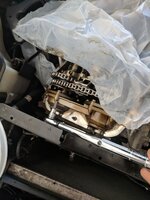
GFjaKtF.jpg

So I went to the hardware store again to see if there was some sort of lower profile bit I could put on my driver but no luck :(

QUESTION:

How's everyone tackled this? My current option is to just tighten it finger-in-the-air with my spanner the same way I loosened it, though 50nm (37 ftb) seems pretty hefty to try and guess.

Alternatively, I'm thinking I could use a swivel socket - but I'm not sure if using that with a torque wrench advisable? I guess though it'd be better than nothing? Never mind a swivel socket I just remembered I hardly had space to put the hex bit!

Any advice much appreciated!
 
I would check your tourque spec again are you sure it’s ft/lbs and not inch /lbs I’m pretty sure the left handed screws are 8nm (hand tight) and the nuts to hold the casing on are 50nm

Step 16 has the tourque values.
https://www.x8r.co.uk/ebay_x8r/instructionspdf/BMW-6-cylinder-dual-vanos-piston-seal-repair-fix-p.pdf
 
hey matty,

yep the left handed ones are 8nm so I plan on just hand tightening those.

The part i'm talking about on that pdf is the Vanos cylinder front bolts which is indeed 50nm.
 
I’m not sure anyone has ever attempted this as a diy on the forum, so well done you for giving it a go. If you could do a full guide with pics to help others it would have been awesome but maybe a little late?
 
ph001 said:
I’m not sure anyone has ever attempted this as a diy on the forum, so well done you for giving it a go. If you could do a full guide with pics to help others it would have been awesome but maybe a little late?

Ah there's actually quite a few guys who have done it on the forums - it's where I've gathered all the info to do it. I'm definitely not a pioneer when it comes to this stuff!

If you're after guides, you should be able to find it on Search - though no one details my specific issue from this thread.

I assume most people just tighten it... Tight. I suppose it's not a load bearing or rotating part. Worst case it leaks a bit but not a huge pain to get to actually. Just the rocker to come off.
 
ph001 said:
I’m not sure anyone has ever attempted this as a diy on the forum, so well done you for giving it a go. If you could do a full guide with pics to help others it would have been awesome but maybe a little late?

If you're after a guide look up Besian Systems and their guide. It's what I used, everything is simply laid out and described albeit their vehicle is an E39 so a few small differences.
 
tomrdy said:
ph001 said:
I’m not sure anyone has ever attempted this as a diy on the forum, so well done you for giving it a go. If you could do a full guide with pics to help others it would have been awesome but maybe a little late?

Ah there's actually quite a few guys who have done it on the forums - it's where I've gathered all the info to do it. I'm definitely not a pioneer when it comes to this stuff!

If you're after guides, you should be able to find it on Search - though no one details my specific issue from this thread.

I assume most people just tighten it... Tight. I suppose it's not a load bearing or rotating part. Worst case it leaks a bit but not a huge pain to get to actually. Just the rocker to come off.

It's been a couple of years since I did mine, but I'm fairly sure I used a long Allen key and then added a bar to get a bit more leverage. As you say they're only there to stop oil running out really, so it isn't particularly critical. I've had no traces of oil leaks etc in 2 years so it clearly worked okay!

Edit: actually, looking at it again it seems your Allen socket bit is longer than the ones I used. I had some old ones in the garage that were shorter so that gave just enough space to get the torque wrench in.

Are you not able to use an extension bar and position the wrench where the fan usually sits? I can't remember the layout exactly and whether or not the cross member blocks that idea.

Final option would be to chop the hex bit down? Perhaps get a cheap one you don't mind chopping up.
 
mjennings23 said:
Are you not able to use an extension bar and position the wrench where the fan usually sits? I can't remember the layout exactly and whether or not the cross member blocks that idea.

Yeh I wish that were the case but I'm having to leverage the bulk head already just to fit my socket in (without a driver. JUST the socket). It appears i have sockets made for GIANTS :headbang:

Cutting could be an option but not that keen on ruining my current bit set. Could probably find a shorter/cheaper set online but then the Z would be in limbo for a while!

At this point i think I've decided to do the "she'll-be-right" option of just doing it up reasonably :D Let's see how it goes.

Thanks for the input!
 
I don't recall how I did this (it's like 6 or 7 years ago that I did my vanos).
To get it loose I probably used a normal 8mm hex L wrench (so a normal hex key) with a small pipe to get the leverage, and to tighten, I might have put a spring balance on that pipe to calculate the torque. (I think I only have a 1/4" hex socket and 50Nm is a bit much for that).

Using a simple spring balance for that is something that I do often. It's a 2quid tool or thereabout.
 
It may be possible to use a small "crow's foot" attachment on the torque wrench. The "crow's foot" would engage an Allen bit without the need for a socket. An adjustment would need to be made to the torque setting to account for the additional length of the lever.
 
wyshyvanuk said:
It may be possible to use a small "crow's foot" attachment on the torque wrench. The "crow's foot" would engage an Allen bit without the need for a socket. An adjustment would need to be made to the torque setting to account for the additional length of the lever.
If you could find an 8mm crowfoot (not impossible, I have one in my set, but not all sets have them), you're not going to be able to put 50Nm on that. It will slip for sure (damaging the tool).

Lets first see how he gets the vanos off the studs in the block. The subframe in front usually limits that. :wink:
 
GuidoK said:
Lets first see how he gets the vanos off the studs in the block. The subframe in front usually limits that.

I was lucky - the unit has been out since yesterday (was the last thing I did before I ran out of time). Came out pretty easily with some prying 8)

CRAIGO said:
How did you determine your Vanos was bad in the first place?

I didn't have any major issues but only thing I noticed was some lumpiness on cold starts randomly and also pretty poor fuel economy. I also ran my C110 tool and looked at the live data feed - saw that the adaption angles sat completely still. Not 100% sure if this verifies a failing VANOS but after the service I'll be able to see if there's any difference in readings.

Thanks for the additional input guys. I'm going to follow suit and pick up some L allen keys instead of trying to grip the bit (it did slip a few times). Hopefully have the car back running today :D
 
Buy some iron central heating pipe (the smallest diameter). That makes for an ideal levering tube for L keys.
 
Job done!

What I ended up doing/notes for others:


The T30 reverse torx bolts

Having seen a story (I can't remember who) about stripping it, I opted to get new ones as recommended by that member.

I could get my torque wrench in for that one and set it to just under 8nm... however when I went to do it up, it got suspiciously tight and still did not click (my wrench can do both directions). 8nm really is very little so I figure maybe there is some give somewhere that wasnt letting me hit the torque (I saw the sprocket was rotating a minor amount) so I left it at hand tight.


The cylinder caps which this topic was originally about

I bought a set of long allen keys and this made winding it on SOO much easier than what I did with my socket. I had got the socket because I planned on use my torque wrench without realising it wouldnt fit.

The allen was quite long at 17cm+ so I could get pretty good leverage on it. I pulled quite hard on it but still felt uneasy. How much did I need??? Then I realised there's probably a calculation I can do to work out how much force/weight I need.

Torque = Length x Force

This ended up working out to be about 3.7 kgs of force on the end which isn't actually that much. I had thought 50nm was a tonne but its not. So, I went and picked up some weights and felt how much ~4kg was and... winged it.


First start


I was expecting the car to have some temporary grumpy idling as noted by guides but mine came back to life beautifully and idled nicely! Did a spin around the block and the car ran smoothly. I got it up to temp and then took it home as the coolant light had come on (expected). Will let the car cool down now and top everything back up.

Not yet put the C110 back in to see if the VANOS numbers are changed but I'll drive around for a while before doing that to butt-diagnose it first :)
 
tomrdy said:
The allen was quite long at 17cm+ so I could get pretty good leverage on it. I pulled quite hard on it but still felt uneasy. How much did I need??? Then I realised there's probably a calculation I can do to work out how much force/weight I need.

Torque = Length x Force

This ended up working out to be about 3.7 kgs of force on the end which isn't actually that much. I had thought 50nm was a tonne but its not. So, I went and picked up some weights and felt how much ~4kg was and... winged it.

If your allen key is 17cm long your calculation is way off :cry:

50Nm is 50N (or about 5kg) at 1m lenght.
If your allen key is 17cm, that means its 0,17 part of a meter or about almost 1/6th of a meter.
That means that the force at the end of the key to get to 50Nm should be 5:0,17=29,5Kg! , so about 8 times as much....

Thats why I said you should get the piece of central heating pipe (a foot or so is enough) to use as leverage. I wouldn't have said that if you had to pull 4kg... :wink:
(although pulling 30kg on an L key is still possible)

I'd remove the cylinder cover (20min. work) and retorque those screws. I dont know if they really need that 50Nm.
(50Nm is quite a load to put on a 8mm hex, on the other hand, 8mm hex is used on m10 bolts and 50Nm is standard on an 8.8 M10 bolt so both key and screw will be allright)

But now they didnt even recieve 7Nm. Thats barely enough for a 6mm thread.
 
Crap you're right Guidok my mistake! I'm such a goose I think I was too rushed.

I'm going to strike out that part on my post so it doesnt misinform .

GuidoK said:
I dont know if they really need that 50Nm (50Nm is quite a load to put on a 8mm hex), but now they didnt even recieve 7Nm. Thats barely enough for a 6mm thread.

I should mention that before I did the maths (wrongly) I did actually put nearly as much force as I could through the Allen (it started flexing) and my hands so I'm thinking it might be enough - conservatively probably half my body weight which is roughly 30kgs.

I might just see how this goes. Opening it back up and pulling again (even with correct math) will still be a guess.
 
Back
Top Bottom