LSD + Exhaust

Do many members have LSDs fitted? Has anyone tried the kit which gives most of the LSD effect but fits within the existing diff?

What diameter is the exhaust? I have been listening to a few aftermarket options on youtube, but have some ideas of my own. Do many members live with straight pipes?
 
I have a Quaife LSD. Fitted by Birds into the existing diff housing (as with all differentials) with a lifetime warranty. In my opinion it's a must have. You can do without it for most road driving but it does make a noticeable difference. It's in a totally different league on track though. Definitely recommended depending how you drive the car.

Exhaust I believe is 50mm diameter for each pipe.
Personally I had a backbox delete on my car for all of 2 weeks - I couldn't bear it as a daily, it was ridiculously boomy between 1500-3000rpm.

I've had my mid-box deleted now and replaced with straight piped for the princely sum of £50 - makes it a bit louder but not intrusive - perfect for me with noise limits on tracks, and for daily driving,
 
motoroller said:
Do many members have LSDs fitted? Has anyone tried the kit which gives most of the LSD effect but fits within the existing diff?
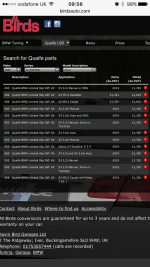
I had a Quaife ATB LSD fitted by Birds just over 3 years ago - all fits within the standard diff casing - thread at https://z4-forum.com/forum/viewtopic.php?f=2&t=74954

Don't know what you mean by 'kit which gives most of the LSD effect' as the Quaife is a proper LSD, but it's a torque sensing LSD rather than a clutch pack LSD
 
^Perry technically the Quaife needs some load on one wheel to 'bias' torque to the other axle - if you actually lift a wheel up in the air, a Quaife will act almost the same as an open diff. Plated diffs will not -they have preload and will lock the wheels together when more than a certain speed differential is experienced across the axle. This is generally a far more agressive diff, and tends to not be very road-friendly!

Interestingly I believe Wavetrac diffs have an additional mechanism to mitigate the 'open' issue with Quaifes when you lift a wheel, whilst still essentially being an ATB-type diff. No idea how it works though - my research ended there!
 
Ed Doe said:
^Perry technically the Quaife needs some load on one wheel to 'bias' torque to the other axle - if you actually lift a wheel up in the air, a Quaife will act almost the same as an open diff. Plated diffs will not -they have preload and will lock the wheels together when more than a certain speed differential is experienced across the axle. This is generally a far more agressive diff, and tends to not be very road-friendly!

Interestingly I believe Wavetrac diffs have an additional mechanism to mitigate the 'open' issue with Quaifes when you lift a wheel, whilst still essentially being an ATB-type diff. No idea how it works though - my research ended there!
This came up when I had the Quaife fitted and, according to Guido, Quaife have a pretension mechanism that provides the preload...

GuidoK said:
TomK said:
Ironically, with a torsen diff (like your quaife) as opposed to a clutch pack type (like Mdiff) the only major relative disadvantage is in the scenario you describe where one wheel looses grip completely (i.e. in the air, or on ice). When 0 torque is sensed on one of the axles the diff is unable to lock and you will get no drive at all.

Actually that is often said, but not quite true in many cases (maybe prejudgemental theoretical deduction?). If you look at a diff like wavetrack they have a cone system that prevents 0 load. That is how they say 'their diff' is different.
But here comes the funny bit. Quaife diffs have 6 belleville washers inside (not many people know this.. and quaife is not unique in this type of build), creating a pretention on the sun gears (sun gearcogs pushing against the the planetary gear cogs).
So they have system inside that always locks the gears to a certain extend.
This is one of quaife's patents (over 30 years old....) that adresses this type of build (they have more variations on this in different patents):https://www.google.com/patents/EP0130806B1?cl=en
 
Bloody hell - learn something new every day! Thanks Perry, that's some useful info!
 
I had an Mfactory lsd diff on my last Z and it transformed the car. Cheap mod at the time (£600) unfortunately prices have gone up and the exchange rate is crap. A diff from Birds is your best option now.
 

Attachments

  • IMG_5286.PNG
    IMG_5286.PNG
    536.2 KB · Views: 2,170
Ed Doe said:
Bloody hell - learn something new every day! Thanks Perry, that's some useful info!
[ref]Ed Doe[/ref]... just look at the last post on this page

Don't worry, I think a lot of us are getting to 'that age'... :lol:
 
.... sorry bit ( ready very :wink: ) off topic ...
ed doe.... notice you have 6 pots on 345 csl( z4m ) discs .... any chance of popping over to the M specific section and posting up the details on the vagbremtechnic thread? Looking at some BBK options . Any help much appreciated :thumbsup:
 
Ed Doe said:
Plated diffs will not -they have preload and will lock the wheels together when more than a certain speed differential is experienced across the axle.
Actually only an m differential (e46m/z4m/e92m) will do this. Thats a 'gerotor' style LSD where an internal oil pump actuates a pistion pushing the clutch pack together. The more speed differential, the more the piston pushes.
A normal clutch pack lsd is actuated by the amount of force acting on the propshaft, so it is also torque dependant (the ramp/peg system only works if torque is applied). In theory, a normal clutchpack lsd thus also needs a certain amount of grip on both wheels to be actuated, but normal clutchpack lsd's have an internal preload spring (just like quaife ATB) to try and minimize this.
In the end only a computer controlled lsd can really cope with these circumstances (it uses abs speed sensors and steering input as parameters for lock/unlock and is therefore more precise and fully flexable), and can even work in negative mode (torque vectoring)
 
I had a Quaife on my Z4 Coupe and it was much nicer to drive afterwards, a direct feeling between your right foot and the rear end when powering through corners.

I have just got a Wavetrac fitted to my C63 and it's better. I'm getting more traction off the line with twice the power/torque than I did with the Quaife. It's also notably better at T-junctions when you accelerate hard over the crest in the road and the inside wheel goes light.

Whilst Quaife has some preload the Wavetrac can create more friction under a zero load condition because of the wavy rings in the middle. Also, they have carbon plates where the planetary gears spin to maintain the same level of friction for life. Quaife spins on the metal so polishes it over time thus becoming less effective.

I'd now choose Wavetrac every time as it's just as invisible/unobtrusive the rest of the time but better at 'locking up'.

Here's my post with pictures on the subject over on MBClub UK: https://forums.mbclub.co.uk/threads/wavetrac-differential-regal-autosport.239911/

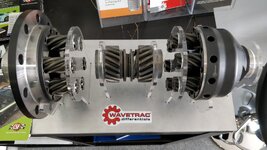
This is what's inside a Wavetrac...

PvHO0bE.jpg
 
I have never had one wheel spinning with the quaife with over 40% more power than you had in the 3.0si, so if you've had that, it was either a tyre issue, or a suspension issue, or an alignment issue. But its not the quaife.
That you now have more traction with the MB can be because its a different car, different tyre size, different weight, different suspension geometry, different electronics or whatever. But the characteristics you describe to your zed dont match up with how mine handles.

Also the wavetrac still relies on a springpack inside to set the initial preload. Not the wavy rings. Look it up in their patent. You see the spring pack sitting inside the wavy rings pack (fig. 7b in the patent). The wavy rings more or less only create a change in bias. Without that springpack the wavy rings cant interlock/unlock. Essentially that also happenes within the Quaife diff but then through the gearsystem, but that is with another bias.
But all this is only relevant on situations like ice, where there's no grip at all. On the normal road there is plenty grip to actuate the locking. And the way the bias transition between gears and wavy rings occurs has to be seen. That doesnt necessarely has to be a good thing. The bias ratio of the helix gears has been chosen for a reason. if there's a secondary system at work with different (greater) bias ratio that can also mess up the drive characteristics under normal/high performance situations.
Also for the wavy rings to work effectively, the other side (so opposed to the wavy rings) has to be coated with a friction surface. This is because the wavy ring actuator is in no means physically connected to the side gears!. One side is the wavy side, the other side is just a flat side rotating on the other flat side of the of the opposed side gear. the patent also talks about this. This is a part that could wear if its a friction surface.

For sure Quaife has a far far greater experience / has seen a far greater scope of use in motorsports (ranging from le mans, F1, rallysport, touringcar championships, dedicated trackcars like radicals etc etc) than wavetrac. From that pov quaife only has drexler and osgiken as real competitors (for bmw applications).
Almost all serious racing cars/track cars choose between those brands. Hardly any of them goes for a wavetrac, so apparantly its not the specialists' choice
 
Yes, every from of lsd is better than an open diff in a sportscar, even the crappy silicone lsd's in an mx5 (some generations at least).
But what lsd has what advantage is another matter. Personally I think the '1 wheel with no traction at all' situation is absolutely not interesting for Z usage. It might be interesting for cars driven on snow, ice, of offroad, but a Zed typically has 2 wheels on the pavement, albeit with different load. Thats what it has to cope with.
 
How about for track use? I think I might have a photo of mine on 3 wheels :lol:

Either way, the difference is night and day - transforms the car :driving:
 
The short time that you're on 3 wheels (a split second) is imho usually short enough that the inertia of the wheel requires enough force to provide some lockup. And I have yet to see that a wavetrac performs better on that.
In this video you can clearly see that a wavetrac also has spinning issues (sub par lockup, one wheel still turns way faster than the other one) with one wheel on ice. There is traction, but ample (one wheel is spinning pretty fast when you hear it getting on the tarmac and squeeling). The acceleration with 1 wheel on the ice or 2 wheels on the ice doesnt differ a lot.
[youtube]H3FTG0RVBJU[/youtube]
So its far from the holy grail they say it is. In the end the lockup under no load is defined by 2 things: 1 the friction between 2 metal rings, pressurized by the internal spring (like I said, wavetracks patent speaks even about putting a friction layer on this), and the wedging the wavy rings give as extra force/preload on the helix gears. Because the wavy rings themselves give no direct connection between the two side gears. Its what the diagrams on wavetracs site make us believe to a certain extend, but if you analyze the patent, you see that its a completely loose unit between the two side gears.
The power I see displayed in the video coming from the one wheel on the ice is not something that stands in relation to the powers used in acceleration on a track imho.

If you want to 100% counter that wheel lift on track situations you have to run a clutch lsd with extreme preload.
No problem on a track, but the next time you turn in a supermarket parking lot or try to parallel park, I'm sure you go back to another diff :lol:
 
I believe the Wavetrac was designed by someone who worked for Quaife before to purposefully address some of the shortcomings.

Some gear differentials rely solely on preload springs to combat loss of drive. The drawback is that you can’t add enough preload to prevent loss of drive without creating tremendous handling and wear problems at the same time. So, to avoid these problems, the preload from ordinary spring packs must be reduced to a level that renders them ineffective at preventing loss of drive. The Wavetrac® is the only differential that can automatically add more load internally when it’s required.

I still think the Quaife is very good but I believe the Wavetrac is better.

As you say, being on ice is something that never really happens but there are tangible differences under more usual scenarios. Those short periods when you experience inside wheel spin is when you get the start of a small wriggle from the rear. Not normally enough to be a problem but nevertheless not as smooth as if they don't happen. My Z4 was well setup and yes the C63 is heavier but with 510bhp & 480lb/ft I think it's fair to say that's enough of a challenge for the traction...

https://www.youtube.com/watch?v=E4wY2NoJ6f8
 
yeah I saw that video too, but it hardly shows anything what happens. theres just an in car view and the sound. For all we know on the second take a wheel is lifted up due to a slightly different racing line. Hardly any objective info in that video.
Anyway the first video I posted clearly shows how much traction can be expected from the wavetrac coupling mechanism with one wheel with ample grip. And that isnt a lot imho. In that video you can see with your eyes what really happens. Everything is shown.
So all mechanisms that try to counter the 1 wheel without grip situation are a mere bandaid imho. They might aid in not getting you stranded on an icey road, but performance wise they add nothing. The wavetrac mechanism isnt suddenly going to provide mega traction is clearly what the video shows.
Quaife is still the preferred ATB solution for many many professional racing teams, track cars and performance setups.
Comparing different parts in totally different cars is well....hardly objective.
At least the wavetrack vid I posted is based on a car that has exactly the same rear axle/drivetrain as the z4, so thats pretty much comparing apples to apples.
 
Think what you like but you haven't tried both so...

My C63 suffered more wheelspin before the Wavetrac so it's not naturally got more traction than the Z4.

They both multiply torque so x times virtually zero friction on ice will give little back. It's still able to transfer more torque than a Quaife so when the wheel is light but not actually in the air it's more effective.
 
Steve84N said:
It's still able to transfer more torque than a Quaife so when the wheel is light but not actually in the air it's more effective.
you dont know that. There's no actual proof or verifyable data.
A very speculative claim.
 
Back
Top Bottom