Individual steering wheel query

Barty

Senior member
 Netherlands
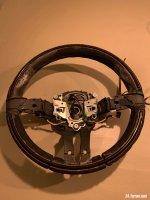
So I’ve managed to bag myself a secondhand Individual wheel, which I really like but would have never thought possible to find. Alas, it’s not in perfect condition, so a retrim is in order
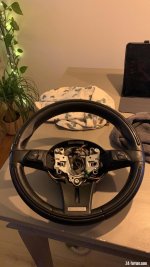
1471DA45-6957-4851-9AEE-4CE911ED1491.jpeg

One problem I face is the wooden inlay. Does anyone know how this is attached to the wheel? Glued onto the leather, glued onto the frame, clipped into the wheel?

The last thing I want is to break the trim; a new wheel will set me back no less than €2480 from BMW…
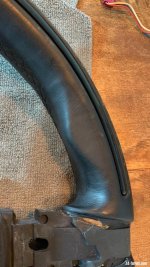
 
Just a quick bump to bring this back. I’ve also contacted BMW NL to see if they have any guidance. Unfortunately the component drawings don’t show the way this is fitted, so no joy there.

Any thoughts, suggestions on how to proceed, ideas- all very welcome!

5B0405D6-7D88-4F69-B153-C88569706AEA.jpeg

So far, the glued to the leather theory sticks (ha!) most with me. Perhaps clipped into the frame of the wheel through holes in the leather… Any alternative theories?
 
Don't know I'm afraid, but I think I'd start by cutting the stitching and carefully lifting it to see underneath?
 
[ref]enuff_zed[/ref], that’s definitely the plan if BMW has no answer, but if at all possible I’d like to know what I’m getting into. Given the rarity of the wheel, I’d rather not break stuff :?
 
A011D4D4-D2A9-45D3-8EE7-9827F95A4841.jpeg
I have one of those wheels, it’s starting to fade slightly around the trim but I was planning on using one of the refurb kits off Amazon to stain and refinish as the leather is in great shape. I’m guessing the reason the wheel is much thicker than standard is because there’s a way of removing the wood from underneath the leather but clearly you’re much braver than me! Sorry I can’t help, good luck!
 
[ref]Baldy76[/ref], very nice! Minor scuffs and fade can be repaired well enough, so you should be fine.

One of the reasons I’m removing the strip is to have it resprayed matching the dash panels. Yes- a lot of risk for such a small item but the devil’s in the details. Also, the leather is damaged by rings and has scuffed beyond regular repair.

Credit to BMW NL: I’ve received a reply, and a helpful one at that! I’ll translate as it’s originally in Dutch:

The wooden inlay is inserted into a groove in the steering wheel after the leather trim has been fitted. This is secured using glue. Removal of the trim may result in it breaking.

Weirdly, this is good news. It allows me to open the stitching and gently tease the trim away from the wheel using pressure from the leather itself. Risky, but I’m an absolute nut for such details. Onwards then!
 
Barty said:
[ref]Baldy76[/ref], very nice! Minor scuffs and fade can be repaired well enough, so you should be fine.

One of the reasons I’m removing the strip is to have it resprayed matching the dash panels. Yes- a lot of risk for such a small item but the devil’s in the details. Also, the leather is damaged by rings and has scuffed beyond regular repair.

Credit to BMW NL: I’ve received a reply, and a helpful one at that! I’ll translate as it’s originally in Dutch:

The wooden inlay is inserted into a groove in the steering wheel after the leather trim has been fitted. This is secured using glue. Removal of the trim may result in it breaking.

Weirdly, this is good news. It allows me to open the stitching and gently tease the trim away from the wheel using pressure from the leather itself. Risky, but I’m an absolute nut for such details. Onwards then!
I think you could still risk breaking the trim tbh.
Maybe with the leather lifted try running a piece of fishing line down behind it to cut though the glue.
The trick is going to be infinite patience I suspect.
Good luck.
 
[ref]enuff_zed[/ref], agreed. A good friend of mine has been in the classic restoration business for years, and recommended patience above all. Take your time, use plenty of warmth to soften both plastic and glue, and see what happens.

If all else fails, and I do break the trim, then I’ll see about fixing it again. For instance by using carbon and epoxy to skin the trim and reattach the components, which can then be resprayed to cover up the carbon. A lot of work, but I really don’t like half-assed jobs :lol:
 
Barty said:
[ref]enuff_zed[/ref], agreed. A good friend of mine has been in the classic restoration business for years, and recommended patience above all. Take your time, use plenty of warmth to soften both plastic and glue, and see what happens.

If all else fails, and I do break the trim, then I’ll see about fixing it again. For instance by using carbon and epoxy to skin the trim and reattach the components, which can then be resprayed to cover up the carbon. A lot of work, but I really don’t like half-assed jobs :lol:
I suppose if you're completely retrimming then you could cut the leather away up close the the trim to get better access to it.
 
enuff_zed said:
Barty said:
[ref]enuff_zed[/ref], agreed. A good friend of mine has been in the classic restoration business for years, and recommended patience above all. Take your time, use plenty of warmth to soften both plastic and glue, and see what happens.

If all else fails, and I do break the trim, then I’ll see about fixing it again. For instance by using carbon and epoxy to skin the trim and reattach the components, which can then be resprayed to cover up the carbon. A lot of work, but I really don’t like half-assed jobs :lol:
I suppose if you're completely retrimming then you could cut the leather away up close the the trim to get better access to it.

True, though I’m thinking that I could use the old leather to my advantage in applying pressure to the strips. Scalpel, picks, trim tools and heat gun at the ready!
 
Small update. Managed to remove the old leather and get a better look at how the trim strip is integrated into the wheel.

E95090CF-5B51-47D9-8C6E-49712F23CF28.jpeg

The leather is placed onto the wheel after which it is tucked into a wooden slot. This is then secured with the trim strip, which is glued into place.

Next step will be to get a fine string underneath the trim and “saw” through the glue. Small steps!
 
Back
Top Bottom