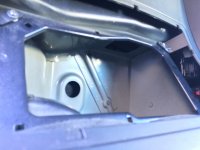
Fitting speakers to the cubbies for those with basic hi-fi...

If you go ported, the reflex system will colour the sound a bit and you’ll need to think more about the amplitude of harmonics compared to a sealed system; especially if you want to set your crossover frequency quite high (for enhanced mid bass). The results can be quite unpleasant in difficult spaces, which is why room correction + cheap speakers is often better value for money than expensive speakers and no ability to tame resonant modes etc.

I wonder whether a passive radiator setup might be best, using the cubby hole space to link an active and a passive long throw driver? Again, not a clue whether this is ever done in car audio circles, but in home audio you can build very high performance subwoofers economically with pairs of units from the likes of Peerless etc. Assume you don’t want to bore a mini Channel Tunnel through your CD changer though. :D :?
 
Well I've just pulled the plug on a couple of those Reckhorn 6.5" subs and also bought two of the oem rubber grommets that form the port on the Carver system. I'll have a play about using the Morel Ultra 602 and then the Reckhorns. I'll try fully sealed and then ported for both drivers. To make it a little more scientific I'll use a wideband microphone and laptop with REW (room equalization wizard) on a 20Hz - 1Khz sine sweep to look at the actual freq response in the driver seat. I suppose I should do a run with roof up and lowered too.
 
At the very bottom end of the price range I did find these... https://www.thompsonsltd.co.uk/brands-lanzar/maxp64-lanzar-maxp64-max-pro-6.5-600w-small-enclosure-4-ohm-subwoofer-(single).html

£12 for a 6.5" subwoofer!!! I have heard of Lanzar so it's not like they are some unknown Chinese brand. The Thiele small parameters look very strange though, so much so that it wouldn't even simulate... 6.8cuft for the VAS is 192.55l !!

Reckhorn D-165:
FS: 28 Hz, Qms: 5,69, Qes: 0,32, Qts: 0,30, Vas: = 17l Mms = 43 g, BL = 9,38, Sd = 132 qcm


Lanzar MAXP64
Fs: 80Hz, Qms: 4.05, Qes: 1.3, Qts: 1.2, Vas: 6.8Cuft (192.5l)
 
ph001 said:
At the very bottom end of the price range I did find these... https://www.thompsonsltd.co.uk/brands-lanzar/maxp64-lanzar-maxp64-max-pro-6.5-600w-small-enclosure-4-ohm-subwoofer-(single).html

£12 for a 6.5" subwoofer!!! I have heard of Lanzar so it's not like they are some unknown Chinese brand. The Thiele small parameters look very strange though, so much so that it wouldn't even simulate... 6.8cuft for the VAS is 192.55l !!

For £13 they gotta be worth a punt! I might give them a go myself.

I just purchased a set of rear cubby speakers from a forum member (Simon) (https://z4-forum.com/forum/viewtopic.php?f=7&t=105049). I have a Pioneer head unit, with a Kenwood KSC-SW11 attached via the subwoofer out RCA. I just split the RCA, and added a small £55 Pioneer amp in the boot, to drive the new speakers. Sounds really nice - they're the default speakers not subs although I'm contemplating making them subs.... that being said, the main reason I wanted these was because the Kenwood Sub is actually enough for me, but when on motorway I struggled to hear the music - only heard the thumping from the sub :rofl: hence why I wanted these to increase my unfiltered volumes.
 
ph001 said:
.. I think it's done through the oval cutout in the top of the enclosure..

Thanks for that, I am in the process of blanking off all holes in the steel cubby enclosure and discovered the 60mm x 80mm (approx) cut-out at the top which I nearly missed. Now at least I know what it is for.
 
GuidoK said:
No I just made a guess. Its certainly not 10-11L (thats the size of a bucket!), and dont forget that the volume of the sub itself also has to be subtracted (1-2L)

I definitely remember reading it in BMW technical document on their HiFi carver system. I am wondering if the value is for the pair of cubbies. Good call on subtracting the volume of the speakers themselves. For modelling the output I use Android App Speaker Box Lite, though annoyingly the latest download appears to need me to register before using it in anger, never used to be the case.
 
ph001 said:
I suppose we ought to consider the fact that the OEM installation IS ported. I think it's done through the oval cutout in the top of the enclosure, You have little chance of finding the thiele small parameters for the oem driver I guess but maybe a fully sealed enclosure is not the way to go.

I dont know if the carver is ported. I dont think so.
There is no real port, thats for sure.
I've had them out but I dont remember a distict gap also.

The drivers you've selected are definately not suited for ported operation, you'll see what I'm talking about once you've simulated that. There are serious physical limitations for that. Closed box is definately the way to go, follow the simulations.

ph001 said:
At the very bottom end of the price range I did find these... https://www.thompsonsltd.co.uk/brands-lanzar/maxp64-lanzar-maxp64-max-pro-6.5-600w-small-enclosure-4-ohm-subwoofer-(single).html

£12 for a 6.5" subwoofer!!! I have heard of Lanzar so it's not like they are some unknown Chinese brand. The Thiele small parameters look very strange though, so much so that it wouldn't even simulate... 6.8cuft for the VAS is 192.55l !!

Lanzar MAXP64
Fs: 80Hz, Qms: 4.05, Qes: 1.3, Qts: 1.2, Vas: 6.8Cuft (192.5l)
Anything with that Qts you can leave on the shelf for this application.
Its not suited for either BR or closed box. Useless driver imo, only suitable for 'open air' suspension, like in rear shelf applications.
(and Lanzar is a brand not to be taken seriously to begin with)
 
GuidoK said:
I dont know if the carver is ported. I dont think so.
There is no real port, thats for sure.
I've had them out but I dont remember a distict gap also.

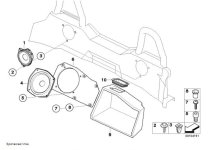
Hmmm, I know what you mean in that it isn't a tuned port in terms of length etc, but I'm fairly certain the rectangle on the topside of the enclosure is open via the grommet (item 10). Maybe they just use the grommet to reduce the wind noise around the metal edge of the hole?
rear speakers.jpg
 
ph001 said:
Hmmm, I know what you mean in that it isn't a tuned port in terms of length etc, but I'm fairly certain the rectangle on the topside of the enclosure is open via the grommet (item 10). Maybe they just use the grommet to reduce the wind noise around the metal edge of the hole?
rear speakers.jpg

Is the grommet perhaps for the speaker cables? I mean, in mine (which I had apart the other day) I have (had) additional speaker connections but no speakers... The connections to speakers (1) in the pic go up behind the carpet in the boot and to the rear of the speaker. Wouldn't it make sense that the wiring for speaker (4) follows the same path, but then through the grommet to the rear of that speaker?

Not sure I made any sense there but I know what I mean lol :rofl:
 
ph001 said:
Hmmm, I know what you mean in that it isn't a tuned port in terms of length etc, but I'm fairly certain the rectangle on the topside of the enclosure is open via the grommet (item 10). Maybe they just use the grommet to reduce the wind noise around the metal edge of the hole?
rear speakers.jpg

If the grommet sits in item 9: item 9 is a soft piece. I dont think thats the box, but rather the dampening material? I'm not sure whats behind that.
If the boot is behind that, its an open air setup and not a box of any kind.

I have the carver DSP option, and I had the speakers out (to look at the speakers) but I didnt really look inside the box past the dampening material to see if there is an actual box behind it :lol:
But I suspect that is the same for every car as it would probably be the chassis, so you can look for yourself behind the cubbyholes.

To go for a ported setup in this situation you get those odd physical extremities that you need a 3ft long port and such things to get it decently tuned on the box volume and speaker parameters....
I made a quick simulation, for the Reckhorn D-165 to go ported, you need a 89cm long port with a 2" diameter to get it tuned, and then it simulates beautifully, goes really deep (-3dB at 47Hz). But where do you leave that 3' long pipe? With a bigger diameter pipe you only need more lenght and if you go smaller, the air speed velocity in the pipe gets really high so you hear pumping air sounds..
 
GuidoK said:
If the grommet sits in item 9: item 9 is a soft piece. I dont think thats the box, but rather the dampening material? I'm not sure whats behind that.
If the boot is behind that, its an open air setup and not a box of any kind.

(9) is indeed soft dampening material. The area it sits in, is enclosed as part of the chassis. (6) is just a "faceplate" for want of a better word. When in place it forms an almost sealed "box"
 
Yes, I got similar port dimension when simulating the D-165!! Might look a bit odd with a piece of pipe stuck out of the window :roll:

In terms of the enclosure, the soft piece (no.9) sits directly into the sheet steel enclosure which forms the rigid speaker cabinet. The grommet goes through the soft piece and locates on a rectangular hole in the sheet metal. I think the cables come in through the circular hole at the back. The rectangular hole forms the 'port'.

894.jpg
895.jpg
 
Ok thats odd.
Whats behind the round and rectangular holes?
Is it directly open to the boot or sealed off again?
Or does it extend the volume of the box?

To have a sealed box principle its important that holes and cracks are sealed as good as possible. It also helps with the power handling/capabilities of the driver.

If the grommet is the port it wouldnt be very effective as it doesnt ventilate in the same compartment as where the listner sits....

A ported box works on the principle that the mass of air situated in the port forms a virtual 2nd speaker/resonator.
Its excursions are in phase with the loudspeaker membrane.
There is no point having that resonator in a different sealed cavity than where the listener sits.
 
GuidoK said:
Ok thats odd.
Whats behind the round and rectangular holes?
Is it directly open to the boot or sealed off again?
Or does it extend the volume of the box?

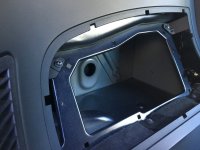
Well the grey you can see behind the round hole is the back of the carpet trim in the boot, but remember that the soft box (9) does not have a corresponding hole, it just has a cross cut 'slice' for the wire to penetrate through. The rectangular hole kind of goes out to the cd changer / roll hoop space (which is pretty much open to the entire boot volume) and has a corresponding hole in the soft box and out through the grommet (10)

I think as you say, it can't be effective as a true port as such. I suspect it is there to increase the air volume of the enclosure.

That's why I'm interested to hear (and measure) how both installations sound. I suspect the Morels will certainly be more suited to the 'ported' configuration but it does make you wonder what the OEM subwoofer parameters are.
 
Odd.
I cant make any funded theoretical statements about that or that it would be able to simulate that in a physical model.
Maybe they experimeted with it and just decided that this sounded best :lol:
Or there is some other reason like they need the holes for draining when the chassis gets submerged in the anti corrosion process tank or need the holes for mounting purposes in the assembly process or whatever and its an acoustical trade off.

All I can say is experiment with your reckhorn speakers. Do a listening test with the holes open and one with the holes closed (preferaby with somethin hard, like a small piece of plywood sticked over the hole with double sided tape), and decide which sounds best.
Also look at the driver and see if one has more distinct uncontrolled excursions of the membrane on low frequencies/high volume passages.
Thats something to avoid, because blowing a sub usually is a result of membrane excursions being too large so the voice coil slams into the pole plate of the magnet damaging/warping the voice coil as opposed to thermal overload.
So play a song with lots of bass at a certain set volume (or any other specific sound source) and compare the excursions of the membrane.
Be sure that the 2 tests are equally loud on radio and amp setting.

My guess is that a completely sealed box will sound more punchy and will allow for more power input (because it dampenes the membrane better), so you can compensate the possibility that the strangely vented system has a slight efficiency advantage by turning up the sub amp a little bit.
 
GuidoK said:
I made a quick simulation, for the Reckhorn D-165 to go ported, you need a 89cm long port with a 2" diameter to get it tuned, and then it simulates beautifully, goes really deep (-3dB at 47Hz). But where do you leave that 3' long pipe? With a bigger diameter pipe you only need more lenght and if you go smaller, the air speed velocity in the pipe gets really high so you hear pumping air sounds..

If you go to a big tube it will have to be long, bear in mind there are many small commercial two way loudspeakers that use 6" drivers in small enclosures with ports around 30mm diameter (wharefdale diamond, JBL control etc.) and sound perfectly acceptable. Sure they are not going to rock the foundations (or shake your door panels off!) but I would imagine they would produce more base than standard Z4 setup. That suggests to me that it must be possible to get acceptable sound with a smaller diameter port.

At the end of the day it is a balance of compromises, the Z4 can't accommodate a 8-10 inch driver in a 30L enclosure. So something has to be compromised. For me it is either go sealed box and sacrifice some bass extension or go ported with small port and suffer some colouration.
 
Magicarcher said:
If you go to a big tube it will have to be long, bear in mind there are many small commercial two way loudspeakers that use 6" drivers in small enclosures with ports around 30mm diameter (wharefdale diamond, JBL control etc.) and sound perfectly acceptable.

Sure but those speakers usually dont come with a long throw sub having 8-12mm lin. xmax capabilities, the speakers in those kind of boxes usually have half or 1/3rd of that.
In the end it all comes down to air port velocity. In the 90's when I did extensive moddeling on PA subwoofers I used a program that automatically calculated that maximum air velocity in the port in a mach number and also gave an indication whether it was good or not. But I never figured it out how it did that. Probably using SD, Xmax and the tuned frequency or so. I dont know if I even have that program, or if it'll even work on modern windows....need some windows 3.11 emulation :rofl:

I know WinISD has some capabilities in that area also but I dont seem to get decent results out of that for the reckhorn driver.
But even if you go with a tiny 30mm port, it'll have to be 30cm. From what I can see thats still way to long to fit in the enclosure. If I look at the picture its only half as deep tops, so still no go.
 
Back
Top Bottom