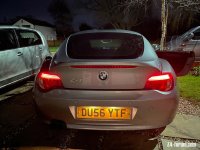
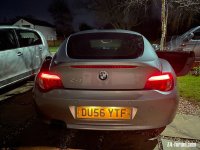
Unit is now sealed up and back on the car. The new unit matches the appearance and brightness of the original one on the left.
Here's a quick run down of what I did, in case it's of use to anybody.
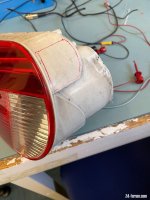
I removed the lamp and used a scalpel to peel back the foam gasket for reuse later.
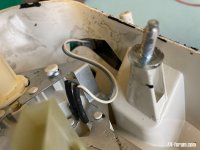
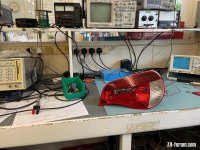
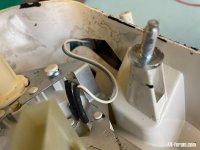
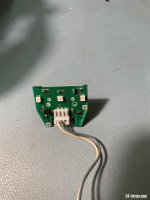
The grey and white wires supply the LED printed circuit board. Grey is +12V. The spades are different sizes so you can't get them the wrong way round. It might be worth putting volts directly onto the wires, just to rule out any loom or connector issues before butchering the lamp.
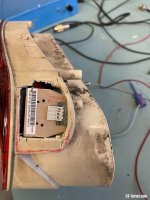
I then tried to work out where to cut an access hole. The board is right up against the outer shell of the lamp, so don't cut too deeply.
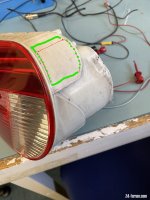
I used a 1mm drill bit to cut a couple of sighting holes to check my guess before I cut. The red marker was slightly off. I used a Dremel with a cutting disc, and was slightly over-enthusiastic. A hot knife blade type tool might have been tidier. I saved the removed piece for later.
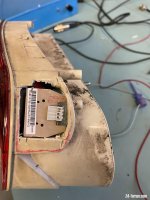
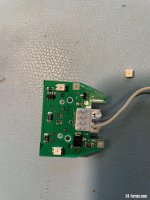
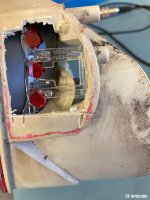
The pcb is located by two pairs of pegs, but just pulls off to reveal the LED light pipes. I haven't tried removing the red/orange lens, but from what I've seen. I don't think that would give access to the PCB.
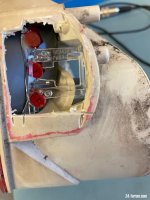
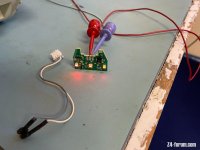
Testing the PCB revealed the central LED to be faulty. (In this case too many volts across it) It was removed using a hot air rework station.
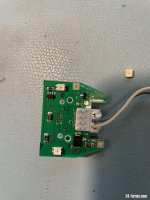
There were no manufacturers idents on the LEDs, so I tried several different ones of the correct size until I found a type that gave matching light levels to the remaining two.
The package is a PLCC2 and I was happy with a Broadcom part HSMZ-A100-T70J1 available from RS as order code 496-6774.
Be aware that the LEDs only work one way round. They usually have a notch cut from one corner, but there isn't a convention for their polarity. My new ones have the cathode to the notch. They also have only two large paired contacts. The old ones are marked the other way round and have four smaller legs. only one of which is a cathode.
As it worked out, the replacemt for the central LED could fit straight onto the existing pads without any messing around.
However, as I can't leave anything alone, I decided to replace the other two LED's, just in case. The tracks for these each needed some mods to work with my chosen LED type.
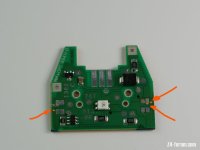
The L/H LED needs one track cut at the point of the orange dot, to isolate the lower left hand pad. (Ignore the other track cut, which was unnecessary)
The R/H LED needs two track cuts where the dots are. This isolates the top right hand pad.
The LEDs could then be fitted. I've marked the orientation of the LEDs with red dots.
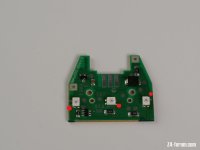
Re-assembly is the reversal of the dismantling process, as they say, so...
My next step was to fasten the pcb back into the lamp. It sits back on the two pairs of pins, which align the LED's with the light pipes. I added small drops of superglue just to be sure. I fitted the lamp to the car and confirmed that the appearance matched the original one.
My intention was then to glue the access panel back, but a kind colleague beat me to it and plastic-welded the piece back into the apperture using a heat gun and 3-D printer filament. He'd rubbed it down and sprayed it by the time I'd come back from lunch, so no pic.
Cheers Jon! Cheers David!





 ), if it works you have peace of mind for the MOT and can always do the same on the other side if it was not matching, if it does not you will only loose about £5 (and have to spend the price for the whole unit ) :|