
You are using an out of date browser. It may not display this or other websites correctly.
You should upgrade or use an alternative browser.
You should upgrade or use an alternative browser.
ESS TS3 Engine Rebuild
- Thread starter Alun1976
- Start date
found it but it wasn't the one i thought.
http://www.ebay.co.uk/itm/Unique-Supercharged-525bhp-BMW-Z4-M-2007-57-in-Outstanding-Condition-/121686712641?pt=LH_DefaultDomain_3&rmvSB=true&clk_rvr_id=893428275808&hash=item1c5517e141&nma=true&si=L4UEdAU%252FhonJQwMTp%252FyvzDI5PcE%253D&orig_cvip=true&rt=nc&_trksid=p2047675.l2557
http://www.ebay.co.uk/itm/Unique-Supercharged-525bhp-BMW-Z4-M-2007-57-in-Outstanding-Condition-/121686712641?pt=LH_DefaultDomain_3&rmvSB=true&clk_rvr_id=893428275808&hash=item1c5517e141&nma=true&si=L4UEdAU%252FhonJQwMTp%252FyvzDI5PcE%253D&orig_cvip=true&rt=nc&_trksid=p2047675.l2557
Roundozo said:found it but it wasn't the one i thought.
http://www.ebay.co.uk/itm/Unique-Supercharged-525bhp-BMW-Z4-M-2007-57-in-Outstanding-Condition-/121686712641?pt=LH_DefaultDomain_3&rmvSB=true&clk_rvr_id=893428275808&hash=item1c5517e141&nma=true&si=L4UEdAU%252FhonJQwMTp%252FyvzDI5PcE%253D&orig_cvip=true&rt=nc&_trksid=p2047675.l2557
that car is jus weird.....
rockship engine power with zero support mods, 20" wheels with crap tyres and owner barely used the kit before selling.....
pokeybritches
Member
Alun1976 said:GuidoK said:I don't see any possibilties to coat parts in the diff. It's made up of gears and roller bearings. Those are made of hardened (heat treated) steel, maybe nitrated. Coating of parts (I see nitrating/carbonating not as a real coating proces, more like impregnating) is mostly done on parts that have low pressure usage, like normal (slide) bearings. The pressure a roller bearing (or the tooth of a cog) gets is maybe 10.000 times that.
So they are made up of extremely hard (mostly +60HRC) materials.
Do you still have a pic of your old big end piston rod bearings. I'd like to see how they held up to the power of the ts2 spec.
This is an interesting project.
Did the colder sparkplugs resolve the pulsating igition timing issues at 5-6k rpm on the ts2/ts2+ setup?
Sorry forgot to get some pics of the bearings, I'll take some now and post them on here. The bearings never seen any FI time as the original engine was a 2.5l not a 3.0 which had 80k miles on it.
I basically bought a used 3.0 at the time i bought the TS2 kit and installed all at once. The engine rebuild I'm doing at the moment was the original 2.5 engine but it has obviously now been stroked using the crank from the 3.0 and pistons and conrods to suit the 3.0.
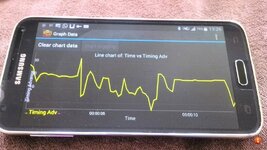
The plugs have made a difference but unfortunately the problem hasn't totally gone away. I've actually done a WOT run today and logged ignition timing shown below. The first flat line is 2nd gear and the last flat line is 4th gear. The bit inbetween is WOT in 3rd gear and as you can see the ignition timing is jumping about. It's seems to be keep retarding timing by 10 degrees and then recovering but retarding again. It didn't pull cleanly in this gear and there was a noticeable difference in performance. It seems that it should hold steady timing at about 18 - 19 degrees when compared with WOT runs in 2nd and 4th gear. Any ideas? It's really irritating! I don't think it's detecting knock as I imagine it would do the same when in 4th gear, but as you can see the timing is steady as a rock in both 2nd and 4th gear. I've also used the knock detect plug-in through torque pro and nothing detected. I'm now toying with the idea that a camshaft or crankshaft sensor maybe on its way out. Also considering whether it's the TPS.
Sent from my SM-G900F using Tapatalk
Bringing this back from the dead...
In the past year there have been several discoveries regarding MS45 tuning and background compensations. Pretty much any high boost M54 with MS45 will run into this issue, and not just those with ESS tunes. I solved this on my own car a few weeks ago, and I put together a writeup to help other tuners here:
https://www.renovelo.com/forum/viewtopic.php?f=11&t=1575
[youtube]R98OwUAlau4[/youtube]
pokeybritches
Member
For the dyno above, I was running flex fuel, water/meth injection, and no intercooler on a stock engine with 147k miles. All three runs were within 1 whp @ 6k rpm when power started to level off, and ambient temps were 95 deg. This setup makes about the same power as a supercharged Z4M up until 6k rpm, and I think with some tweaking it can hit 330-350 whp at 6800 rpm.
I'm in the process of assembling a new (to me) engine for a TS3 setup to go with the ESS twin screw kit I have sitting in the garage. Hopefully I'll have everything going by the end of the year. Here are the engine specs:
- CP Pistons 8.5:1 CR Pistons
- Eagle Forged H-Beam Connecting Rods
- Balanced M54B30 Crankshaft
- Seems Legit Garage Oil Pump
- Dr VANOS Rebuilt VANOS
- Timeserted Engine Block
- Schrick / VAC 256/248 Intake & Exhaust Camshafts
- Supertech +1 MM Oversized Intake & Exhaust Valves
- Supertech Titanium Double Valve Springs and Retainers
- New Hydraulic Lifters
- New Main & Crank Bearings, IWIS Racing Timing Chain, M3 Chain Tensioner, etc
- New OEM Damper
- New Hydraulic Tensioner
I'm in the process of assembling a new (to me) engine for a TS3 setup to go with the ESS twin screw kit I have sitting in the garage. Hopefully I'll have everything going by the end of the year. Here are the engine specs:
- CP Pistons 8.5:1 CR Pistons
- Eagle Forged H-Beam Connecting Rods
- Balanced M54B30 Crankshaft
- Seems Legit Garage Oil Pump
- Dr VANOS Rebuilt VANOS
- Timeserted Engine Block
- Schrick / VAC 256/248 Intake & Exhaust Camshafts
- Supertech +1 MM Oversized Intake & Exhaust Valves
- Supertech Titanium Double Valve Springs and Retainers
- New Hydraulic Lifters
- New Main & Crank Bearings, IWIS Racing Timing Chain, M3 Chain Tensioner, etc
- New OEM Damper
- New Hydraulic Tensioner
Interesting.
Did you also have the problem of the puling of the advanced ignition timing of the ecu from ~19ms down to 5-10ms in 1 sec intervals on sequential in gear pulls in the rpm range of about 4-7krpm? (so in 1 gear max aacceleration it pulls constantly and in the next gear it starts to pull timing about every second giving a jerky acceleration).
Thats the main issue ms45 twinscrew users have.
And is it solved now?
ESS' solution is to modify the mapping to 17ms advanced ignition timing, but that of course costs a little bit of power.....
I have considered going to an aftermarket ecu to get rid of all ms45 intervention mapping niggles but thats a lot of work and money too.
Did you also have the problem of the puling of the advanced ignition timing of the ecu from ~19ms down to 5-10ms in 1 sec intervals on sequential in gear pulls in the rpm range of about 4-7krpm? (so in 1 gear max aacceleration it pulls constantly and in the next gear it starts to pull timing about every second giving a jerky acceleration).
Thats the main issue ms45 twinscrew users have.
And is it solved now?
ESS' solution is to modify the mapping to 17ms advanced ignition timing, but that of course costs a little bit of power.....
I have considered going to an aftermarket ecu to get rid of all ms45 intervention mapping niggles but thats a lot of work and money too.
pokeybritches
Member
Yes, that’s the issue. I didn’t really experience it when I was running the basic VF kit, but after installing a full exhaust, raising the boost, and having the car dyno tuned, I started having periodic timing cut that seemed to oscillate at about a 1-2 Hz frequency. Rolling onto the throttle reduced the likelihood I would encounter it, and abruptly going WOT (like after a gear change) almost always caused the car to porpoise.
I dug in deep when trying to solve the issue. I bought $20k in tuning gear, and spent several hours a day for months tracking down the issue. I even bought an MS43 engine harness and ECU with EWS delete to convert. Ultimately I found the issue is related to several a compensation tables - intake manifold model and requested engine torque tables.
The intake manifold model does what the descriptor implies - it models the intake manifold. When boost pressure much greater than atmospheric pressure is introduced, it confuses the ECU. One axis on all three tables is rpm, and the cells in three tables must be increased relative to boost pressure seen at each rpm to account for the extra airflow. I don’t know exactly how the intake manifold model plays into fuel and ignition calculations... perhaps it’s an upper bound for airflow. My AFR’s were perfect, yet timing was being pulled at a 1-2 Hz frequency until I learned that these tables need to be increased to reflect the greater airflow of a supercharged engine.
While increasing the intake manifold model tables solved the oscillating ignition timing problem, it also introduced a new one - torque was now out of bounds for what the ECU would allow. The ECU would try to close the throttle body to limit torque, and if that didn’t work, it would send the car into limp mode if 450 Nm of torque was exceeded. More challenging is a checksum prevented the torque tables from being modified. The ECU converts voltage from the MAF sensor to kg/hr based on one table, then does another calculation to convert kg/hr to mg/stk with rpm input, and finally there’s a “torque lookup table” the ECU uses to convert mg/stk to Nm. While the cells in the table couldn’t be modified due to the checksum, the sites on the axis can be modified... so instead of 750 mg/stk equalling 450 Nm, one could make 1050 mg/stk (or any number) equal 450 Nm.
Finally there’s another airflow table that had to be modified to reflect the torque table axes changes; some DTC’s that had to be suppressed; and an additional checksum that has to be disabled. It’s as complicated as it sounds, but it’s within the realm of possible for an enthusiast to make the changes if they follow my guide.
ByteTuner will be awesome once it’s released. I’m not associated with Renovelo, but I am beta testing for them for free. I spent months finding maps on MS45.0 using a hex editor, but with ByteTuner all 5000 parameters are defined.
FWIW, all three dyno runs looked like a single run up to 6200 rpm. There was maybe 1 horsepower difference between them, from going pedal flat to the floor at 2000 rpm to redline. I have some work to do up top, but I’m running 29.5 deg timing @ 6k rpm on flex fuel (56% ethanol on the dyno runs) and WMI with no intercooler. I experience zero hesitation. The car drives absolutely perfectly. I admittedly made some other tuning changes too to avoid the binary on/off feel of going from part throttle (targeting lambda 1.0) to full load (targeting a rich mixture). Instead I progressively increase AFR with load for the sake of safety and smoothness. I’m sticking with MS45 while I do the TS3 conversion, and if anything I may move to MS45.1 for wideband support (although I would lose sport mode).
I dug in deep when trying to solve the issue. I bought $20k in tuning gear, and spent several hours a day for months tracking down the issue. I even bought an MS43 engine harness and ECU with EWS delete to convert. Ultimately I found the issue is related to several a compensation tables - intake manifold model and requested engine torque tables.
The intake manifold model does what the descriptor implies - it models the intake manifold. When boost pressure much greater than atmospheric pressure is introduced, it confuses the ECU. One axis on all three tables is rpm, and the cells in three tables must be increased relative to boost pressure seen at each rpm to account for the extra airflow. I don’t know exactly how the intake manifold model plays into fuel and ignition calculations... perhaps it’s an upper bound for airflow. My AFR’s were perfect, yet timing was being pulled at a 1-2 Hz frequency until I learned that these tables need to be increased to reflect the greater airflow of a supercharged engine.
While increasing the intake manifold model tables solved the oscillating ignition timing problem, it also introduced a new one - torque was now out of bounds for what the ECU would allow. The ECU would try to close the throttle body to limit torque, and if that didn’t work, it would send the car into limp mode if 450 Nm of torque was exceeded. More challenging is a checksum prevented the torque tables from being modified. The ECU converts voltage from the MAF sensor to kg/hr based on one table, then does another calculation to convert kg/hr to mg/stk with rpm input, and finally there’s a “torque lookup table” the ECU uses to convert mg/stk to Nm. While the cells in the table couldn’t be modified due to the checksum, the sites on the axis can be modified... so instead of 750 mg/stk equalling 450 Nm, one could make 1050 mg/stk (or any number) equal 450 Nm.
Finally there’s another airflow table that had to be modified to reflect the torque table axes changes; some DTC’s that had to be suppressed; and an additional checksum that has to be disabled. It’s as complicated as it sounds, but it’s within the realm of possible for an enthusiast to make the changes if they follow my guide.
ByteTuner will be awesome once it’s released. I’m not associated with Renovelo, but I am beta testing for them for free. I spent months finding maps on MS45.0 using a hex editor, but with ByteTuner all 5000 parameters are defined.
FWIW, all three dyno runs looked like a single run up to 6200 rpm. There was maybe 1 horsepower difference between them, from going pedal flat to the floor at 2000 rpm to redline. I have some work to do up top, but I’m running 29.5 deg timing @ 6k rpm on flex fuel (56% ethanol on the dyno runs) and WMI with no intercooler. I experience zero hesitation. The car drives absolutely perfectly. I admittedly made some other tuning changes too to avoid the binary on/off feel of going from part throttle (targeting lambda 1.0) to full load (targeting a rich mixture). Instead I progressively increase AFR with load for the sake of safety and smoothness. I’m sticking with MS45 while I do the TS3 conversion, and if anything I may move to MS45.1 for wideband support (although I would lose sport mode).
pokeybritches said:Yes, that’s the issue. I didn’t really experience it when I was running the basic VF kit, but after installing a full exhaust, raising the boost, and having the car dyno tuned, I started having periodic timing cut that seemed to oscillate at about a 1-2 Hz frequency. Rolling onto the throttle reduced the likelihood I would encounter it, and abruptly going WOT (like after a gear change) almost always caused the car to porpoise.
I dug in deep when trying to solve the issue. I bought $20k in tuning gear, and spent several hours a day for months tracking down the issue. I even bought an MS43 engine harness and ECU with EWS delete to convert. Ultimately I found the issue is related to several a compensation tables - intake manifold model and requested engine torque tables.
The intake manifold model does what the descriptor implies - it models the intake manifold. When boost pressure much greater than atmospheric pressure is introduced, it confuses the ECU. One axis on all three tables is rpm, and the cells in three tables must be increased relative to boost pressure seen at each rpm to account for the extra airflow. I don’t know exactly how the intake manifold model plays into fuel and ignition calculations... perhaps it’s an upper bound for airflow. My AFR’s were perfect, yet timing was being pulled at a 1-2 Hz frequency until I learned that these tables need to be increased to reflect the greater airflow of a supercharged engine.
While increasing the intake manifold model tables solved the oscillating ignition timing problem, it also introduced a new one - torque was now out of bounds for what the ECU would allow. The ECU would try to close the throttle body to limit torque, and if that didn’t work, it would send the car into limp mode if 450 Nm of torque was exceeded. More challenging is a checksum prevented the torque tables from being modified. The ECU converts voltage from the MAF sensor to kg/hr based on one table, then does another calculation to convert kg/hr to mg/stk with rpm input, and finally there’s a “torque lookup table” the ECU uses to convert mg/stk to Nm. While the cells in the table couldn’t be modified due to the checksum, the sites on the axis can be modified... so instead of 750 mg/stk equalling 450 Nm, one could make 1050 mg/stk (or any number) equal 450 Nm.
Finally there’s another airflow table that had to be modified to reflect the torque table axes changes; some DTC’s that had to be suppressed; and an additional checksum that has to be disabled. It’s as complicated as it sounds, but it’s within the realm of possible for an enthusiast to make the changes if they follow my guide.
ByteTuner will be awesome once it’s released. I’m not associated with Renovelo, but I am beta testing for them for free. I spent months finding maps on MS45.0 using a hex editor, but with ByteTuner all 5000 parameters are defined.
FWIW, all three dyno runs looked like a single run up to 6200 rpm. There was maybe 1 horsepower difference between them, from going pedal flat to the floor at 2000 rpm to redline. I have some work to do up top, but I’m running 29.5 deg timing @ 6k rpm on flex fuel (56% ethanol on the dyno runs) and WMI with no intercooler. I experience zero hesitation. The car drives absolutely perfectly. I admittedly made some other tuning changes too to avoid the binary on/off feel of going from part throttle (targeting lambda 1.0) to full load (targeting a rich mixture). Instead I progressively increase AFR with load for the sake of safety and smoothness. I’m sticking with MS45 while I do the TS3 conversion, and if anything I may move to MS45.1 for wideband support (although I would lose sport mode).
Why not just go standalone? So many good options now. Even plug and play options. Then you have control if the whole system. Or get a trusted proven mapper. My project has stalled and it’s turbo not charged but if I am not hitting 400bhp with my set up ands SCS delta ecu I won’t be happy.
pokeybritches
Member
I’ve got the issue solved, so no need to go standalone at this point with the centrifugal setup. I haven’t completely ruled it out in the future. The car drives like it came from the factory with a supercharger, everything works, and I’m thrilled with it.
There aren’t any pnp ECU’s for MS45 as far as I know. There are some for MS43 like MaxxECU, but when I contacted them they said there were no plans for MS45. I spent a couple days and mapped the MS45 engine harness to compare to MS43, and there are a few things you’d lose if you made the switch. I don’t remember them all offhand - sport mode and low oil level are two. You’ll have to run separate AC and alternator wiring. EWS has to be deleted and a couple pins shorted. Emissions compliance would be questionable. Then there are all the CAN modules that require output from the DME, like EPS. Most people would prefer a reflash solution.
Hindsight is 20/20, and I’ll admit it would have been easier and cheaper to swap to MS43 and piggyback off all the other knowledge out there. However, there’s something to be said for solving problems that have existed since the first supercharger kits for these cars showed up in 2006.
There aren’t any pnp ECU’s for MS45 as far as I know. There are some for MS43 like MaxxECU, but when I contacted them they said there were no plans for MS45. I spent a couple days and mapped the MS45 engine harness to compare to MS43, and there are a few things you’d lose if you made the switch. I don’t remember them all offhand - sport mode and low oil level are two. You’ll have to run separate AC and alternator wiring. EWS has to be deleted and a couple pins shorted. Emissions compliance would be questionable. Then there are all the CAN modules that require output from the DME, like EPS. Most people would prefer a reflash solution.
Hindsight is 20/20, and I’ll admit it would have been easier and cheaper to swap to MS43 and piggyback off all the other knowledge out there. However, there’s something to be said for solving problems that have existed since the first supercharger kits for these cars showed up in 2006.
pokeybritches said:I’ve got the issue solved, so no need to go standalone at this point with the centrifugal setup. I haven’t completely ruled it out in the future. The car drives like it came from the factory with a supercharger, everything works, and I’m thrilled with it.
There aren’t any pnp ECU’s for MS45 as far as I know. There are some for MS43 like MaxxECU, but when I contacted them they said there were no plans for MS45. I spent a couple days and mapped the MS45 engine harness to compare to MS43, and there are a few things you’d lose if you made the switch. I don’t remember them all offhand - sport mode and low oil level are two. You’ll have to run separate AC and alternator wiring. EWS has to be deleted and a couple pins shorted. Emissions compliance would be questionable. Then there are all the CAN modules that require output from the DME, like EPS. Most people would prefer a reflash solution.
Hindsight is 20/20, and I’ll admit it would have been easier and cheaper to swap to MS43 and piggyback off all the other knowledge out there. However, there’s something to be said for solving problems that have existed since the first supercharger kits for these cars showed up in 2006.
Cool glad it’s sorted.
But if you do need one in the future contact SCS they can sell you a straight swap delta 800 like I have in mine. Everything works as it should. They had my car for a few weeks as a development car. You wouldn’t know it’s standalone.
pokeybritches
Member
By the way, MS43 and MS45 have an option within the calibration code to run a single O2 sensor. So tuning for a log-style turbo exhaust manifold is certainly feasible.
pokeybritches
Member
That’s great to hear! I’ll check them out.Machine monkey said:pokeybritches said:I’ve got the issue solved, so no need to go standalone at this point with the centrifugal setup. I haven’t completely ruled it out in the future. The car drives like it came from the factory with a supercharger, everything works, and I’m thrilled with it.
There aren’t any pnp ECU’s for MS45 as far as I know. There are some for MS43 like MaxxECU, but when I contacted them they said there were no plans for MS45. I spent a couple days and mapped the MS45 engine harness to compare to MS43, and there are a few things you’d lose if you made the switch. I don’t remember them all offhand - sport mode and low oil level are two. You’ll have to run separate AC and alternator wiring. EWS has to be deleted and a couple pins shorted. Emissions compliance would be questionable. Then there are all the CAN modules that require output from the DME, like EPS. Most people would prefer a reflash solution.
Hindsight is 20/20, and I’ll admit it would have been easier and cheaper to swap to MS43 and piggyback off all the other knowledge out there. However, there’s something to be said for solving problems that have existed since the first supercharger kits for these cars showed up in 2006.
Cool glad it’s sorted.
But if you do need one in the future contact SCS they can sell you a straight swap delta 800 like I have in mine. Everything works as it should. They had my car for a few weeks as a development car. You wouldn’t know it’s standalone.