E89 Z4 Roof in wrong position

My roof stopped in the wrong position.
Panel 2 is on panel 1 and the Rear Module is fully open. To start the closing of the roof I would have to close the rear module, and then start the closing. I can't close the rear module manually. The pistons prevent me. Help Me. I have ISTA+ and wait the Cable K-DCAN Usb https://www.amazon.it/gp/product/B07Z43 ... UTF8&psc=1
If I use ISTA +, can I force the position of the various roof components? If not, how can I do it?
Tanks.
 
Grazie mille!
But, why don't you place it under E89 problems? Curious. :roll:


Hi,
There is no known way to close the roof manually by just using an OBD tool. That was the reason I developed tools of my own.
I assume, there is a defective hallsensor on the right piston of the rear module. They often suffer on corrosion (rust inside of the HS!) and deliver wrong position states to the CTM.
Where do you live in Italy?
 
Thanks for the prompt reply,
I did not put the post in "E89 problem", because I do not know the forum well and did not know where to put it. I apologize if I have caused you problems.
I live in Milan.
Today the odb cable will arrive I hope to be able to understand which sensor is broken. I disassembled the two fall sensors of the rear module, and tried with a tester to measure the voltage produced during a passage of a magnet. I've seen them react, so I've assumed they're working.
The roof got stuck during an opening. Panel 2 moved to panel 1, and the Rear Module disengaged, then locked.
It was no longer possible to continue opening or closing.
I opened the rear module manually, with force, but he had already blocked before, so I assume that the offending sensor could be the one that controls the effective release of the rear module, if such a sensor is provided.
 
The problem with these hall sensors is not an electrical fault, but a drifting working point of the magnetic detection. You can't measure a defective one.
Nevertheless, put it on an ohmmeter and measure about 33k in one direction, 130k drifting down to 50k in the opposite direction. That's their standard behaviour.

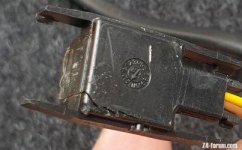
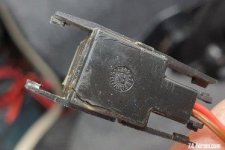
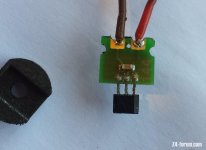
Have a look at the black housings. If there are small breaks or traces of rust, it has to be renewed.
 
No cracks on Hall sensor. But the ohm values is very different. I use the digital ohmmeter. Two Hall senso have the same values. 15k in one direction and 15Mega in the other. I believe it is due to the amount of current the tester injects to measure the resistance. The internal impedance of the tester changes the measured value, since it is not a resistance, but a hall effect sensor.
Among other things, it is not clear to me how healthy these sensors are. Hall effect sensors usually have three terminals. They must be powered to function properly.
In any case, the sensors do not appear to have suffered any stress. They are perfect. So I think their position, relative to the piston magnet, is correct.
 

Attachments

  • IMG_6855.JPG
    IMG_6855.JPG
    146.7 KB · Views: 1,022
  • IMG_6854.JPG
    IMG_6854.JPG
    118.8 KB · Views: 1,022
Hi Ezio,

No cracks on Hall sensor. But the ohm values is very different. I use the digital ohmmeter. Two Hall senso have the same values. 15k in one direction and 15Mega in the other. I believe it is due to the amount of current the tester injects to measure the resistance. The internal impedance of the tester changes the measured value, since it is not a resistance, but a hall effect sensor.
Just re-measured with another DMM and the values differ in deed! Common is one static value and a decreasing value when connected in the opposite order.

Among other things, it is not clear to me how healthy these sensors are. Hall effect sensors usually have three terminals. They must be powered to function properly.
Not quite correct. This one has an internal resistor on a PCB and requires only 2 wires. The current is measured by the CTM, that is ~4mA or ~16mA.
Hallsensor2_UK.jpg

HS Basics:
https://www-doerfler--elektronik-de.translate.goog/experimente-mit-aktiven-und-passiven-sen?_x_tr_hl=de&_x_tr_pto=wapp&_x_tr_sl=auto&_x_tr_tl=it

In any case, the sensors do not appear to have suffered any stress. They are perfect. So I think their position, relative to the piston magnet, is correct.
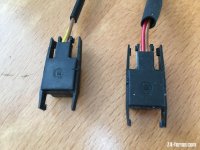
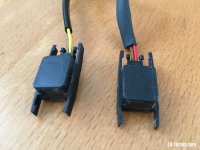
As both HS are identical except the wire colours, just mount it crossover and test the behaviour of your trunk lid.
file.php


Have a look at my maintenance thread:
https://z4-forum.com/forum/viewtopic.php?t=130932

Cheers
Robert
 
Ok now I understand, the two wires feed the sensor, which has a different impedance according to the magnet, the impedance will be measured by CTM. The hall effect component inside it is a common three-wire component. Very useful thanks, I couldn't have broken the sensor to see how it was done. Very precious thank you.

Meanwhile, the ODB cable arrived. After lunch I will pick it up and see what errors are reported to me through ISTA+
 
HS basics:
https://www-doerfler--elektronik-de.translate.goog/experimente-mit-aktiven-und-passiven-sen?_x_tr_hl=de&_x_tr_pto=wapp&_x_tr_sl=auto&_x_tr_tl=it
 
So I think their position, relative to the piston magnet, is correct.
Another correction for a better understanding:
The magnets are INSIDE of these hallsensors. The piston itself is only bare metal and disturbs the magnetive field when passing by.

More details can be seen on my cutout hydraulic ram:

file.php
 
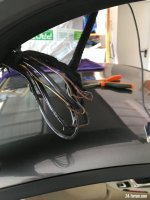
I used ISTA + to determine which sensor was broken. The software has detected the 2 packed panel roof hall sensor. Since I was sure that the sensor was working, I checked the electrical circuit with a tester. The circuit was open. The wire from pin 3 of the roof control module's 26-pin connector was broken.
 

Attachments

  • IMG_6858.JPG
    IMG_6858.JPG
    105.1 KB · Views: 927
All in Panel 2, where they make a sharp curve in motion. I replaced the four wires with a very flexible AWG 20 model with silicone sheath and very thin leads. The wires used by BMW, MY OPINION, are not right for use "in movement".

Now the roof works fine.
Thanks to RobbiZ4 for his invaluable help.

RobbiZ4 do you have any triggers to reduce the noise of the roof when it is closed and walking on bumpy (vibrations)?
 
flybobbie said:
I think the sticky on the tape has made the wire insulation brittle.
I disagree, as in many BMW's wires will break in areas with joints/bends. The best example are the tailgates of station wagons, i.e. 3 or 5 series, where no adhesive tape can be found in the broken areas.
It's a "feature' of the selected quality.

@Ezio
Perfect, well done. Keep an eye on the wires of the opposite side.

The noises have to be specified more precisely, as they can come from plastic parts as well as from the mechanics.
 
None of my cars wires broke on bends, broke on straight sections.
In fact one wire had been looped around the other, slight too long and still broke.
It's as though the insulation shrinks and pulls apart.
I noticed the insulation seemed quite brittle, as though reacted with the glue on the tape.
Non taped wires are still flexible.
 
flybobbie said:
None of my cars wires broke on bends, broke on straight sections.
In fact one wire had been looped around the other, slight too long and still broke.
It's as though the insulation shrinks and pulls apart.
I noticed the insulation seemed quite brittle, as though reacted with the glue on the tape.
Non taped wires are still flexible.

Wiring insulation can be affected by strange things, the gas that leaked from the air conditioning in London Underground signaling rooms (tetrafluracarbon something) slowly turned lots of it into a sticky, oozing mess due to the chemical reaction that took place!
Rob
 
A lot of Piper aircraft used a rubber to mount sun visors, that turns into what looks like chewing gum.
Also interior plastic becomes brittle and breaks up in Cessnas.
 
Back
Top Bottom