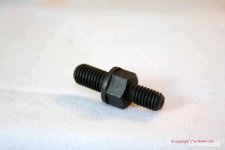
Cylinder head/Valve cover stud torque settings

Rldee007

Member
 Warwickshire
Hi all,

I need to replace the fixing stud that secures into the cylinder head and then the valve cover, as mine has snapped. M7/6X29,5 -11121718856

I am ware the valve cover needs to be secured to 10Nm - M6 side, but doesn't anyone know what is the torque is when securing it into the cylinder head (M7 side)? I believe it needs to be 15Nm, but can anyone confirm please?
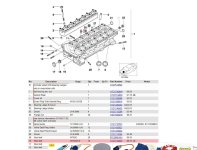
 
Images of the part and installation
 

Attachments

  • 265.JPG
    265.JPG
    118.2 KB · Views: 732
  • 11121718856.jpeg
    11121718856.jpeg
    57.2 KB · Views: 732
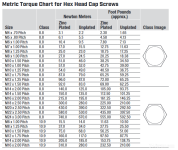
M7 is generally 13NM, M6 is 8NM, that is on a 8.8 grade.
A 10.9 grade M7 is 15NM and M6 is 12NM ... I believe, best to google it if in doubt.
 
grannyknot said:
M7 is generally 13NM, M6 is 8NM, that is on a 8.8 grade.
A 10.9 grade M7 is 15NM and M6 is 12NM ... I believe, best to google it if in doubt.

Thank you for the reply.

I know the M6 side of the stud is 10Nm. I find this in assembly instructions.

Your suggestions for torque what material are you assuming the fixing is going into? Prevailing torque? Joint classification? thread friction class or thread type or size?

Ideally I would like actual work instructions. I guess I can do the calculation but I don't have the information of the stud material grade.
, but I can't seem to find it.
 
Hi all,

I have someone else from another source confirm that the M7 part of the stud needs to be torques down to 15Nm. I hope someone stumbles upon this and finds this useful
 
Rldee007 said:
grannyknot said:
M7 is generally 13NM, M6 is 8NM, that is on a 8.8 grade.
A 10.9 grade M7 is 15NM and M6 is 12NM ... I believe, best to google it if in doubt.

I guess I can do the calculation but I don't have the information of the stud material grade.
, but I can't seem to find it.
The grade of bolt is listed on top of the head, but if some previous owner has substituted a 10.9 grade bolt for the stock 8.8 then you torque it to the 8.8 grade.
That usually doesn't happen and you can trust that the bolt that the bolt you just removed is the proper bolt for the job.
When it comes to aluminum threads I would just add that you need to be very careful, you can't always trust that the aluminum threads are in good condition, a mechanic along the way may have over torqued and those threads are now ready to strip out.
 
grannyknot said:
Rldee007 said:
grannyknot said:
M7 is generally 13NM, M6 is 8NM, that is on a 8.8 grade.
A 10.9 grade M7 is 15NM and M6 is 12NM ... I believe, best to google it if in doubt.

I guess I can do the calculation but I don't have the information of the stud material grade.
, but I can't seem to find it.
The grade of bolt is listed on top of the head, but if some previous owner has substituted a 10.9 grade bolt for the stock 8.8 then you torque it to the 8.8 grade.
That usually doesn't happen and you can trust that the bolt that the bolt you just removed is the proper bolt for the job.
When it comes to aluminum threads I would just add that you need to be very careful, you can't always trust that the aluminum threads are in good condition, a mechanic along the way may have over torqued and those threads are now ready to strip out.

Thank you for your guidance. I haven't removed the stud yet but because it's a stud I'm not sure where the embossing would be as it isn't a bolt Looking at photos Ive seen; it isn't clear and the faces wouldn't be big enough or out of die line or effect would contact face. The replacement part will be with me soon so I'll double check on that.

The block is steel on my car. The reason why I asked the material you used, joint, thread type etc. for your torque figures because it seemed low from personal experience. Just wanted to make sure I didn't miss anything.

Knowing that the M6 side of the stud is torqued to 10Nm and you suggesting that a M7 needs to torqued to <10 Nm did make me worry that I might if stretched the M7 side within the cylinder head lol.
 
grannyknot said:
Rldee007 said:
grannyknot said:
M7 is generally 13NM, M6 is 8NM, that is on a 8.8 grade.
A 10.9 grade M7 is 15NM and M6 is 12NM ... I believe, best to google it if in doubt.

I guess I can do the calculation but I don't have the information of the stud material grade.
, but I can't seem to find it.
The grade of bolt is listed on top of the head, but if some previous owner has substituted a 10.9 grade bolt for the stock 8.8 then you torque it to the 8.8 grade.
That usually doesn't happen and you can trust that the bolt that the bolt you just removed is the proper bolt for the job.
When it comes to aluminum threads I would just add that you need to be very careful, you can't always trust that the aluminum threads are in good condition, a mechanic along the way may have over torqued and those threads are now ready to strip out.

Thank you for your guidance. I haven't removed the stud yet but because it's a stud I'm not sure where the embossing would be as it isn't a bolt Looking at photos I've seen; it isn't clear, some of the faces wouldn't be big enough, out of die line or I wouldn't expect it to be on the contact face. The replacement part will be with me soon so I'll double check on that. I haven't taken the old stud out.

The block is steel on my car. The reason why I asked the material you used, joint, thread type etc. for your torque figures because it seemed low from personal experience. Just wanted to make sure I didn't miss anything.

Knowing that the M6 side of the stud is torqued to 10Nm and you suggesting that a M7 needs to torqued to <10 Nm did make me worry that I might if stretched the M7 side within the cylinder head lol.
 
I doubt you will ever find a 10.9 bolt in aluminum unless there is a steel sleeve in the aluminum, you can safely torque to 8.8 specs and be fine.
In a iron block you can have a variety of grades depending on the job the bolt is doing.
 
Wot he said. Even a good pressure casting is no match for an 4.4 bolt let alone anything harder!

Looking at the application I'd be going for a moderate heave. And a little blue threadlock of I was feeling paranoid.
 
I'm just going to give you something else to consider if you don't mind.
Using the BMW factory service manual is the best place to find your torques specs. Using the torque values based on size and grade of bolt is a valid method but sometimes BMW engineers don't want you using the maximum torque that a bolt is capable of.
For instance I'm rebuilding my engine right now and have started re-assembling it, an M8, 8.8 bolt can handle 27NM of torque but there are recommendations from BMW that certain M8 bolts on this engine require 20NM, 21NM, 22NM and 25NM and not one of them needs 27NM.
So the safest bet is BMW's specs although many people get away with the size/grade system for torque settings.
Hope I haven't completely confused the topic. :)
Screenshot 2022-10-12 at 17-10-37 A_FastenerTorqueCharts.pdf.png
 
Back
Top Bottom