Connecting CTEK Battery Charger?

Nick177

Member
It’s that time of year when I normally plug in my CTEK Battery Charger into my E89. I found it simple with my old E85, just plug it in to the cigarette lighter. With the E89 the two power connectors, one the cigarette lighter,the other under the arm rest appear not to be live. I’ve been on line and it appears that there might be a power socket in the boot. It’s possible that my model 2011 SDrive 23i M Sport Highline doesn’t have a power socket in the boot, which would mean that I would have to connect direct to the battery, or via the terminals in the engine bay. Does anybody know any different?
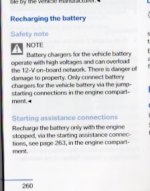
 
Terminals in the engine bay is usually the preferred place. Defo not across the battery as you have an IBS module.
 
ph001 said:
Terminals in the engine bay is usually the preferred place. Defo not across the battery as you have an IBS module.

The "Book" is quite specific although quit a few members have connected directly over the battery.Scan 1.jpeg
 
Thanks ph001, seems a bit of a backward step going from E85 to E89. Not much of a comfort package there. Car will have to sit in the garage with the bonnet open.
 
Nick177 said:
Thanks ph001, seems a bit of a backward step going from E85 to E89. Not much of a comfort package there. Car will have to sit in the garage with the bonnet open.

You can shut the bonnet OK, under the front rather than the side - no harm done.
 
Plenty of room to connect a c-tek under the bonnet, then run the cable out between the headlight and bumper, shut the bonnet, no problem at all.
 
ph001 said:
Terminals in the engine bay is usually the preferred place. Defo not across the battery as you have an IBS module.

So, my idea of leaving the CTEK 'convenience'(?) connectors permanently attached to the battery and run up through the boot floor, for connection to the CTEK when needed, is a bad one.

Kuh.
 
Well I didn't know that and have been connecting direct to the battery.
Doesn't appear to done any harm, fortunately.
I'll connect under the bonnet in future.
 
I don’t think it would do much harm in reality but the IBS is supposed to look at the recharge current so it knows the battery is fully charged. Take it all with a pinch if salt...I’m of the opinion that if the IBS is looking at live data anyway it will soon sort itself out once you start driving normally.
 
Well like I said it doesn't seem to have done any harm, I left it connected because the battery is on its way out as it's the original, I have got a new battery the dealer paid for but haven't fitted it yet as I haven't been using the car.

I assume I can permanently attach the Ctek convenience connector to the terminals under the bonnet ?
 
For the last 3 winters mine has been connected direct to the battery using the convenience connections which I leave in place all year . There has been no ill effect or problems . Its easier than under the hood due to the lengths of the CTEC cables.
 
I've always understood that the connection post is recommended in owners manuals because high amp fast chargers and jump starting can overload the system and there is charge protection on the post. For comparison the ctek is strictly speaking a smart controlled 'conditioner' which delivers a max of 5 amps (hence the skinny leads). An average boost or jump starter will push over 400 amps which would knock down a horse! so requires the big fat leads and quite sensibly needs protection.

The CTEK is safe to connect directly to the battery via the supplied plug, in fact CTEK make the chargers for BMW and are identical, including the battery plugs and lead supplied even for the E89.
 
Handy to know, Thanks Ewazix
I must admit I thought it unlikely a Ctek battery charger would push enough amperage to cause any harm.
Jump starting as you say, is a different mater
 
ph001 said:
I don’t think it would do much harm in reality but the IBS is supposed to look at the recharge current so it knows the battery is fully charged. Take it all with a pinch if salt...I’m of the opinion that if the IBS is looking at live data anyway it will soon sort itself out once you start driving normally.
Surely, once the battery is fully charged, it is fully charged, you cannot charge it higher than its max physical capacity.
Why do we need a module to monitor something that is fixed?
Is it to warn of excess discharge? or maybe something to do with the system that disconnects the alternator at full charge?
Either way would it be required or active (connected) if the car is parked up?
 
mcbutler said:
ph001 said:
I don’t think it would do much harm in reality but the IBS is supposed to look at the recharge current so it knows the battery is fully charged. Take it all with a pinch if salt...I’m of the opinion that if the IBS is looking at live data anyway it will soon sort itself out once you start driving normally.
Surely, once the battery is fully charged, it is fully charged, you cannot charge it higher than its max physical capacity.
Why do we need a module to monitor something that is fixed?
Is it to warn of excess discharge? or maybe something to do with the system that disconnects the alternator at full charge?
Either way would it be required or active (connected) if the car is parked up?

Read this... http://www.z4-forum.com/forum/viewtopic.php?f=23&t=100385&start=15

The IBS module is active all the time btw.
 
mcbutler said:
ph001 said:
I don’t think it would do much harm in reality but the IBS is supposed to look at the recharge current so it knows the battery is fully charged. Take it all with a pinch if salt...I’m of the opinion that if the IBS is looking at live data anyway it will soon sort itself out once you start driving normally.
Surely, once the battery is fully charged, it is fully charged, you cannot charge it higher than its max physical capacity.
Why do we need a module to monitor something that is fixed? ...
Battery charge is not fixed, charge dissipates through the charge medium (acid, gel etc) but is concentrated around the plates. Monitoring devices read that charge and switch out. After several hours charge more fully dissipates from the plates through the medium, readings will drop around the plate and more charge can be applied. Try it with any car battery, you can always get more charge in once it's been left for a few hours.

Ctek conditioners run a very low current so charge 'soaks' through the medium very consistently, they also 'cycle' the charge by discharging slowly then re-charging, this will 'condition' the battery to accept more charge improving (or repairing) knackered batteries to some degree. Some models also have desulphurisation modes which will clear sulphur from lead-acid plates again restoring the battery. Theoretically a battery could have decades oflifeif it is maintained carefully (the one in my Z4 is the 2003 original always kept on a Ctek when not used for a week or more).
 
Interesting stuff, so could we fit a lithium battery instead of Lead acid? I am presuming lithium batteries are the gel type?
 
No lithium are not gel.
Gel batteries are lead acid but instead of liquid acid they use a gel. Made of acid and silica.
 
Back
Top Bottom