Completely dead

Gazza51

Member
 Romford Essex
(Z4M) Driving this morning, radio on, headlights on, heater blower on 1, 15 miles into my journey and the car started hesitating, radio on and off, on and off, ABS, traction light, tyre pressure light, brake light all lit up like a Xmas tree. Pulled over and all went back to normal except no volume on the radio. Only 2 miles from my destination so I carried on. Once parked I played with radio and still no volume, I turned off the ignition to see if the radio needed a reset or something - no ignition, totally dead, as if no battery were connected.

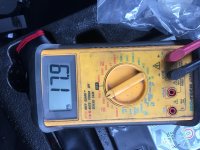
I checked the battery connections and they were tight, I checked the battery with a multimeter and it read 18.75 volts :o

I tried the ignition after a few minutes and the car started, checked battery again while engine running and the multimeter read 20.71 volts :o

Looks like the alternator must be at fault.

I checked realoem for the part number and was surprised that only the Z4M was listed using this part number.
I checked online to purchase an alternator using the part number from realoem and quite a few came up that use the same part amongst others, all BMW

I guess my point is, do your research before buying parts as many parts are shared with other models and are listed much cheaper.

Euro car parts price is £454.99 (only one listed) and I got one from Autodoc including postage for £141 with 2 year warranty.
 
I don't think your meter is reading correctly, as the chemistry of a battery won't allow it to exceed its rated voltage. As soon as the over voltage is removed, it will return to the nominal voltage.

It could well still be an alternator fault and if the voltage was that high, expect damage to quite a few systems. More likely however, it was dumping AC onto the battery from a diode pack fault and this caused the fault.
 
As above, there is just no way you can have >20V on a healthy lead acid battery - the acid will boil first! You need to confirm those readings with a different meter I think. If they really do turn out to be correct then basically you have no battery at all (in terms of function anyway) so you would need to replace it, which may well sort your problems. The car would not start from such a battery though.

I think more likely is that the alternator was failing to charge the battery and the car was basically running from battery power which was gradually discharging, hence the electrical gremlins and eventual cut out.
 
Theoretically you can overcharge a lead acid car battery to show about 16-17v immediately after it's disconnected but it will rapidly drop off as the charge dissipates from the plates throughout the charge medium, resting in the usual 12 -14.5v range. As mentioned above that requires an alternator to be massively overcharging........ and a great deal of luck that the battery didn't POP!

and this is what happens to dumb people who stand over an old car battery and deliberately short it :popcorn: https://youtu.be/G4LQIDkqiF0
 
I take your points guys but, the car started fine about 10 minutes after the power loss.

I agree about the battery boiling, I thought it would have exploded.
 
I didn’t chance driving the car back home, I’ll retest the battery tomorrow before starting and also when running.


The battery was replaced in February this year.
 
The charge current basically goes up exponentially as you approach more than about 3V difference between the battery terminal voltage and the charge voltage.

So if you try to apply more than around 15.5V to a healthy, low impedance battery it just takes a ton of current defined by the impedance of the battery which is typically just a few milli ohms (so hundreds of amps)

The charge energy initially goes into the chemical reaction between the sulphuric acid and lead plates until the specific gravity of the electrolyte is around 1.265 (i.e. battery is fully charged). Keep upping the voltage beyond that and it simply goes in as heat in the plates / acid. Hence the acid boils and the plates warp.

As soon as the acid level starts to drop off due to venting, the plates become exposed to air and the impedance of the battery starts to rise and charge current drops off correspondingly. The battery is then essentially classed as dry and you can apply as many volts as you want to it as it's basically just a lump of lead filled plastic.
 
After six days the battery still shows 17.9 volts
 

Attachments

  • DFBB0EFA-BB5D-4156-B4C1-5F082DF0915E.jpeg
    DFBB0EFA-BB5D-4156-B4C1-5F082DF0915E.jpeg
    377 KB · Views: 974
Have you confirmed the meter is reading correctly? Any reason you are using the 200V range rather than the 20V range and isn't that battery symbol on the lcd telling you the meter battery is low?

You just cant have that high a voltage on a healthy lead acid - chemically it's not possible. You either have a duff meter or a duff battery!
 
You can have surface charge that ( as referred to above ) can be 17V or so BUT that is only usually just after charging, it then dissipates back to the 'normal' voltage. Isotech are shall we say not the BMW of the meter world. Check it on a good battery in a car then measure the same battery again whilst the car is running. You are looking at 12 -13v static and up to 14.2 ish charging. This will tell you the health of the meter and ( again as above ) measure on the 20V range.
 
The meter was on the 200v range as the car was running and was showing 20.1v

I’ve still not sorted the ‘completely dead’ scenario but did manage to check the meter on another battery and the reading were very similar, proving the battery in the meter was nearly dead giving false readings, battery changed and the readings were normal.

I did drive the car home this evening and the tyre pressure, Brake warning light and Traction light came on, looks like I’ll be replacing the front two speed sensors (I did the rears a few weeks ago).

So I now have a new Alternator as a spare.

Thanks for the input guys
 
Back
Top Bottom