Brake Fluid Change

kis

Veteran
 Surrey / West Sussex Boarder
Had a read through some old posts, and have gathered that I’ll need just over 500ml for a full flush. That being said, I’m looking at what type to get?

I’ll not be tracking so I’ll stick with dot4 unless someone can persuade me otherwise?

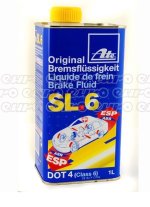
This one? Obviously I’ll get 2x 500ml
https://www.eurocarparts.com/ecp/c/BMW_Z4+Roadster_3.0_2003/p/car-accessories/engine-oils-and-car-fluids/auxiliary-fluids/brake-fluid/?524770271&0&cc5_179
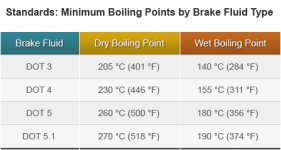
 
I suppose it begs the question.... why NOT use DOT5.1? Given it doesn’t tend to attract any kind of cost premium and has to meet a higher minimum boiling point spec. I just don’t see the benefit of going for a DOT4 fluid.
 
Could not remember the reason why there was a problem with Dot 4 and a Dot 5 fluid when I had my Westfield so below is the info to explain it


Remember, these are only the minimum standards. Brake fluid manufacturers can and often do improve on these figures and it is possible to find DOT 4 brake fluid with a higher boiling point than some DOT 5.1 fluids on the market.

Since DOT 4 and 5.1 are both glycol-based brake fluids they are compatible with each other, which means they can be readily mixed without harming your brake system. It is important never to mistake DOT 5.1 (glycol-based) with DOT 5 which is silicone-based and should never be mixed with any other DOT fluid.

So just which brake fluids can you mix without causing harm to your brake system? Let's take a look at the chart below.

Compatibility chart for DOT and Mineral Oil brake fluids
Here you can see that silicone based DOT 5 is the odd one out and is not compatible with any other DOT brake fluid. By mixing DOT 3, 4 and 5.1 brake fluids, assuming it is fresh fluid, the worst thing that can happen is a drop in the boiling point of the whole fluid.
 
Chart did not copy and paste over so here is the link

https://www.epicbleedsolutions.com/resources/faq/difference-between-dot4-and-dot51-brake-fluid/
 
The DOT4 Vs 5.1 issue is not clear cut, the wet dry boiling point standards are a MINIMUM, some DOT4 products like the ATE type 200 actually exceed the DOT5.1 minimum boiling points, so you need to compare the data sheets for products to be sure that the DOT5.1 you are looking at has any advantage. BUT OEM BMW DOT4 and many others are low viscosity designed for ABS systems at road use temperatures and improve response compared to stuff like the ATE type 200 which is more viscus and is designed for high temp use as it thins, when cold it can reduce resonse and lead to a 'wooden' pedal feel.
dot-fluid-boiling-points.png

ATE type 200 DOT4 has min wet/dry boiling points of 280/198 C

Comma DOT5.1 has min wet/dry boiling points of 278/183


The Pagid is 260/165 but still plenty good enough for 99% of road users

The wet boiling point is the one to look at really as it relates to fluid that has been in the system a while and is assumed to have absorbed some water during it's service life (which is why not changing fluid leads to corroded internals like caliper pistons!).

DOT4 and DOT5.1 can be mixed in the system, but DOT5 is silicon based so must not be mixed with any of the others or used without a flushing process and potentially replacing seals first.

On the face of it the ATE type 200 DOT4 looks like a good recommendation if you want to up-rate your fluid for track use, but good OEM spec DOT4 may be better for road use. Choices :)
 
Plucked from a previous post, can't claim validity or anything else but worth considering?

The BMW DOT4 ESL brake fluid is a low viscosity formula for modern ABS and DSC systems. BMW recommends low viscosity brake fluid for all chassis beginning with the E60 5-series. Low viscosity (LV) is a thinner fluid that works better than a normal fluid in the small channels and passageways in the ABS/DSC pump. Using the heavier fluid will result in a delayed response to ABS and DSC activation and a spongy feel in the brake pedal (only during ABS stops). BMW ESL is a DOT4 rated fluid and is compatible with other DOT3 or DOT5.1 fluids. For track use, a heavier high performance brake fluid such as Ate Typ 200 or Motul RBF600 or RBF660 is recommended because of their higher boiling point and because the thicker fluid will thin out at track temps. But for street use we recommend switching back to a LV fluid, especially in colder climates.
 
Cheers I knew there was some sort of issue with the different grades. After reading I realised it was the 5 that’s incompatible. Thanks for that :thumbsup:

5.1 wasn’t much more expensive. So I’ve got some of that on the way. Hopefully the 1 litre is enough otherwise if I find I’m running short can always order more (not my daily) :)
 
I used Pagid Dot 5.1 when i recently replaced the fluid on mine, I bought 5L of it for about £20 and did three cars at the same time. i used about 1.25 L to fully flush the Z4 with a pressure filler. Sucked out the reservoir with a 200ml Syringe to get most of the old stuff out first then bleed 4 brakes and clutch until brake fluid changed to a uniform light colour.
 
Used ATE TYP200 for years in the Z4 and previous cars, never had any issues with poor pedal feel or heavy feel. It just works, and has the added benefit of a bit more confidence for those B road blasts.

Held up to a couple of Alpine passes pretty well past week too, not even a hint of fade or the pedal getting longer.
 
Well the Pagid Dot 5.1 stuff that I've got coming is very similar to ATE SL6 (Dot 4). No doubt the new fluid I've got will be better than whatever is in the car at the moment.
However if I do run into any issues I can always give the ATE 200 a go as that's better rated better than the other two fluids mentioned previously (even though as mentioned its Dot 4).
 
You can check the owner's handbook or the master cylinder to see what sort of brake fluid your vehicle requires. Both can tell you what your vehicle requires to function properly. A simpler option is to search for "brake fluid type" using your car's year, make, and model on a search engine like Google.

Always keep in mind that if your car requires a DOT 3, you can use a DOT 4. If your vehicle requires DOT 4, however, DOT 3 will not suffice. If your vehicle requires DOT 5 or DOT 5.1 tires, you must purchase those instead. It's crucial to understand that different types of brake fluid aren't always interchangeable.
 
r1concepts said:
You can check the owner's handbook or the master cylinder to see what sort of brake fluid your vehicle requires. Both can tell you what your vehicle requires to function properly. A simpler option is to search for "brake fluid type" using your car's year, make, and model on a search engine like Google.

Always keep in mind that if your car requires a DOT 3, you can use a DOT 4. If your vehicle requires DOT 4, however, DOT 3 will not suffice. If your vehicle requires DOT 5 or DOT 5.1 tires, you must purchase those instead. It's crucial to understand that different types of brake fluid aren't always interchangeable.

Stay away from dot 5

You can mix all other fluids but if you ever go to or from 5 it requires everything to be changed including the seals.
 
The correct grades for E89s are either DOT 4 or DOT 5.1

These can be intermixed although its good practice to bleed the whole system

DOT 5 is not recommended for many reasons.. a good write up is here..

http://www.orthene.co.uk/bulletins/OTB002.pdf
 
Back
Top Bottom