Anti seize on wheel nut... Bad Idea!!!

z4too4

Member
 Surrey
I am ordering some new lock nuts and and thought about using anti sieze when putting them on because they can be begger to remove.

Well according to the torque testing in the video below, don't do it.

Watch "Should You Put Anti-Seize On Wheel Studs / Lug Nuts
https://youtu.be/X3ndeXiZUeM

You will end up seriously over torquing the nut or even if you try to adjust for less friction, possibly under torquing instead.
So I bought a slip tire wrench instead :)
 
I've put a dab of copper slip on my wheel bolts every time - never had one come loose, or be a bugger to take back off, in over 300,000 miles - and plenty of on/off applications on track days.
 
Most times the wheels come off I’ll clean the threads and pop a tiny dab of copper grease on too. I know there are supposedly issues with corrosion between dissimilar metals but I’ve never seen any white powder or anything.

If there’s a chance I’ll need to get something off years down the line I generally put a bit of anti seize on. Brakes get specific silicone grease.
 
Short answer is all toque values are quoted as 'dry' unless otherwise stated and lube risks either snapping off or shaking loose.

From a technical point of view once a nut and stud have been re torqued more than half a dozen times the combined effect on studs and nut base compression (aka dilation) means that the real pre-load values (tightness) may be reduced by up to 50% requiring much higher torque values to achieve a safe pre-load. Adding lube in to the equation makes it near impossible to calculate the real torque required or the resulting pre-load so is a risk.

Fortunately there are massive safety margins designed in to wheel fastenings because designers know they will be removed regularly so we get away with over tightening, corrosion and bad practice like lube most of the time. Ideally light corrosion should be removed with a wire brush and heavily corroded nuts/studs replaced. The same safety factors are not designed in to other fixings on our cars which is why we snap off things like strut braces and suspension bolts when we re-use or over-tighten them.
 
I have been using coppperlube and torque to recommended settings for 30+ years without any problem. But here is an interesting story. I once worked for a manufacturer of gas turbines. They were suffering from bolt failures on the turbine rotor and did a lot of testing to get to the bottom of it. Their standard process was to use anti seize grease on the bolts. The bolts they used came in sealed plastic bags and were oiled prior to bagging up. The tests proved that the combination of oiled bolts and ant size grease led to significant over torquing and caused bolt failures. When the bolts were degreased before applying the anti seize there were no such problems. when the "oilded bolts" were used without anti seize there was also no problems. But the interaction of oil + anti seize caused bolt failures.
 
Ewazix said:
Short answer is all toque values are quoted as 'dry' unless otherwise stated and lube risks either snapping off or shaking loose.

From a technical point of view once a nut and stud have been re torqued more than half a dozen times the combined effect on studs and nut base compression (aka dilation) means that the real pre-load values (tightness) may be reduced by up to 50% requiring much higher torque values to achieve a safe pre-load. Adding lube in to the equation makes it near impossible to calculate the real torque required or the resulting pre-load so is a risk.

Fortunately there are massive safety margins designed in to wheel fastenings because designers know they will be removed regularly so we get away with over tightening, corrosion and bad practice like lube most of the time. Ideally light corrosion should be removed with a wire brush and heavily corroded nuts/studs replaced. The same safety factors are not designed in to other fixings on our cars which is why we snap off things like strut braces and suspension bolts when we re-use or over-tighten them.

Thanks I didn't know the in and outs of it, I just assumed there was a peak grab point of a bolt and thread.
 
Always put copper grease on my wheel bolts and never had any issues.

I actually snapped a wheel bolt in the hub when I first got my Z4, which is why I religiously put a small amount of copper grease on the threads now.

If you believed everything on the Internet, you'd never leave your bed for fear of instant death :lol:
 
ben g said:
Always put copper grease on my wheel bolts and never had any issues.

I actually snapped a wheel bolt in the hub when I first got my Z4, which is why I religiously put a small amount of copper grease on the threads now.

If you believed everything on the Internet, you'd never leave your bed for fear of instant death :lol:

Lol.. That's why I considered the anti freeze, and there is a difference between fake news and the laws of physics...well until they are proven wrong :)

Anyway my current 14.5 year old lock nut looks like it's been to hell and back. I can't imagine the wheel nuts haven't been overly stressed by impact wrenches and over enthusiastic tightening over the years, so I'll probably just replace the lot.
 
i dab copper grease on everything you can safely dab copper grease on.
Dabbing copper grease on things is immensely satisfying! :lol:
greasyglock.jpg
 
Chris_D said:
i dab copper grease on everything you can safely dab copper grease on.
Dabbing copper grease on things is immensely satisfying! :lol:
greasyglock.jpg

I think you have a fetish for the stuff :lol:
 
ben g said:
Chris_D said:
i dab copper grease on everything you can safely dab copper grease on.
Dabbing copper grease on things is immensely satisfying! :lol:
greasyglock.jpg

I think you have a fetish for the stuff :lol:
I'd put it on me toast in the morning if I could. :lol:
 
You could always buy a 'food-safe' protein based anti seize to alleviate the 'dissimilar metal' corrosion issues. You could then use it as a dip for crisps if you decide you didn't want to use it on your wheel bolts. :oops:
 
I've used copper grease on my wheel bolts ever since I had serious issues once on a VW - I think the bolts had been overtightened by an un-named tyre fitters (Kwik Fit).

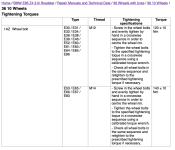
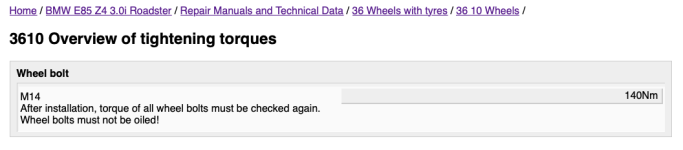
After reading this I thought I'd check out TIS for instructions for the e85 Roadster - I was surprised at what I read, here are my findings...

https://www.newtis.info/tisv2/a/en/e85-z4-3.0i-roa/repair-manuals/36-wheels-with-tyres/36-10-wheels/1VnYt8YaXQ
https://www.newtis.info/tisv2/a/en/e85-z4-3.0i-roa/repair-manuals/36-wheels-with-tyres/36-10-wheels/5Tp9xUw

Screenshot 2018-10-03 at 11.34.53.png
Screenshot 2018-10-03 at 11.31.29.png
 
paullyjay said:
I've used copper grease on my wheel bolts ever since I had serious issues once on a VW - I think the bolts had been overtightened by an un-named tyre fitters (Kwik Fit).

After reading this I thought I'd check out TIS for instructions for the e85 Roadster - I was surprised at what I read, here are my findings...

https://www.newtis.info/tisv2/a/en/e85-z4-3.0i-roa/repair-manuals/36-wheels-with-tyres/36-10-wheels/1VnYt8YaXQ
https://www.newtis.info/tisv2/a/en/e85-z4-3.0i-roa/repair-manuals/36-wheels-with-tyres/36-10-wheels/5Tp9xUw

Screenshot 2018-10-03 at 11.34.53.png
Screenshot 2018-10-03 at 11.31.29.png
Good Information! :thumbsup:
Do mind editing your post and adding the term "E85/E86 Wh33ll T1ght3n1ng Torques" (spelt correctly) to help google when I need to look this up :-)
 
Just to clarify - putting copper grease on the threads is usually fine, but never the bolt or the chamfered part of the bolt head.
 
Feel like I’m in the minority as would never copperslip/grease the thread.

I've had Shogun’s & other heavish vehicles where the bolts are tightened probably way more than they should, yet a breaker bar (with hi torque rounded edge sockets) has always cracked every challenging bolt I’ve ever come across
 
Back
Top Bottom