28i vs E89 3.0 coupe bhp/torque didn't make sense?

sars said:
Smartbear said:
The engines torque output has nothing to do with the cars weight, HP is calculated by a formula using torque x revs
That's how a car with a higher torque output can have a lower HP figure (it revs lower)
Regards

That's correct the calculation is HP = (RPM x Torque)/5252

Units for torque are lb.ft and at the RPM

and...
Torque gives you acceleration
Power gives you speed

? But this formulae suggests
Torque = hp x 5252/rpm

So if the hp is kept the same (our lower) rpm will have to go down in order to increase the torque?

Sod it, I think I'll just put my right foot down and believe a magic makes it go quicker. Much saner way to live then twisting these formulas :D
 
Smartbear said:
lux said:
Smartbear said:
Nope, increasing hp can just rely on increased rpm without increasing torque-look at sars post as he had the correct formula, yours is to confusing :wink:
Regards

She....I know, how can a woman possibly know all this!! :?

Oops, sorry sars :oops:
Regards

hey none taken my friend :thumbsup:
 
RX-78 said:
sars said:
Smartbear said:
The engines torque output has nothing to do with the cars weight, HP is calculated by a formula using torque x revs
That's how a car with a higher torque output can have a lower HP figure (it revs lower)
Regards

That's correct the calculation is HP = (RPM x Torque)/5252

Units for torque are lb.ft and at the RPM

and...
Torque gives you acceleration
Power gives you speed

? But this formulae suggests
Torque = hp x 5252/rpm

So if the hp is kept the same (our lower) rpm will have to go down in order to increase the torque?

Sod it, I think I'll just put my right foot down and believe a magic makes it go quicker. Much saner way to live then twisting these formulas :D

The difference with the formulae thrown around here is that distance = rpm...
Torque is a force, it is not dependant on any other variables for what we're considering here, BHP is a power and requires a distance over which to be applied.

Maximum Torque = fixed value for an engine; this is literally the maximum turning force that can be applied to the wheels
Maximum BHP = MAX(torque x rpm) across every possible combination

The above means that even though the peak torque may be lower for the 3.0i, if it happens at a proportionally higher rpm then that torque x rpm is greater than the torque x rpm of the 28i!
 
Thanks Mel :thumbsup:

I suppose this means torque will be more important where a higher force is required to propel a car (e.g. On a incline with existing down wars force).

So really, we need to see bph at each rpm and gear in order to make sense of the car's real world performance?
 
Absolutely, if you're trying to overcome momentum (due to a heavy car or a force acting against the car, e.g. gravity on a hill) then torque is what you're going to look for.

Everyone loves comparing bhp but simplistically all that indicates is how fast the car can go when actually pushed to that small portion of the rev range. I'd guess the majority of drivers typically have more fun exploiting torque either at low ends (accelerating from stationary) or in the mid-range (overtaking and B-road winds).
 
You are right! We should buy diesel cars which would fit daily living better with higher torque on lower revs:D
 
RX-78 said:
You are right! We should buy diesel cars which would fit daily living better with higher torque on lower revs:D

Not for me thanks, I like my engine to sound like a finely tuned piece of mechanical engineering that's keen to rev & rewarding to drive, not a lump of pig iron from a tractor :thumbsup:
Regards
 
No, torque and power are stated at the flywheel, not at the driven wheels so it is not just a function of torque it's also about gearing, a reduction gearbox increases torque but not power ( remember power = torque x rpm/5252)

A turbo diesel produces lots of low down torque, however they do not produce high rpm and thus the gearing is slightly lower to allow for the reduced rpm. Thus the torque generated at the driven wheel is usually less than its petrol bhp equivalent.

Hence modern 7 or 8 speed autos on Diesel engines are so good
 
sars said:
No, torque and power are stated at the flywheel, not at the driven wheels so it is not just a function of torque it's also about gearing, a reduction gearbox increases torque but not power ( remember power = torque x rpm/5252)

A turbo diesel produces lots of low down torque, however they do not produce high rpm and thus the gearing is slightly lower to allow for the reduced rpm. Thus the torque generated at the driven wheel is usually less than its petrol bhp equivalent.

Hence modern 7 or 8 speed autos on Diesel engines are so good

I think you mean that the gearing is slightly higher to allow for reduced rpm :wink:
I think :P
Regards
 
Lol, yes engines are geared down, but a diesel is less geared down than a petrol, but not higher geared which means geared up, but yes higher geared down.....no that doesn't work either :D
 
sars said:
Lol, yes engines are geared down, but a diesel is less geared down than a petrol, but not higher geared which means geared up, but yes higher geared down.....no that doesn't work either :D

Stop digging now :rofl:
Regards
 
sars said:
No, torque and power are stated at the flywheel, not at the driven wheels so it is not just a function of torque it's also about gearing, a reduction gearbox increases torque but not power ( remember power = torque x rpm/5252)

A turbo diesel produces lots of low down torque, however they do not produce high rpm and thus the gearing is slightly lower to allow for the reduced rpm. Thus the torque generated at the driven wheel is usually less than its petrol bhp equivalent.

Hence modern 7 or 8 speed autos on Diesel engines are so good

^ exactly what makes diesels ultimately less "fun" to drive (that and the noise).
 
RX-78 said:
Thanks tech, I kinda get it. I think :oops:

Because the acceleration (0-60mph) is an average of acceleration that took place, acceleration at the point of max torque may not be the same in both car? And therefore my calculation is fundamentally flawed?
I've used data taken from real dyno pulls to generate this is thrust to weight ratio graph. As you can see the 28i spends most of it's time above the 3.0si except for right at the top end of the rev range.
5mh7aq.jpg

0-60 the 28i records a theoretical 0.1s advantage between 5 & 60mph. It's all about the 1st gear pull. The thing is though, the 3.0si has a higher theoretical TV at 60 than the 28i, at 65mph the 3.0si pulls ahead and slowly widens the gap as the speed builds.


sars said:
That's to simplistic and using power to describe acceleration is inaccurate, acceleration of an object is governed by it's mass and the amount of force applied to it, in other words the amount of torque at the driven wheel gives you the force. and then, well there are just so many factors that can shape the acceleration curve of a car, gear ratios, number of gears, spacing between gear ratio's, final drive, driven wheel diameter, tractability, engine torque curve, maximum rpm and etcetera
Enough of the variables are constrained that simplistic works here & I was trying to keep it simple for someone who hadn't quite got the concepts sorted in their head :P
 
As always techathy, great valuable input.

However this I believe will slightly change the perspective

14532302347_e8c1ba33f7_c.jpg

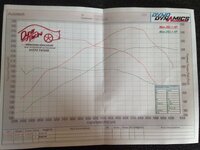
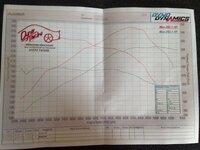
As the torque figures have increased from 258 lbs @ 3300 to 275 @ 2900

And the green line - standard is very simular to the Manufactures guidance
 
Twin Turbo said:
As always techathy, great valuable input.

However this I believe will slightly change the perspective

14532302347_e8c1ba33f7_c.jpg

As the torque figures have increased from 258 lbs @ 3300 to 275 @ 2900

And the green line - standard is very simular to the Manufactures guidance

It completely falls on its arse past 5k!
 
Wow i've never seen a Petrol turbo look so... Diesely!

Did the tuner explain why it falls off a cliff? The stock power run produces more power over 5900RPM! I really wouldn't be happy with that - something looks wrong. I also wouldn't be happy with a before/after dyno without an AFR graph.

Could be heat-soak perhaps, exasperated by the higher boost levels (although if a tuner told that to me, id probably call BS!)
 
That's an interesting analysis techathy, calculating specific force (N/kg) is by definition acceleration in each gear, doing it that way gives you a better picture of the cars real world performance than just using peak power and torque taken from the brochure :thumbsup:

One thing the graph does show is how 3rd and 4th gear in either car gives reasonable acceleration over a wide speed range, makes for a relaxed cruising and how both cars are clearly geared for good 0 to 60 times
 
Hi,

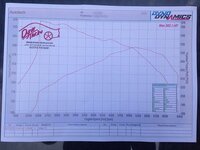
I think it falling off an cliff is more to do with the operator - as below is an previous run - however they inputted the wrong settings so the numbers were incorrect - however it does show an improved flow for BHP, but Torque is SO WRONG.

14676046805_dfc4b6b99b.jpg

To be honest, I am thinking of taking it to another rolling road center - so more information is provided
 
Back
Top Bottom