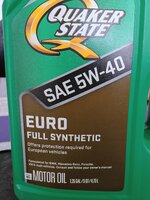
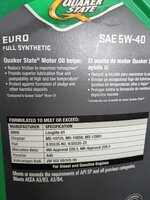
Here is my two penny worth.. (3 cents)
Why the owner's manual is silent
You're right that the early E89 owner's manual is unhelpful. BMW's deliberate position from roughly 2005 onwards was that the
approval (BMW Long Life rating) was the specification, and the SAE viscosity grade was a secondary detail handled by the approval list. The thinking was:
- SAE viscosity alone tells you nothing about whether an oil is suitable for a BMW engine — a 5W-40 from a supermarket and a 5W-40 LL-01 are radically different oils
- An LL-01 oil has been tested, approved, and is therefore safe in any BMW engine that calls for LL-01, regardless of viscosity grade
- Quoting a viscosity in the manual would mislead owners into thinking SAE grade was the relevant filter
This was technically defensible but unhelpful for owners. The actual answer for the N52 is
BMW LL-01 in either 5W-30 or 5W-40, with a regional bias that explains the US confusion.
Why US N52 owners see 5W-30 dominantly
In the US market, BMW's dealer fill for N52s from around 2007 onwards was
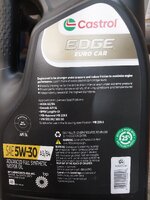
Castrol Edge 5W-30 (LL-01), sometimes branded as "BMW High Performance 5W-30" with BMW packaging on the same Castrol product. This wasn't because 5W-30 was the only correct grade — it was because:
- BMW negotiated a contract with Castrol for one grade across most of their petrol fleet for fleet logistics simplicity
- 5W-30 met the LL-01 requirement and was a slightly more fuel-economy-friendly grade for CAFE compliance
- Bulk dispensing at dealerships meant one barrel for everything
European-market N52s often saw 5W-40 LL-01 dealer fill (Shell Helix Ultra was common). Same engine, different default grade, both correct.
So the US "5W-30 must be right" instinct comes from dealer fill conformity, not from a technical specification that excludes 5W-40.
Why 5W-40 is also correct (and arguably better)
The N52 is BMW's magnesium-alloy block engine, and that's the technically interesting bit. The block uses an AJ62 magnesium alloy with aluminium cylinder bore inserts. Magnesium and aluminium have different thermal expansion coefficients, which means:
- Bearing clearances change measurably across the operating temperature range
- The crankcase grows slightly faster than the bore liners as it heats up
- Oil film thickness needs to be adequate across a wider operating clearance window than in a conventional all-aluminium block
A 5W-40 gives you slightly more film thickness at sustained operating temperature than a 5W-30 — useful margin for an engine that asks more of its oil than its all-aluminium siblings, particularly in summer heat or sustained highway running. The N52 is also a high-revving naturally aspirated engine that holds high oil temperatures for longer than a turbo engine on the same drive cycle (turbo engines spend less time at peak load; NA engines often cruise at higher RPM continuously).
For a US N52 owner driving in Texas summer heat,
5W-40 LL-01 is the technically more conservative choice even though 5W-30 was the dealer fill. For a Boston driver doing mostly city miles, 5W-30 is genuinely fine.
Why not 0W-30 or 0W-40?
Three things to understand:
1. The "W" number is the cold-flow rating, not just availability. 0W-XX oils flow at lower temperatures than 5W-XX oils. The "0W" rating means the oil pumps cleanly at -35°C; "5W" pumps cleanly at -30°C. Both are well below any temperature at which an N52 would be started in normal use anywhere in the lower 48 US states.
2. Achieving the 0W cold rating means more polymer thickeners. This is the technical catch most owners miss. A 0W-40 oil has to start as a
thinner base oil than a 5W-40 (to pass the cold flow test) and then be thickened back up to grade-40 viscosity at operating temperature using viscosity index improvers (VII). Those polymers shear over time and miles, meaning the oil's effective viscosity drops as the OCI progresses. A 5W-40 of the same base-oil quality needs less VII thickening, shears less, and stays closer to its label viscosity through the change interval.
For a fleet of cars in Anchorage, the cold-flow benefit of 0W-40 outweighs the shear concern. For Phoenix, you've added shear susceptibility to gain cold-flow performance you'll never use.
3. Some 0W oils are LL-01 approved; many aren't. Mobil 1 0W-40 (the famous "European Car Formula" with the silver bottle) is BMW LL-01 approved and is genuinely a fine oil for an N52. Castrol Edge 0W-40 is also LL-01 approved in some markets. Other 0W-40s on US shelves carry only API SP / ILSAC ratings without LL-01, which means they haven't been tested against BMW's specific durability requirements.
The practical answer for the question "why not 0W-XX":
- 0W-40 LL-01 (e.g. Mobil 1 European Car Formula): perfectly fine, slightly more VII shear than a 5W-40 LL-01 over a long OCI but otherwise excellent. Particularly good if winters get cold.
- 0W-30 LL-01: harder to find, less common, no real benefit over 5W-30 LL-01 in any US climate where an N52 would be started
- 0W-XX without LL-01: avoid regardless of cold-flow advantage; the missing approval matters more than the W number
What the US N52 owner should actually run
The honest hierarchy for normal US driving conditions (temperatures from -10°C to +40°C):
| Climate | Recommended | Reasoning |
|---|
| Hot southern states (TX, AZ, FL, southern CA) | 5W-40 LL-01 | Higher operating-temp viscosity margin. Castrol Edge 0W-40 or 5W-40 LL-01, Liqui Moly Top Tec 4200 |
| Temperate (NC, VA, much of CA, OR) | 5W-30 LL-01 or 5W-40 LL-01 | Either is genuinely fine. Pick on availability and price |
| Cold winter states (MN, WI, ME, MT, AK) | 0W-40 LL-01 | Genuine cold-flow benefit, shear penalty is acceptable on annual changes |
| Track or sustained high load | 5W-40 LL-01 with shorter OCI | Operating-temperature margin matters more than cold flow |
A specific note on N52 oil consumption
The N52 has a known tendency to consume oil — the valve-stem seals harden with age, the crankcase ventilation system can develop leaks, and the magnesium block's gasket interfaces (oil filter housing especially) seep with age.
A 5W-40 can mask this because the thicker oil at operating temperature consumes slightly more slowly than a 5W-30 in the same engine. Some N52 owners find consumption drops noticeably switching from 5W-30 to 5W-40 — this is real and is one of the strongest practical arguments for 5W-40 on a higher-mileage US N52.
If a US N52 is consuming a quart between changes on 5W-30, switching to 5W-40 LL-01 may reduce that to half a quart without any other intervention. Worth knowing.
How would a US owner know any of this?
The straightforward answer: by reading the BMW LL-01 approval list maintained by BMW Group, which includes both 5W-30 and 5W-40 oils. The owner's manual being silent on grade is BMW saying "any approved oil works"; the dealer fill being 5W-30 is fleet logistics, not a technical mandate.
For someone unwilling to dive into the spec lists, the safe heuristic is:
- Pick BMW LL-01 approval as the non-negotiable filter
- Pick 5W-30 or 5W-40 based on climate and use (5W-40 for hot climates, towing, mountains, high mileage; 5W-30 for moderate climates and city driving)
- Avoid 0W-XX unless winters are genuinely cold, in which case 0W-40 LL-01 specifically
- Change at 5,000–7,500 miles regardless of what the iDrive service light says — BMW's long-life intervals were optimistic and N52s suffer for them at 15,000-mile intervals
Should the book series cover this?
Yes — and it's a good reason to add a short US-specific oil-strategy section in V2 (Maintaining). The European/UK perspective in the existing book content is correct for European cars, but US owners face a genuinely different situation:
- Different dealer fill conventions (5W-30 universally vs grade-flexibility in Europe)
- Different climate range (Phoenix to Anchorage covers more ground than Lisbon to Helsinki)
- Different oil availability (Mobil 1 0W-40 European Car Formula is the dominant LL-01 oil in the US, where in the UK it's one option among many)
- Different attitude to manual silence — US owners typically default to "follow the dealer fill" which produces the 5W-30 default that may not be ideal in their actual climate
A 1–2 page US oil-strategy callout in V2 would land well with American buyers and is the kind of regional sensitivity that distinguishes a definitive reference from a UK-centric book wearing a global title.
Want me to draft that callout for V2 inclusion? It would slot naturally into the existing engine-oil chapter and references both the "what BMW says" and "what actually works in your climate" angles.

 Minnesota
 What the sources say
 Why compatibility depends on fuel sulfur
 What this means for you in Minnesota
 Bottom line

 North West Surrey


 Scottish Borders

 ). But I've always stuck to a 5K mile oil change interval.