Handbrake issue

pvr

Dutch
 Ruler of the South East UK
The handbrake has gone from fine to more or less non working. A very small incline and at the highest setting, it basically almost no longer works.

The cable seems ok as there is the same pull required to put the handbrake on, just that the car just rolls away then.

Is there a way to check the handbrake somehow without taking everything apart?
 
These links might help….

https://www.pelicanparts.com/techarticles/BMW_Z4M/92-BRAKES-Parking_Brake_Adjusting/92-BRAKES-Parking_Brake_Adjusting.htm

https://z4-forum.com/forum/viewtopic.php?p=1968254&hilit=Handbrake+adjustment#p1968254

…or just leave it parked up in 1st gear.
 
It is only for MOT purposes that I need a fix as i park in reverse gear always :lol:
 
But thanks inkey$, I will try to adjust but don’t hold too much hope really as it went from ok to nothing
 
pvr said:
But thanks inkey$, I will try to adjust but don’t hold too much hope really as it went from ok to nothing
It looks like quite a convoluted and involving task to properly check, adjust and/or replace it all. Not BMW’s finest hour.
 
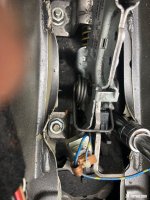
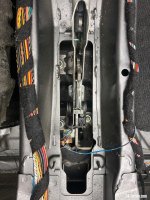
Fellow Zedder who breaks Z4's has devised a way of extracting the handbrake lever from inside the car, it requires a few bends to be made to the bodywork around the handbrake mounting hole in the centre tunnel to allow a long socket to get on the lever unit retaining bolts, the bends can be easily bent back after installation of a replacement or refurbished lever.
Sure beats having to drop the exhaust and propshaft on the underside.
Seems the most common issue with these levers is the wear on the ratchet teeth, once extracted from the car some delicate filing the teeth to a sharper profile will usually restore the ratchet to reliable working. Before and after pics of the method.
Pic 1 Before removal, centre console removed.
Pic 2 Access bends for access to unit securing bolts.
Bends achieved using a suitable crowbar.
To avoid premature wear of the ratchet teeth in the first place people should get into the habit of pressing the lever button in when applying the handbrake, seems simply pulling the lever up without pressing the button and hearing a reassuring clicks of the teeth on the ratchet takes its toll on the not so hard teeth on the lever.
 

Attachments

  • Handbrake Pic 2.jpg
    Handbrake Pic 2.jpg
    186.6 KB · Views: 1,305
  • Handbrake Pic 1.jpg
    Handbrake Pic 1.jpg
    261.7 KB · Views: 1,302
I can still hear movement at the rear wheels and the teeth seem to ratchet.

What worries me is that nothing works though, ie both wheels at the same time. I would assume that one side might fail but both at the same time - is that pointing to the front of the handbrake mechanism rather than at the wheel side?
 
Is the automatic adjuster locking thigummy under the handbrake in the released position? That's the only thing I can think that'd scupper both sides together.
 
I have no idea, but is that even possible to slip off without intervention?
 
You'd have thought BMW with their infinite wisdom would have used the lever and mechanism from other common bmw's. Large scale economies being the most dominant factor. :headbang:
 
BMW are very big on economies of scale, there's many parts that went unaltered from E30 to E90, say, but there's only so far generic parts can take you. What BMW do then is to take an existing design and modify it to accordingly. That way you save on a ground up design and test and, hopefully, keep the subtle design bits from the original that were introduced to improve it, avoid problems, make manufacturing easier, etc. Trying to learn from the "lessons learnt."

The handbrake arrangement is the same for all of the cars around the same era but with changes to suit the vehicle. So the X5 handbrake layout is similar but altered to suit its higher driving position.

The E85 also gained the self adjuster next seen on the E90.
 
inkey$ said:
Good pictures and top-access suggestion, Colb :thumbsup:

Indeed - very good insight in how to avoid the dreaded access issue which I had read about :thumbsup:
 
Before adjusting handbrake at the wheels the Handbrake lever itself has to be put in the service position, this means prising the cable out of its location per BMW instructions.
Probably better to
a) remove both wheels
b) readjust the shoe adjusters to their minimums
c) Put the lever in its service position
d) re adjust the shoe adjusters until they are just bindin
e) reset the Handbrake service position to normal
 
That spring loaded tensioner can be a real pain to compress and latch so it takes the tension off the cables, it can be done with a long flat blade screwdriver by compressing the end plate so it latches. Once latched and the tension is released on the cables then and only then go to the wheel ends and use the adjusters inside the drums to take the shoes up to the drum till it liocks the hub, then back the adjusters off approx 6 or 7 clicks according to BMW TIS service data so the hub rotates without binding on the shoes, you may need to reduce this number. Once happy with that go back inside the car and unlatch the tensioner so the cables get tensioned. Check the operation of the handbrake lever, if you have too many clicks repeat the process decreasing the amount of clicks you back them off. Unlatch the tensioner and retest the lever clicks.
Always worth removing the disc/drum and clean out the old dust and use some emery cloth on the surface to roughen them up, also the shoes so it takes the glaze off the friction material. If you still have problems getting a good handbrake then maybe the cables are worn or seized, if thats the case then replacement would be the way to go.
 
BMW TIS Service Handbrake extract

Perform inspection in the following manner:

When 1st ratchet is engaged, no braking force should be exerted.

The difference in wheel circumferential forces between the left and right wheels may deviate by max. 30 % from the greater value (measured on brake analyzer).

The parking brake must be readjusted in the event of greater deviations in the wheel circumferential force!

Braking with locked wheels must be possible with the parking brake.

The parking brake must be reset if the actuation stroke is greater than 10 teeth.
Note:

Accurate adjustment of the parking brake is only possible if the parking brake Bowden cables and all moving parts on the parking brake move easily and function correctly.

Basic setting of the parking brake is required whenever:
- When replacing parking brake shoes.
- When replacing brake discs.
- In event of excessive actuation stroke (10 teeth).
- When replacing parking brake Bowden cables


1. Setting instruction for brake shoes (basic setting)

Unclip parking brake lever trim (1) at rear and tilt forwards.

Lock adjuster unit (ASZE):

Actuate parking brake lever. Screw in special tool 32 1 030 partially. Release parking brake lever and press stop (2) of adjusting spring back to such an extent that retaining hook (3) engages in stop (2).


Completely unscrew one wheel stud on each rear wheel.
Installation:

Tightening torque 36 10 1AZ.

Turn wheel until adjustment screw is visible in tapped hole.


Turn adjusting screw with a screwdriver until the wheel is no longer able to turn.

Then unfasten the adjusting screw 9 notches.


Unlock adjuster unit (ASZE):

Lever restraint hook (2) outwards with a suitable screwdriver (1).

Restraint hook (2) must disengage from stop of adjusting spring.

2. Setting instruction for parking brake Bowden cables

The parking brake lever must be applied 5 times to approx. 400 N actuating force.
2.1 On brake analyzer
0th tooth (parking brake released):


Vehicles with manual transmission: Shift lever in neutral position.

Vehicles with automatic transmission: Selector lever position ”N”.

Without locking differential ≤150 N.
With locking differential ≤ 200 N (possibly odd display).

1st tooth: No increase in braking force with regard to 0th tooth. Indicator lamp can be lit.
2nd tooth: Indicator lamp must be lit.
3rd tooth: Increase in braking force.
5th tooth: The brake force display must have reached ≥ 400 N.

Checking brake force differential at wheel:

Apply parking brake until a wheel circumferential force (brake force display) of min. 1000 N is reached.

Max. permitted brake force differential right/left ≤35 % (referred to greater brake value).

3. Braking in the duo-servo parking brake
The following braking-in procedures are applicable in case of insufficient braking effect or after replacing brake discs and/or brake shoes.

3.1 On brake analyzer

Apply parking brake lever until wheel circumferential force at first wheel is 800 N.

Lock parking brake lever in next lower tooth.

Release parking brake lever after approx. 2 minutes.

3.2 When driving on road

(If possible inside the company grounds or on an unused road)

At approx. 40 km/h apply parking brake lever until a braking effect can be felt.

Pull parking brake lever to next notch and drive on for approx. 400 m.

A basic requirement is that parking brake is adjusted uniformly
 
Thanks colb, I will try the adjustment first and see if that has any impact at all
 
So ... the handbrakes have pulled through the backplate, which means wheel bearings out and so on.

Total bill to be £1500 ... :cry:
 
Fellow Zedder who breaks Z4's has devised a way of extracting the handbrake lever from inside the car, it requires a few bends to be made to the bodywork around the handbrake mounting hole in the centre tunnel to allow a long socket to get on the lever unit retaining bolts, the bends can be easily bent back after installation of a replacement or refurbished lever.
Sure beats having to drop the exhaust and propshaft on the underside.
Seems the most common issue with these levers is the wear on the ratchet teeth, once extracted from the car some delicate filing the teeth to a sharper profile will usually restore the ratchet to reliable working. Before and after pics of the method.
Pic 1 Before removal, centre console removed.
Pic 2 Access bends for access to unit securing bolts.
Bends achieved using a suitable crowbar.
To avoid premature wear of the ratchet teeth in the first place people should get into the habit of pressing the lever button in when applying the handbrake, seems simply pulling the lever up without pressing the button and hearing a reassuring clicks of the teeth on the ratchet takes its toll on the not so hard teeth on the lever.
This is best news today! can you please let me know how easy/hard would it be to remove the ratchet from the cables once these nuts are removed? Thank you very much
 
Back
Top Bottom